Eight people who have spent their lives around the elephants of Mount Elgon were asked a narrow question: which plants do these animals eat when something is wrong with them? Their answers, published on 24 September 2026 in Scientific Reports, name 35 plant species and four soils, minerals or clays, and they are now the most detailed account anyone has of what African elephants may be using as medicine.
The study is careful about what it is, and so is this. It documents what expert observers report, not what researchers watched and measured. The word the authors use throughout is “putatively.”
What the study actually did
Fabien Schultz of the Bernhard Nocht Institute for Tropical Medicine in Hamburg led a team of ten, including Elodie Freymann, Rahab N. Kinyanjui and Emmanuel Ndiema of the National Museums of Kenya, and Thomas O. Clark and Christopher Powles of the Mount Elgon Foundation. They worked across a 344.9 square kilometer study area, interviewing at seven locations.
The eight informants were local experts from the Sabaot indigenous community: wildlife community scouts, a retired ranger and elders. Semi-structured questionnaires asked them to connect their own knowledge of human medicinal plants to what they had seen elephants do. Every plant named was collected and taxonomically identified through herbarium voucher specimens, with help from the East African Herbarium at the National Museums of Kenya. That last step is what separates this from anecdote: the species list is verifiable.
Thirty-nine resources came out of it. Of those, informants named 34, or 87 percent, as also having traditional human medicinal uses, and identified 25 that they believe serve as medicines for elephants. For 19 of the 39, they could supply a specific anecdote: an unusual feeding event, a particular preparation, a resource targeted only rarely.
The classification is the honest part
Rather than present every reported plant as elephant medicine, the authors sorted the accounts by how much behavioral evidence sat behind each one.
Eight plant species reached Mode 4, the strongest category, defined as medicines sought by visibly sick elephants for a perceived therapeutic purpose, or administered to their offspring. They are Aloe arborescens, Bersama abyssinica, Coleus barbatus, Dombeya burgessiae, Dombeya rotundifolia, Dombeya torrida subsp. torrida, Ficus natalensis and Kuloa usambarensis.
A further seven species were placed in a tentative category the authors write as Mode 4(!): explicitly named as medicines used by or given to a sick elephant, but with no specific ailment or symptoms recorded. Mode 3 covers resources called medicinal by at least one informant where no associated health condition was specified at all, which leaves open whether an elephant is treating something or simply eating a plant that happens to be bioactive.
Mode 4 does not mean confirmed. It means the report cleared the study’s highest bar for evidence, which is a different claim and a more useful one.
The mothers and calves
Five of the reported observations involve allocare, meaning apparent health-related behavior directed at another individual. One concerns a Mode 4(!) resource and four concern Mode 4 resources.
The most striking of them: informants described mother elephants combining Ficus natalensis with Coleus barbatus and Bersama abyssinica and their own milk before giving the mixture to their calves, which the observers characterized as “a kind of immunization.”
That phrase is the informants’ interpretation, and the paper does not demonstrate that these plants stimulate a calf’s immune system or prevent anything. Nor does it set out the mechanics: how the material was combined, or how it was transferred. It is a hypothesis with unusually good observational provenance, and the authors treat it as one.
Humans and elephants reaching for the same plants
The 87 percent overlap between elephant resources and Sabaot human medicine is the result most likely to be over-read. Several informants suggested people had learned about particular plants by watching elephants. The study does not establish that, and the authors flag the obvious alternative: observers deeply versed in medicinal plants may be more likely to read an unusual feeding event as medicinal.
Both can be true at once. Deep local knowledge is what makes an observer able to notice that an elephant is doing something out of the ordinary, and it is also what shapes the explanation offered.
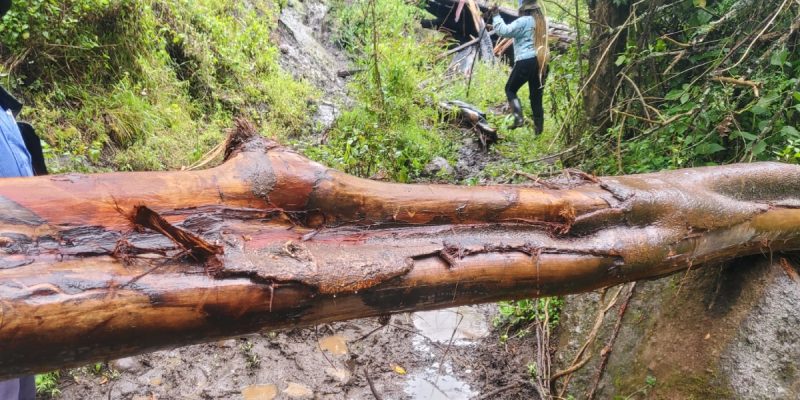
Mount Elgon’s elephants were already known for entering caves and mining mineral-rich earth, and the paper’s photographs document fresh tusking on fallen Dombeya rotundifolia outside Tupkeber cave and on a Podo tree, Podocarpus latifolius. Notably, the informants generally did not classify the cave soil as medicinal, attributing it instead to minerals such as salt and iron. A study that labeled everything unusual as medicine would not have drawn that line.
One note on the listing
The paper closes by observing that “the African elephant is classified as an endangered species” by the IUCN. The Red List is a little more specific than that, and the distinction is worth keeping. Since 25 March 2021 it has assessed the two African species separately: the African forest elephant, Loxodonta cyclotis, is Critically Endangered, and the African savanna elephant, Loxodonta africana, is Endangered. Forest elephant numbers fell by more than 86 percent over 31 years and savanna elephants by at least 60 percent over 50 years, according to those assessments. The paper names both species itself when it introduces the genus, so this is shorthand rather than error, and it does not touch the findings.
No zoo money behind this one
We trace the accredited zoological funding behind African field research as a standing practice, and it turns up more often than most readers would guess. Not here. The study was supported by two grants from the Volkswagen Foundation and one internal grant from Neubrandenburg University of Applied Sciences, with open-access funding organized by Projekt DEAL. No zoo or aquarium appears in the funding statement, and the Mount Elgon Foundation’s own key partners page names none either. The work is dedicated to the memory of Dr Jane Goodall and Dr Christina Janson.
Readers who want the comparison can see what the other outcome looks like in Tsavo’s six cats, and the zoo money that is not theirs, where the trace landed on a named American zoo and still did not reach the particular work in question.
What the Mount Elgon study leaves behind is a shortlist: eight species worth pharmacological analysis, a protocol for distinguishing a sick elephant’s choices from a healthy one’s, and 344.9 square kilometers where somebody has already been watching for decades. That is a good position from which to start testing.
Quick answers
- What did the Mount Elgon study find?
Eight local experts from the Sabaot community described 35 plant species from 23 families, plus four soils, minerals or clays, that they believe elephants in the Mount Elgon region use medicinally. Of the 39 resources, informants named 34, or 87 percent, as also having traditional human medicinal uses, and identified 25 they regard as elephant medicines.
- Where was it published?
In Scientific Reports on 24 September 2026, volume 16, article 28904, under the title "African elephants putatively self-medicate with medicinal plants in the Mount Elgon region, Kenya." The lead author is Fabien Schultz of the Bernhard Nocht Institute for Tropical Medicine in Hamburg. The paper is open access.
- Does it prove elephants treat themselves?
No, and it does not claim to. The study documents first-hand accounts from expert local observers rather than experimental results, and the authors use the word "putatively" throughout. What it provides is a verified species list and a set of testable hypotheses.
- What do the modes mean?
They rank the behavioral evidence behind each report. Mode 3 covers a resource called medicinal with no health condition specified. Mode 4(!) covers seven species named as used by or given to a sick elephant without a stated ailment. Mode 4, the strongest, covers eight species sought by visibly sick elephants for a perceived therapeutic purpose or given to their offspring.
- Which eight species reached Mode 4?
Aloe arborescens, Bersama abyssinica, Coleus barbatus, Dombeya burgessiae, Dombeya rotundifolia, Dombeya torrida subsp. torrida, Ficus natalensis and Kuloa usambarensis.
- What is the story about mothers and calves?
Five reported observations involve allocare, meaning apparent health-related behavior directed at another animal. In the most striking, informants described mother elephants combining Ficus natalensis, Coleus barbatus and Bersama abyssinica with their own milk before giving it to their calves, which the observers called "a kind of immunization." That phrase is the observers’ interpretation; the study did not test it.
- What is the African elephant’s IUCN Red List category?
The Red List has assessed the two African species separately since 25 March 2021. The African forest elephant, Loxodonta cyclotis, is Critically Endangered, and the African savanna elephant, Loxodonta africana, is Endangered. Forest elephant numbers fell by more than 86 percent over 31 years and savanna elephants by at least 60 percent over 50 years, according to those assessments.
- Did a zoo fund this research?
No. The work was supported by two grants from the Volkswagen Foundation and one internal grant from Neubrandenburg University of Applied Sciences, with open access funding organized by Projekt DEAL. No zoo or aquarium appears in the funding statement, and the Mount Elgon Foundation names none on its key partners page either.