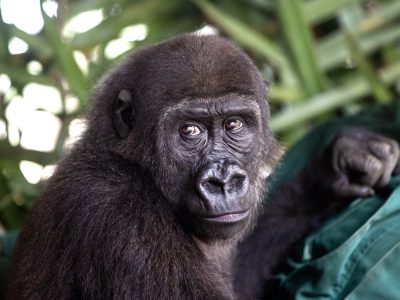

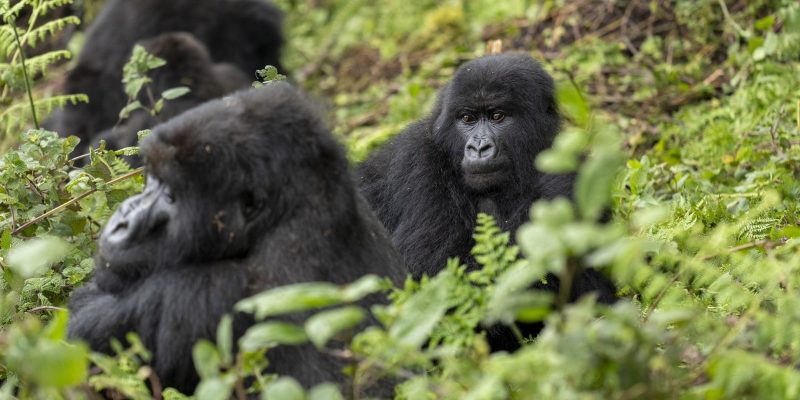
On July 15 the researchers and trackers who walk out to Rwanda’s mountain gorillas every morning found a young female in the wrong family. Bisoke, four weeks short of her eighth birthday, had left the Ntambara group she was born into and was sitting peacefully among the neighboring Titus group, as though she had always been there.
Female mountain gorillas transfer. It is the ordinary mechanism by which a population avoids inbreeding, and it usually happens around the age of eight, just before a female begins breeding. What made the Dian Fossey Gorilla Fund’s researchers look twice is that nobody saw it happen, and that by the usual script it should not have happened at all.
She appears to have gone alone
Most transfers take place when two groups meet. A female leaves during the contact, or shortly after it, with the new group right in front of her. The Ntambara and Titus groups were not together when Bisoke moved, and they were not especially close. Both happened to be ranging on the slopes of Mount Bisoke, the volcano she is named for, and the Fossey Fund’s working explanation is that she heard the Titus group vocalizing or moving downhill and followed the sound on her own.
The dominant silverback of her natal group is probably her father, and if he is not, the other adult males there are likely close relatives. From the only perspective that matters genetically, leaving was the right call. She turned eight on August 12, which puts her squarely in the window.
She was not walking into a room of strangers
The Titus group already contained Agaseke, an adult female who made the same move out of Ntambara in 2022, when Bisoke was four and old enough to remember her. The Fossey Fund has published work finding that females prefer to transfer into groups where a familiar female already lives, and this is that finding happening in front of the people who made it. The two groups had also crossed paths many times over the years, so Bisoke had watched the Titus gorillas before she chose them.
What she chose was a group with three silverbacks, several experienced adult females and a number of young gorillas, which is to say protection and playmates. She has spent most of her time since playing with Macibiri and Nshunguye, the daughters of an older female in the group named Kurudi, and she has become a favorite playmate of Izere, Agaseke’s one-year-old. Agaseke lets her infant play with her, which the fund reads as the residue of the years the two females spent in the same group. Play, in a young gorilla, is not idleness. It is how a newcomer builds the relationships that keep her safe.
The part only sixty years of notebooks could find
After Bisoke arrived, the researchers went back through the records, and the records are the reason this story exists at all. The Fossey Fund has monitored these families continuously for close to six decades and holds one of the most complete multigenerational pedigrees of any wild mammal.
Living in the Titus group is Kurudi, an elderly female who transferred in back in 2013, years before Bisoke was born. Kurudi’s mother, Walanza, is Bisoke’s great-great-grandmother. Neither animal has any way of knowing that. It took a filing cabinet to notice that a maternal line split generations ago had just been rejoined by a teenager walking downhill after a sound.
Dominant silverback Urwibutso watches whenever another silverback approaches her. Pato, second in command, has shown little interest in competing. The blackback Ishimwe, closest to her in age, plays with her and rests beside her. Those relationships are peaceful now and the fund is explicit that it does not know how they will develop as she matures.
Which zoo is behind this
The article names no funder, so we went looking, and the answer is a single institution that has been there the whole time.
Zoo Atlanta has housed the Dian Fossey Gorilla Fund’s international headquarters on its own grounds since 1995. In a joint announcement marking thirty years of that arrangement on September 23, 2025, the zoo described what it supplies as office space, information technology and financial support, and the fund’s president and chief scientific officer, Dr. Tara Stoinski, said the pro bono office space and other support had let the fund put more of its money directly into protecting gorillas in Africa. The fund was named one of Zoo Atlanta’s Signature Conservation Partners in 2025. The zoo keeps about 20 gorillas in distinct social groups and has had 26 born there, and the two organizations were among the founders of World Gorilla Day.
That is an unusual shape for a zoo and field partnership. It is not a grant for a project with a start and an end date. It is overhead absorbed for three decades, which is exactly the sort of support that allows an organization to keep trackers walking to the same families every morning for sixty years. The daily monitoring that noticed an eight-year-old had moved house is the product that overhead buys.
For context on the sector, the Association of Zoos and Aquariums reports that in 2025 its 235 accredited and certified facilities spent approximately $372.4 million on conservation across 139 countries. No published breakdown isolates the African share, and we are not going to estimate one.
On the listing
The IUCN Red List assesses the mountain gorilla, Gorilla beringei ssp. beringei, as Endangered under criterion B1ab(iii), in an assessment by Hickey, Basabose, Gilardi, Greer, Nampindo, Robbins and Stoinski dated July 31, 2018 and amended in 2020. The population trend is listed as increasing, which is rare enough on that site to be worth stopping on. A separate Green Status assessment for the subspecies was completed on April 30, 2026 by Junker and colleagues, with Stoinski again among the authors.
We wrote last week about the same organization’s work across the border, where a community forest in the Democratic Republic of the Congo gained formal recognition for Grauer’s gorillas. One story is a map and a legal instrument. This one is a single young female and a sound she heard on a volcano. Both are made of the same thing, which is people in the forest writing down what they see, year after year, until the record is long enough to mean something.
Source: the Dian Fossey Gorilla Fund’s September 29, 2026 account, part of a series presented by the fund’s gorilla program senior advisor Veronica Vecellio, and Zoo Atlanta’s September 2025 partnership announcement.
Quick answers
- What happened?
On July 15, 2026 Dian Fossey Gorilla Fund researchers and trackers found that Bisoke, a young female mountain gorilla, had left her natal Ntambara group and joined the neighboring Titus group in Rwanda. She appears to have made the move entirely on her own. She turned eight on August 12.
- Is it normal for a female gorilla to change groups?
Yes. Female mountain gorillas usually transfer at around eight years old, just before they begin breeding, and the move reduces the chance of inbreeding. What is unusual here is that it did not happen during a meeting between the two groups. They were not together and were not especially close.
- Why did she choose the Titus group?
The fund points to familiarity. Bisoke already knew Agaseke, an adult female who transferred out of Ntambara into Titus in 2022, when Bisoke was four. The fund has published research finding that females prefer to join groups where a familiar female lives. The two groups had also crossed paths repeatedly over the years, and Titus offers three silverbacks, experienced females and young playmates.
- What was the family connection the records turned up?
Kurudi, an elderly female who transferred into the Titus group in 2013, is the daughter of Walanza, who is Bisoke's great-great-grandmother. Bisoke's arrival reunited that maternal line for the first time in generations. Neither gorilla has any way of knowing it; the connection exists only in the fund's records.
- How long has this monitoring been running?
Close to six decades, continuously. The Fossey Fund says it holds one of the most complete multigenerational family histories of any wild mammal, which is what allows a single transfer to be read against several generations of pedigree.
- Which zoo is behind the Fossey Fund?
Zoo Atlanta, which has hosted the fund's international headquarters on its own grounds since 1995 and supplies office space, information technology and financial support. The two marked thirty years of the arrangement on September 23, 2025, and the fund was named one of the zoo's Signature Conservation Partners that year.