
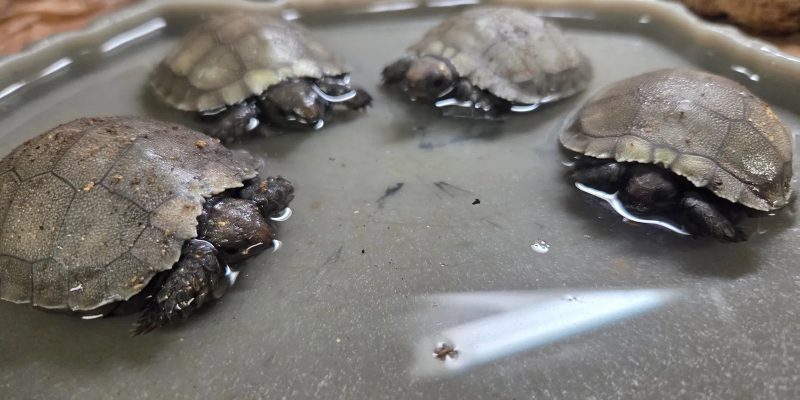
Four Asian brown giant tortoises have hatched at the Cincinnati Zoo and Botanical Garden. They are currently the size of a hand. The adults they are heading toward are the second largest tortoises in Asia, capable of passing two feet in length and 40 pounds.
The hatchlings are part of the AZA Species Survival Plan for the species, the cooperative program that manages breeding across accredited North American zoos so that the population stays genetically diverse rather than drifting toward a handful of related animals.
The tortoise that builds a nest and then guards it
Most tortoises dig a hole, lay, cover it and leave. The Asian giant tortoise does not. Females rake together a large mound of leaves and forest debris, bury the eggs inside it, and then stay with the mound, maintaining and defending it for days or even weeks. It is one of the most unusual nesting behaviors in any tortoise, and it is the sort of thing that is easy to miss in a species people mostly think of as slow and passive.
Guarding is the part that stands out. Parental care of any kind is rare in tortoises, and an animal that stays with a nest for weeks is spending weeks of its own energy on eggs it could simply have buried and walked away from.
Why do four hatchlings matter?
Because there are not many of this animal left to lose. The IUCN Red List assesses the Asian giant tortoise as Critically Endangered, the category directly above Extinct in the Wild, in an assessment dated July 1, 2018 and published with an erratum in 2019. The criteria it was listed under, A2cd, are the formal way of recording a population that has fallen because of habitat loss and because of collection, which is the same pair of pressures the zoo named.
Collection is the harder of the two to fix. A large, slow, conspicuous tortoise in a forest is a food animal and a pet-trade animal at the same time, and neither of those markets is waiting for it to reach breeding age. A species that takes years to mature does not absorb that kind of removal, which is why four animals hatched under human care, into a managed breeding program, is a larger event than the number suggests.
Cincinnati has made a habit of the unglamorous, long-horizon version of this work, from the reproductive science its CREW laboratory runs on lions to the ordinary business of hatching reptiles that nobody puts on a poster. Oregon Zoo is doing the same for a species nearer home with its northwestern pond turtle hatchlings.
The four in Cincinnati are on their way to being very large animals. Right now they are four small tortoises in a shallow dish of water, and that is worth going to see before it stops being true.