
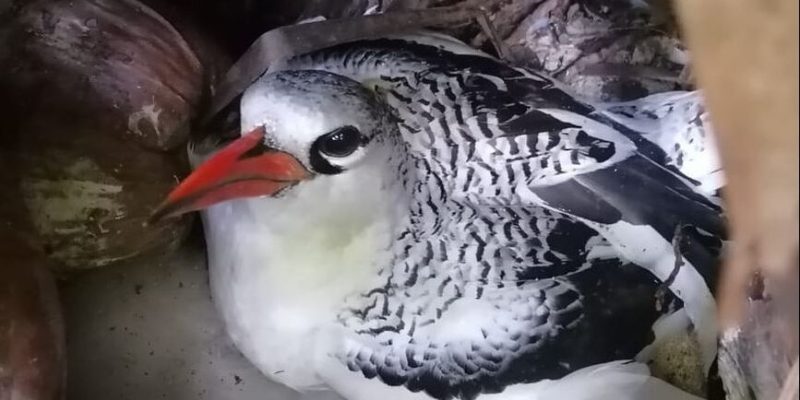
A pair of Red-billed Tropicbirds raised a chick on Platte, a half-square-kilometer island 130 kilometers south of Mahe, and in doing so gave Seychelles the first breeding record of the species in its history. The Island Conservation Society, which runs a conservation center on the island, reported the nest in December 2025. The Seychelles Bird Records Committee has since ratified it.
The committee’s account is the precise one. A breeding pair of the race indicus was located with a chick near the Island Development Company guesthouse on November 7, 2025, and the chick fledged before the end of the year. Those two birds are the 21st and 22nd records of Red-billed Tropicbird ever accepted for Seychelles, and the pair is the first to have bred.
Three tropicbirds, one island
The detail that makes this more than a tick on a national list is what else nests there. Red-tailed Tropicbirds bred on Platte in August 2025 and White-tailed Tropicbirds nested for a second year in the same month. With the Red-billed pair, all three of the world’s tropicbird species have now bred on one island of 0.578 square kilometers, roughly 1.3 kilometers long and 550 meters across at its widest.
The Seychelles Bird Records Committee, whose 2025 annual report was compiled by Adrian Skerrett, calls that remarkable and then declines to over-read it: “It remains to be seen whether this is a one-off or the beginning of a natural colonisation of the islands.” That is the right amount of caution for a sample of one nest, and it is worth quoting because the organization reporting its own good news is rarely the party that supplies the caveat.
What the island was before
Platte, which the Island Conservation Society calls Ile Plate, has a history that reads like a catalogue of everything that goes wrong with small islands. It was proposed as an isolation site for people with leprosy in 1828 and taken over by the British administration as a ships’ quarantine station ten years later. By the 1840s it held enough guano to be worth excavating, and the digging carried on into the early twentieth century. Turtle poaching was heavy enough that one part of the island became known as the turtle graveyard. Cats, rats and castor oil plants arrived and stayed.
The Island Conservation Society opened its conservation center on the island in 2024 and has run a restoration program there since, pulling out invasive plants, putting native vegetation back to hold the sand, and controlling predators. Ground-nesting seabirds benefit first from that last item, because a tropicbird nest is a scrape in leaf litter or a cavity in a cliff and a rat does not need to be large to empty one.
“This breeding record is more than just a milestone,” said Emma Mederic, Senior Science and Conservation Officer at the Island Conservation Society. “It’s proof that sustained island restoration, invasive species control, and careful management are making a tangible difference.”
What the Red List says, and what it does not yet say
Phaethon aethereus is Least Concern on the IUCN Red List, assessed on August 1, 2019 by BirdLife International, with 16,000 to 30,000 mature individuals and a decreasing trend. The Island Conservation Society’s own figures match the assessment exactly, which is worth saying because they frequently do not.
The interesting gap is elsewhere. The 2019 assessment lists eight countries and territories where the species breeds: Cabo Verde, China, Ecuador in the Galapagos, Grenada, Portugal, Saint Helena, Ascension and Tristan da Cunha, Senegal, and the United Arab Emirates. Seychelles appears on the same assessment under a different heading, as extant and vagrant. That is not an error on the Red List’s part. The assessment is six years older than the nest. It means the range map has some news to catch up with, and that the Platte chick is the kind of record that eventually moves a line on a global document.
Who paid for it
We look for the accredited zoos and aquariums behind conservation work in this region, because they are often there and often unnamed. On Platte we did not find one. The Island Conservation Society names two partners for the restoration program that produced this result: the Island Development Company, the Seychelles parastatal that administers the outer islands, and the Waldorf Astoria hotel on the island. Neither is a zoological institution, and no zoo or aquarium appears anywhere in the society’s account of the work.
That is a finding rather than a gap. Not every conservation outcome in this region runs on zoo money, and the honest version of the trace is more useful than a connection stretched to fit. Our report on the coral breeding laboratory Nature Seychelles runs on Praslin reached the same conclusion about a different Seychellois organization. The question can go the other way: in the SANCCOB case more than forty accredited institutions turned up on a published supporter wall.
What happens next is a second nest
Platte sits three meters above sea level. The society’s own write-up is blunt about what that means for storm surge, sea-level rise and reef degradation, and blunter still about the condition attached to the good news: predator control and monitoring have to continue, without a gap, or the birds that have started nesting stop.
One nest is a record. Two would be a colony. The Island Conservation Society’s report is published on its own site, and the ratified record appears in the Seychelles Bird Records Committee Annual Report 2025.
Quick answers
- What is the first breeding record?
A pair of Red-billed Tropicbirds of the race indicus nested near the Island Development Company guesthouse on Platte, in the outer islands of Seychelles, and were located with a chick on November 7, 2025. The chick fledged before the end of the year. It is the first confirmed breeding of the species anywhere in Seychelles.
- Who confirmed it?
The Island Conservation Society, which runs a conservation centre on the island, reported the nest in December 2025. The Seychelles Bird Records Committee ratified it in its Annual Report 2025, compiled by Adrian Skerrett, and logged the two adults as the 21st and 22nd Seychelles records of the species.
- Why does one nest matter?
Because of what else nests on the same island. Red-tailed Tropicbirds bred on Platte in August 2025 and White-tailed Tropicbirds nested there for a second year in the same month, so all three of the world's tropicbird species have now bred on a single island of 0.578 square kilometers.
- How threatened is the Red-billed Tropicbird?
Phaethon aethereus is Least Concern on the IUCN Red List, in an assessment published by BirdLife International on August 1, 2019, which gives 16,000 to 30,000 mature individuals and a decreasing population trend. That assessment lists Seychelles as a country where the species occurs as a vagrant, not one where it breeds, because it predates this nest by six years.
- Which zoo or aquarium funded the work?
None that we could verify. The Island Conservation Society names the Island Development Company and the Waldorf Astoria hotel as its partners in the Platte restoration program, and neither is a zoological institution. We looked for accredited zoo or aquarium funding behind this and did not find any.