
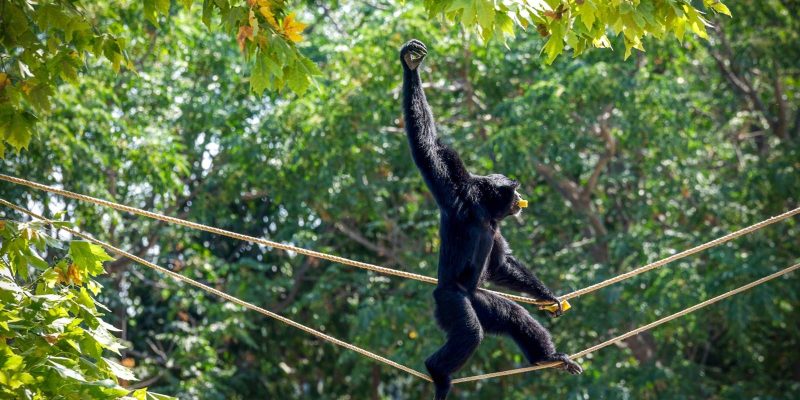
Four apes moved into İzmir Doğal Yaşam Parkı this summer, and between them they cover two species that almost nobody in Turkey gets to see. Bruno, a 19-year-old male, and Justine, a 29-year-old female, are white-handed gibbons, and the park says they are the only ones in the country. Savannah, who is 24, and her eight-year-old daughter Mula are siamangs, the largest members of the gibbon family. All four arrived because another zoo closed.
What will visitors actually see?
Gibbons are the best brachiators alive, which is the technical word for moving hand over hand beneath a branch, and it matters here because it is the entire reason a gibbon enclosure is worth standing in front of. They have no tail, their arms are disproportionately long, and they cross open space by swinging rather than climbing. At speed it does not read as climbing at all.
Serkan Eğrilmez, who runs the park for the Izmir Metropolitan Municipality’s Department of Veterinary Affairs, put it in the plainest possible terms. In the park’s announcement he said: “Ağaçların dallarında elleri üzerinde yürüyorlar, uçuyorlar. Bu nedenle ziyaretçilerin çok ilgisini çekiyor.” In English, translated by ZooReviews: “They walk on their hands along the tree branches, they fly. That is why they draw so much interest from visitors.” The park notes the four spend most of the day up in the trees, which is where you should be looking.
The two species are easy to tell apart once you know what you are looking for. White-handed gibbons have dark bodies with pale hands and feet, which is exactly what the name promises. Siamangs are larger and entirely black, and they carry a throat sac, an inflatable pouch of skin under the chin that works as a resonating chamber. A siamang fills it and produces a call that carries for kilometers. If you are in the park when one of them starts, you will not need directions.
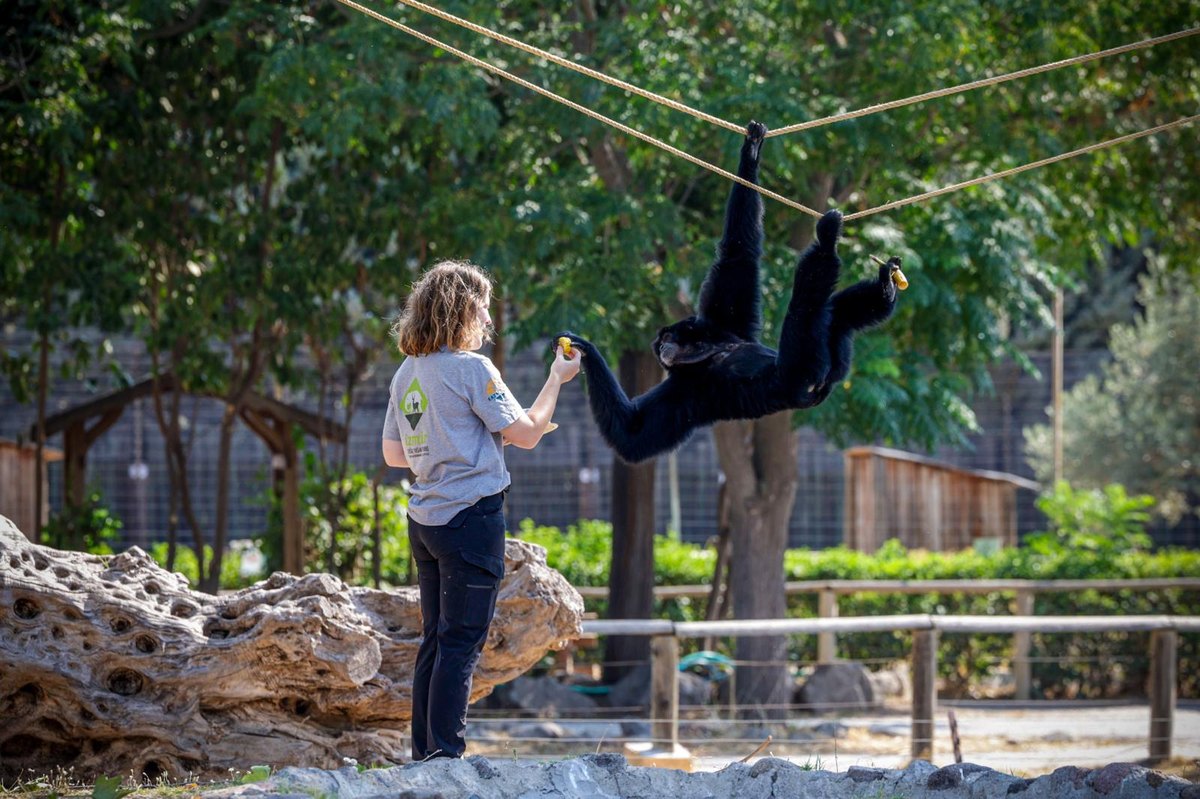
Why did they come to Izmir?
Because a private zoo in Darıca closed, and its animals needed somewhere to go.
Izmir has been on the receiving end of this before. Around seventeen years ago the old Kültürpark zoo in the middle of Izmir was shut down, and the animals that could not be returned to the wild were moved out to the Natural Life Park, which had been built on a far larger site for exactly that kind of purpose. Eğrilmez drew the line between the two events himself: “17 yıl sonra Türkiye’de bir hayvanat bahçesi daha kapandı. İzmir Doğal Yaşam Parkı olarak oradaki bazı hayvanları alıp doğal yaşam parkının koşullarıyla buluşturmaya karar verdik.” Translated by ZooReviews: “Seventeen years on, another zoo in Turkey has closed. As Izmir Natural Life Park, we decided to take in some of the animals from there and bring them into the conditions of the natural life park.”
That is a sentence worth sitting with. A closure is a hard thing for the animals inside it, and where they land afterward is decided in a short window by whoever has the space, the permits and the willingness. Izmir had all three, twice, seventeen years apart.
How threatened are these species?
Both of them, and more than most people expect of an animal they have only ever seen swinging cheerfully on a rope.
The white-handed gibbon, also called the lar gibbon, Hylobates lar, is listed as Endangered on the IUCN Red List in an assessment carried out in 2015. The siamang, Symphalangus syndactylus, is listed as Endangered under criteria A4cd, last assessed on November 20, 2015, with a decreasing population trend. Both are Southeast Asian forest animals, and both are losing forest.
Neither of these four is going back to Southeast Asia. They came out of a zoo collection that was shutting down, and the realistic choice in front of them was one enclosure or another, not a forest. What they got is a large municipal park with rope runs strung between real trees, a veterinary department attached, and a city that has done this before.
The park has been running this kind of placement for years, from the zoo closures down to individual animals: it is the same institution that hand-raised an orphaned zebra foal until she picked her own herd. Bruno, Justine, Savannah and Mula are the latest arrivals, and they are up in the branches most of the day.
Quick answers
- Which gibbons arrived at Izmir?
Four. Bruno, a 19-year-old male, and Justine, a 29-year-old female, are white-handed gibbons, which the park says are the only ones in Turkey. Savannah, who is 24, and her eight-year-old daughter Mula are siamangs, the largest species in the gibbon family.
- Why did they move to Izmir?
A private zoo in Darıca closed and its animals needed placing. İzmir Doğal Yaşam Parkı took some of them in, as it did about seventeen years ago when the old Kültürpark zoo in central Izmir was shut down and the animals that could not be returned to the wild were moved out to the park.
- How do you tell a siamang from a white-handed gibbon?
By the hands and the size. White-handed gibbons have dark bodies with pale hands and feet. Siamangs are larger and entirely black, and they have a throat sac, an inflatable pouch of skin under the chin that works as a resonating chamber for a call that carries for kilometers.
- How threatened are these species?
Both are Endangered on the IUCN Red List. The lar gibbon, Hylobates lar, was assessed in 2015. The siamang, Symphalangus syndactylus, is listed under criteria A4cd, last assessed on November 20, 2015, with a decreasing population trend.