
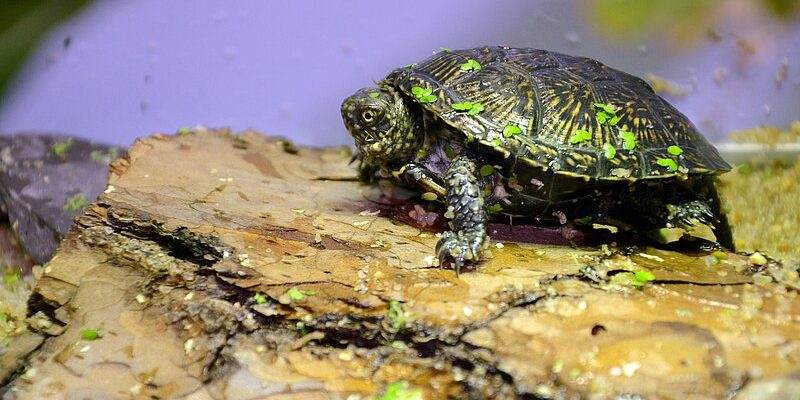
Ten European pond turtles raised behind the scenes at Tiergarten Nürnberg went into nature reserves in the German state of Hesse during July 2026. Forty more came from Zoo Frankfurt and the Opel Zoo, making fifty released this year into protected wetlands along the Rhine, the lower Main and the Nidda.
The interesting number is not fifty. It is that the turtles released in earlier years have started breeding on their own.
Two years from a one-euro coin
The ten Nürnberg turtles arrived from Hesse as hatchlings in early summer 2024. They were about the size of a one-euro coin and weighed between three and nine grams. Keepers raised them out of public view until they were ready to go back.
“Wir haben die Schildkröten zunächst mit Glanzwürmern und Mückenlarven, später auch mit Regenwürmern und kleinen Fischen gefüttert. Da sie unterschiedlich schnell gewachsen sind und manche recht dominant waren, haben wir sie nach ein paar Monaten nach Größen sortiert und in unterschiedlichen Aquarien gehalten.”
At first we fed the turtles bloodworms and mosquito larvae, later also earthworms and small fish. Because they grew at different rates and some were quite dominant, after a few months we sorted them by size and kept them in separate tanks.
Jessica Liebel, keeper and deputy section head at Tiergarten Nürnberg, in a statement translated from German
The target weight for release is 120 grams, at which point a turtle is roughly the size of a palm. That is the threshold where it becomes sturdy enough to be difficult for a predator to swallow, and it is why the zoo holds them for two years rather than putting hatchlings straight into a pond.
Clearing the water first
Before the release, the roughly 13-hectare reserve was fished. The catch included pike, which had been taking a heavy toll on the amphibians and reptiles already there.
This is the half of a reintroduction that tends to go unmentioned. Putting an animal back is the easy part; the site has to be able to hold it. Conservation workers here also hunt raccoons, an introduced species in Germany that eats more or less anything and pressures ground-nesting birds, amphibians and reptiles along with the turtles.
Every released turtle carries a microchip, which the zoo describes as a kind of identity card: it allows an individual animal to be recognized years later, which is the only way anyone finds out whether a release worked.
Did it work?
The Hessian program has reintroduced a good 900 turtles since 1999 and wants to reach 1,200 by 2030. The evidence that it is doing more than topping up a pond comes from the animals themselves.
“Wir sind auf einem guten Weg, unser Ziel zu erreichen. Wir haben seit einigen Jahren die ersten Freilandnachzuchten nachgewiesen und können mittlerweile regelmäßig Schlüpflinge oder Jungtiere beobachten, die von unseren ausgewilderten Tieren abstammen.”
We are well on the way to reaching our goal. For some years now we have documented the first offspring bred in the wild, and we can regularly observe hatchlings or juveniles descended from the animals we released.
Dr. Matthias Kuprian of the Hessian environment ministry, who leads the European pond turtle conservation program, in a statement translated from German
That is the distinction between a release program and a recovery. Animals that are put out and survive are a holding operation. Animals that are put out and then breed, and whose young are found in the wild years later, are a population.
Tiergarten Nürnberg joined the project in 2020 and released three of its own captive-bred turtles for the first time in 2023, into the Nidda meadows near Stockheim. The AG Sumpfschildkröte, the working group that started the program, was founded on a volunteer initiative and has run since 1999 with the Hessian agriculture and environment ministry and a handful of zoos.
How endangered is it, exactly?
Two answers, and they measure different things. The European pond turtle is the only turtle native to Central Europe, and on the German Red List it is classed as threatened with extinction, the most severe national category. Globally the IUCN Red List rates the species Near Threatened, on an assessment made in 1996 with an errata version published in 2016. A species can be widespread across Europe and Asia and still be on the edge of disappearing from Germany, which is what these two figures are describing.
Its German decline has an unusual history. Populations were hunted down in part because the turtle counted as fasting food: church rules treated it as fish rather than meat, so it could be eaten during Lent. What hurts it now is more familiar. Rivers were straightened and wetlands drained, which took away the shallow, structured water it needs, and road traffic and invasive species finish the job.
Other European zoos have put animals back on the ground this summer as well. Tiergarten Schönbrunn returned 8,000 moor frog tadpoles to Carinthia, and Tierpark Hellabrunn helped release ten Alpine ibex into the Sölktal.
Source: Tiergarten Nürnberg. Quotations translated from German.
Quick answers
- How many European pond turtles were released?
Ten from Tiergarten Nurnberg during July 2026, part of fifty released this year across Hessian reserves along the Rhine, the lower Main and the Nidda. Zoo Frankfurt and the Opel Zoo supplied the other forty.
- Is the reintroduction working?
The program has documented turtles bred in the wild, and observers regularly find hatchlings and juveniles descended from released animals. Roughly 900 turtles have gone out since 1999, with a target of 1,200 by 2030.
- Why are the turtles raised for two years first?
They arrive as hatchlings weighing three to nine grams and are released at about 120 grams, roughly palm-sized, which makes them far harder for a predator to take.
- How threatened is the European pond turtle?
The German Red List classes it as threatened with extinction, its most severe national category. Globally the IUCN Red List rates the species Near Threatened, on a 1996 assessment with a 2016 errata version.