
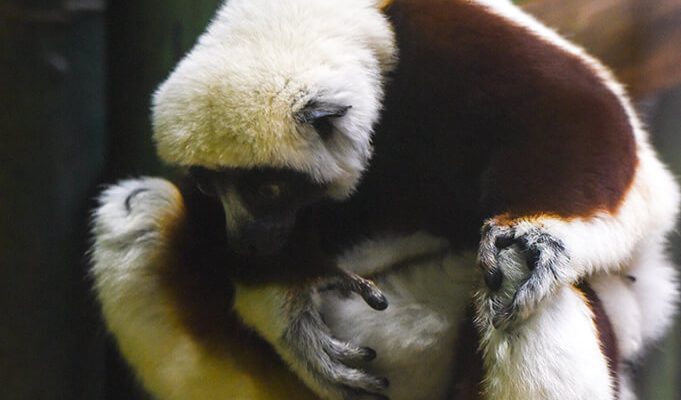
A female Coquerel’s sifaka was born at the Maryland Zoo on March 2, weighing 116 grams, about four ounces. The zoo announced her on April 20, 2026.
Her parents are Terence and Arcadia, and she is their second baby, born on a recommendation from the AZA Sifaka Species Survival Plan. The zoo had no sifaka at all between 2021 and 2023.
“Sifaka babies are very small when they’re born and need the protection of their mothers as they nurse to get stronger. We gave the pair lots of time to bond behind the scenes and are pleased the public can now see them regularly.”
Erin Cantwell Grimm, mammal curator, Maryland Zoo
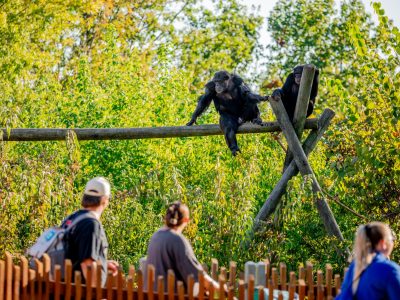
She is on view on a rotating basis in the Chimpanzee Forest, moving to the outdoor habitats along Lemur Lane in warmer weather.
Where the listing actually sits
The zoo’s announcement describes the sifaka as endangered. The IUCN Red List category, assessed in 2018 and published in 2020, is a step further along: Critically Endangered. It is also on CITES Appendix I. The species was listed as Endangered in 2014, 2008, 2000 and 1996, and Vulnerable in 1990, which is a listing history moving in one direction.
The Duke Lemur Center and the San Diego Zoo Wildlife Alliance both put the decline at roughly 80 percent over the past three decades, driven by habitat loss and hunting.
Two forests
Coquerel’s sifaka lives in the dry deciduous forest of northwestern Madagascar and nowhere else. In practice that means two protected areas: Ankarafantsika National Park, the largest forested area in northwestern Madagascar, and the Bora Special Reserve. Both have been damaged by fires set annually by neighboring farmers.
A species with a global range of two forests has no margin. A bad fire season is not a setback, it is a percentage of the world population.
Why almost nobody keeps them
Sifaka are folivores with sensitive digestive systems, and that single fact governs everything about holding them. At the Duke Lemur Center, the hub of the North American population, they are fed multiple times a day to mimic the feeding bouts of wild animals and keep their gut working the way a wild sifaka’s does. In the wild as many as 98 plant species have been recorded in their diet, though twelve make up two-thirds of it.
Winter is the real problem. Duke harvests and freezes browse every fall, and only one plant survives freezing intact:
“Winged sumac is the only plant that will freeze well, without disintegrating upon thawing. We fill seven large chest freezers with sumac harvested from many different sites around Durham and Chapel Hill.”
Duke Lemur Center
Duke puts the cost of caring for one sifaka at 8,400 dollars a year. That combination, a specialist diet, a seasonal harvesting operation and a five-figure annual cost per animal, is why only a handful of accredited institutions hold the species.
How many zoos keep Coquerel’s sifaka?
Only a handful of accredited institutions in North America, and the Maryland Zoo describes itself that way rather than giving a number. The Duke Lemur Center is the hub of the population and the source of most of the animals held elsewhere. We could not find a current published count of AZA institutions holding the species; the figures in circulation date to around 2014 and should not be repeated as current.
The bottleneck, and the fix
The last import of wild Coquerel’s sifaka to an AZA institution was in 1988. Every one in North America descends from a closed founder pool decades old, which is what the Species Survival Plan exists to manage.
The concentration risk was the acute worry, and Duke’s colony curator Britt Keith has described it directly: with the entire safety net population in the United States and half of it at one center, a single disease outbreak was an unacceptable exposure. In 2021 Duke relocated four breeding pairs to Tierpark Berlin, Kölner Zoo and Chester Zoo. Eighteen months later a sifaka named Sofena was born at Chester, the first ever born outside Madagascar and the United States.
Against that background, a second baby to an established pair in Baltimore is not a routine birth notice. It is one more animal in a population that is counted rather than estimated.
The same closed-population arithmetic drives careful pairing decisions elsewhere, including the reproductive science program at Cincinnati.
Source: Maryland Zoo; Duke Lemur Center; San Diego Zoo Wildlife Alliance; IUCN Red List.