
In 1994 there were fewer than 200 Lear’s macaws left in the world. There are now more than 1,100.
Loro Parque Fundación counts the Lear’s macaw as its flagship success, and the arithmetic supports the claim. The species moved from Critically Endangered to Endangered on the IUCN Red List, which is the rarest kind of news in conservation: a bird moving in the right direction.
What the foundation did
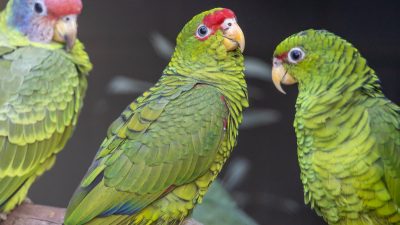
Lear’s macaw is a deep blue parrot restricted to the caatinga, the dry thorn scrub of northeastern Brazil, where it depends almost entirely on licuri palm nuts and roosts in sandstone cliffs.
The foundation has spent more than $460,000 directly on the species and roughly $726,000 on its wider Brazil program, along with $387,000 on local awareness work.
That last line is the one people skip. A macaw that eats palm nuts and raids maize gets shot by farmers, so the foundation runs a compensation fund for crop damage. Paying a farmer for his corn is not glamorous conservation and it is the difference between a bird that recovers and a bird that does not.
Birds bred in Tenerife, released in Brazil
In 2006 the Brazilian government sent breeding stock to Tenerife. Over the following decade the foundation bred 36 chicks there.
In February 2016 nine macaws were repatriated to Brazil, described as the largest repatriation of the species. They were received by Yara Barros, technical director of the Foz do Iguaçu Bird Park, with Bioparque M’Bopicuá also involved.
Six birds were released to the wild in August 2018. Another release followed in 2019, and two more birds went out in early 2021, bringing the total returned for controlled reintroduction to eight at that point. Field coordination in Brazil has been led by the biologist Erica Pacífico.
The milestone that matters most
In its 30th anniversary materials the foundation noted something easy to overlook: the first chick born to a breeding pair that had itself been raised entirely in Tenerife went on to reproduce successfully in the Brazilian caatinga.
That is the closing of a loop. A bird bred by people, from parents bred by people, breeding on its own in the wild. Everything before that point is a holding action. That is the point where a reintroduction becomes a population.
Very few reintroduction programs ever get there. The Przewalski’s horse return to Kazakhstan is one of the only others in the same category.
A note on the numbers
The foundation’s own pages give the current wild population variously as 1,100, 1,200 and 1,300, depending on which page and which year. We have used the figure on its current site, more than 1,100. Earlier counts it publishes are 242 birds in 2001 and fewer than 200 in 1994.
Source: Loro Parque Fundación.