
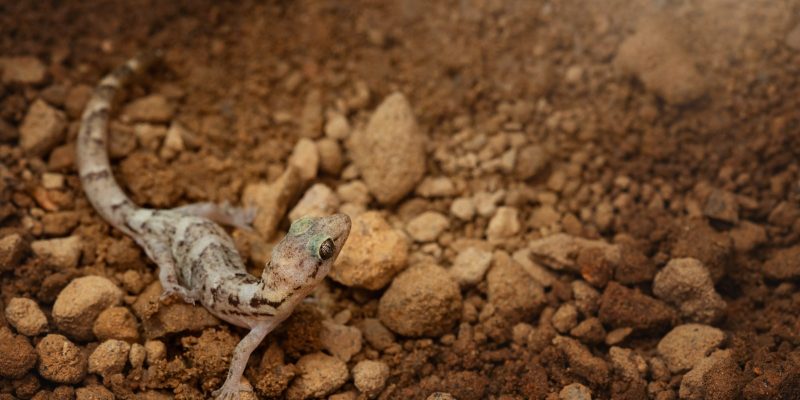
In December 2025, Durrell Wildlife Conservation Trust sent 142 lesser night gecko eggs from Jersey Zoo to Mauritius. In January, staff found ants eating them.
What happened next is the story.
The ants
Invasive big-headed ants had reached the eggs on the release island. A quarter showed clear signs of predation. For more than half the rest, nobody could tell whether the embryo inside was still alive.
The team pulled 91 unhatched eggs out and moved them to a biosecure facility run by the Mauritian Wildlife Foundation. Sixty-eight geckos hatched there and were released by hand. Durrell puts the total returned to Mauritius from this second translocation at 104 animals.
“We were surprised to find so many ants attacking the eggs, especially when the initial release had gone so well. Our quick response and coordination with our partners meant we were able to save over half of the eggs from Jersey Zoo, where very few would have survived had we not reacted.”
Dr. Nik Cole, island restoration manager, Durrell Wildlife Conservation Trust
Cole adds that the plan now is to incubate and hand-release future eggs, which he expects will get many more geckos through.
Why it matters that they changed the method
The first translocation, in 2025, sent 57 eggs and saw roughly an 88 percent hatch rate. It worked, so the obvious move was to do it again at scale.
Scaling up is where reintroductions usually fail quietly. A method that worked once meets a variable nobody planned for, the numbers come back poor, and the program limps along repeating a procedure that no longer fits the site. What Durrell did instead was notice inside a few weeks, intervene physically, and then change the protocol: eggs will now be incubated and the hatchlings hand-released rather than eggs being left in the ground.
That is the difference between running a program and learning from one.
Why the geckos are on that island at all
In 2020 the bulk carrier MV Wakashio grounded off Mauritius and spilled roughly 1,000 tonnes of fuel. The damage to the lesser night gecko’s restricted island habitat is what set this rescue and breeding effort going in the first place.
The work is run with the Mauritian Wildlife Foundation and the Government of Mauritius, through its National Parks and Conservation Service and Forestry Service, as part of the Mauritius Island Restoration Programme.
Durrell’s release does not give the species’ scientific name or its IUCN category.
Source: Durrell Wildlife Conservation Trust.