
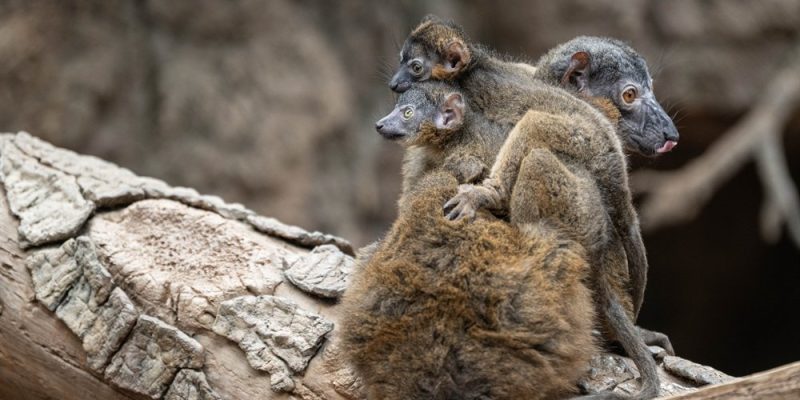
Fewer than a quarter of collared lemur pregnancies in managed care produce more than one infant. The Bronx Zoo announced twins in May 2026.
The collared lemur is a medium-sized primate from southeastern Madagascar, listed as Endangered by the IUCN. Populations have fallen by half over the past 24 years, driven by habitat loss and poaching.
The most endangered group of mammals on earth
That phrase gets used loosely. In this case it is precise: roughly 96 percent of lemur species are at risk of extinction.
The reason is geography. Lemurs exist only on Madagascar, they evolved there in isolation over tens of millions of years, and there is nowhere else for them to be. An island species cannot retreat inland when its forest goes. Every lemur species is therefore exposed to exactly one country’s rate of deforestation, and Madagascar’s has been among the world’s worst.
Against that, a set of twins is a small thing that is not nothing. The Bronx Zoo participates in the Collared Lemur Species Survival Plan, the AZA-managed breeding program that maintains genetic viability across accredited institutions, and multiple births in a species that rarely produces them widen the population’s base faster than single births can.
The animals themselves
Collared lemurs take their name from the rust-colored fur around the neck. Infants nestle into the mother’s belly to nurse and keep warm, and ride on her back as they grow, a contrast with ruffed lemurs, which park their young in canopy nests instead.
Adults live mostly in the treetops, using long tails for balance as they move through the canopy.
The sexes of the twins had not yet been determined at the time of the announcement; that waits for a first veterinary exam, which is a deliberate choice not to disturb a mother and two newborns for information that can be collected later.
Where to find them
The pair went on view in the Spiny Forest section of the zoo’s Madagascar! habitat, alongside critically endangered red-ruffed lemurs and radiated tortoises, a grouping that reflects what the Wildlife Conservation Society works on across Madagascar itself.
Other AZA institutions have been adding to their lemur holdings under the same programs: Zoo Atlanta took in a pair of critically endangered ruffed lemurs on an SSP recommendation.