
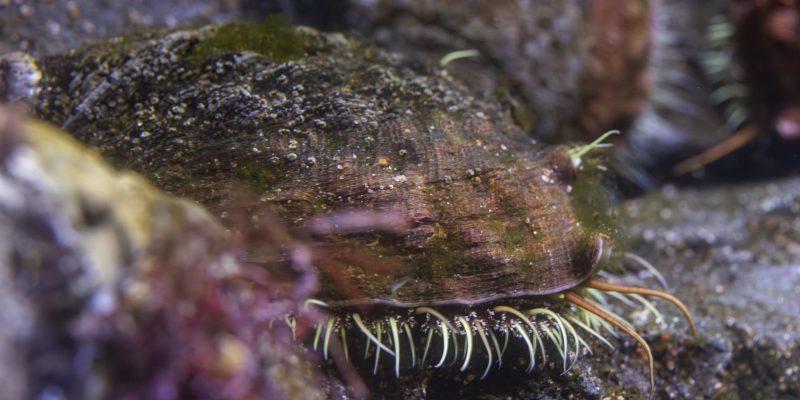
For the first time in five years, an endangered white abalone has been seen alive in the Channel Islands National Marine Sanctuary, spotted by a staff member from the Aquarium of the Pacific during a habitat survey.
The sighting
Jaimee Butler, the aquarium’s assistant dive safety officer of field operations, was helping with surveys in the sanctuary in May 2026. Diving as a buddy pair with Julie Bursek, the sanctuary’s education and outreach team lead, she spotted an abalone.
They suspected it was a white abalone on sight, but suspicion is not a record. The pair took video and shell length measurements, and the identification was confirmed with project leads at NOAA Fisheries.
The surveys are part of Wanted Alive! White Abalone, a campaign run jointly by the Aquarium of the Pacific, NOAA Fisheries, the sanctuary and the National Marine Sanctuary Foundation. The goal is to find living white abalone and identify habitat that could support the species’ recovery.
A snail with a federal listing
The white abalone (Haliotis sorenseni) was harvested into crisis. Commercial and recreational take continued well into the twentieth century until abalone fishing was banned in 1997, and in 2001 the white abalone became the first marine invertebrate ever listed as federally endangered.
Protection alone has not been enough, for a reason specific to how abalone reproduce. They spawn by releasing eggs and sperm into the water, which only works if animals are close enough together for the two to meet. A population thinned out across the seafloor can be perfectly healthy individually and still fail to breed. That is why finding one alive is worth a press release, and why the campaign is looking for habitat rather than just animals.
The same aquarium took in nearly 500 trafficked animals after a single wildlife seizure in June.
What the aquarium does about it
The Aquarium of the Pacific has worked on white abalone since 2007: breeding, rearing, releasing and monitoring. It had another successful spawn earlier this year, with staff putting in long hours monitoring the first stages of larval development. Those abalone are growing behind the scenes until they are large enough to be outplanted into the ocean.
“The hope is that with our continued work with partners, white abalone will reach sustainable populations again,” said Nate Jaros, the aquarium’s vice president of animal care.
Seeing one yourself
White abalone can be seen in the aquarium’s Southern California Gallery, which is a rare opportunity to look at an animal that is close to unfindable in the wild. It is a snail on a rock. It is also the first marine invertebrate the United States decided it could not afford to lose.