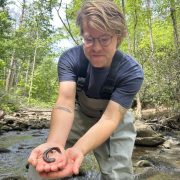

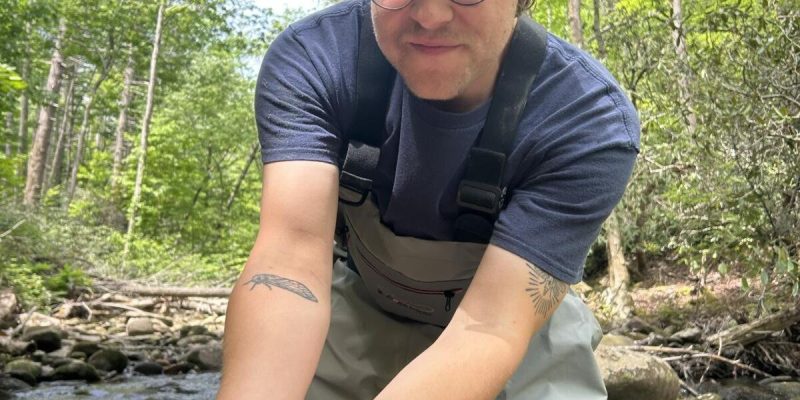
On May 4 and 5, 2026, staff from Chattanooga Zoo, the U.S. Forest Service and Lee University drove into the Cherokee National Forest and released 64 eastern hellbender salamanders into several creeks. It brings the total released by the zoo’s headstart program to 125.
What a hellbender needs
Eastern hellbenders are native to Tennessee and more than a dozen other states, and they have been declining for decades, chiefly through habitat destruction and stream pollution. The reason they are so exposed is anatomical: hellbenders breathe directly through their skin, absorbing oxygen straight from the water, which makes them acutely sensitive to anything in it.
That same sensitivity is what makes them useful. “Hellbenders rely on clean, well-oxygenated flowing water to survive, so a strong population of healthy hellbenders signifies good water quality and a thriving ecosystem,” said Will Ternes, a zookeeper who helps lead the program. “It’s important that we take measures to save this crucial, local species from extinction and help them thrive in our region like they used to.”
Headstart programs of this kind are quietly common at accredited zoos: the Oregon Zoo runs one for northwestern pond turtles, and Como Park Zoo shipped 3,000 Wyoming toad tadpoles to Laramie this summer.
Two to three years in a building in Chattanooga
The Hiwassee Hellbender Research and Education Facility opened at the zoo in March 2021 to run the repopulation program. Each cycle starts by collecting hellbender eggs and larvae in the wild. Those are raised at the zoo for two to three years, then released.
The numbers explain why. Young hellbenders are eaten by fish at a high rate; adults, which reach two feet long and around five pounds, largely are not. Holding an animal through the vulnerable years and releasing it at a size nothing local can swallow converts a low-survival species into a high-survival one.
The release itself
Getting 64 salamanders into creeks is manual work. The team drove forest roads, hiked along streams and waded into the water carrying hellbenders in coolers and buckets, acclimating them to stream temperature in plastic bags before letting them go. Hellbenders shelter under rocks, branches and fallen timber, so finding the right release points matters as much as the animals themselves.
Dr. Michael Freake of Lee University and Dr. Tony Ashley, the zoo’s veterinarian, injected PIT tags so individuals can be identified later. That is how the program will eventually know whether any of this worked.
“We plan to continue the cycle of collection, care and release until local populations have made a demonstrable improvement,” Ternes said.
Seeing them
Hundreds of hellbenders are growing at Chattanooga Zoo right now, waiting to get big enough. A hellbender is a strange animal to stand in front of: a two-foot, flat-headed, wrinkle-skinned aquatic salamander that has been in these creeks far longer than any of us. Tennessee is one of the few places you can.