
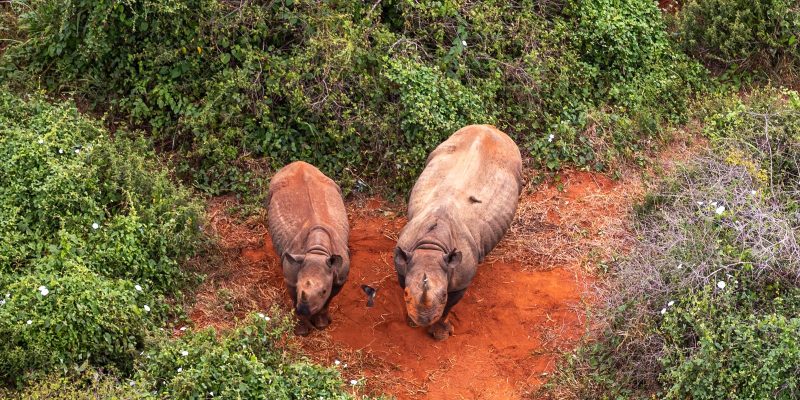
Kenya’s black rhino population reached 1,207 animals in September 2026, passing a national target of 1,200 ahead of schedule. More than 80 percent of them now live inside fenced sanctuaries that are at or above the number of animals the land can feed. A draft national plan for 2027 to 2031, sent to conservation stakeholders for validation this month by the Kenya Wildlife Service, is an attempt to answer the question that success created: where do the next five hundred rhinos go?
The arithmetic is unusual enough to be worth stating plainly. In 1989, after two decades in which poaching reduced a national population of roughly 20,000 animals to a few hundred, Kenya held about 370 black rhinos. The service recorded zero rhino poaching incidents in 2025, and none through the first nine months of 2026. The threat that defined the species for forty years has, for the moment, been held off. The constraint that replaced it is real estate.
What does the new plan actually propose?
The document is the eighth edition of the Recovery and Action Plan for the Black Rhino in Kenya, covering 2027 to 2031. The Kenya Wildlife Service convened a stakeholder validation workshop for it in Nairobi, with support from WWF-Kenya, to put the draft in front of the conservancies, county governments, private landowners and research institutions that would have to carry it out.
The headline numbers are a population of at least 1,500 black rhinos by 2031 and at least 2,000 by 2037, sustained by annual growth of at least 5 percent. Participants were asked to work on four areas in particular: institutional responsibility and accountability, habitat expansion and stakeholder consent, population viability and management, and sustainable financing. The recommendations go into a final draft, then technical review, then endorsement by the Ministry, with a launch planned for World Wildlife Day.
Speaking on behalf of Director General Professor Erustus Kanga, the service’s Director of Wildlife Security, Jillo Arero, put the problem in one sentence: success has brought new challenges, and more than 80 percent of Kenya’s black rhinos are held in fenced populations operating at or above their ecological carrying capacity.
Why does a recovering population run out of room?
Ecological carrying capacity is the number of animals a given piece of land can support without the land itself starting to degrade, and for a browsing animal that eats woody shrubs it is a hard ceiling rather than a soft one. The IUCN Red List assessment for the black rhinoceros describes the two mechanisms that show up when a population approaches it, and they are worth knowing because they are what managers actually watch. The first is food competition, which shows up in the survival rate of calves after weaning. The second is social: black rhinos are largely solitary and territorial, and crowding produces male-to-male aggression that can be fatal.
Historically the answer was to keep populations below that ceiling deliberately, and to move animals out when the warning signs appeared. That only works while there is somewhere to move them to. The same assessment makes the broader point that fragmentation has left the species dependent on managed movement where it once dispersed on its own.
Kenya is now seeing the ceiling reached in more than one place at once. On November 20 the wildlife service announced a full audit of the rhinos at Ol Pejeta Conservancy in Laikipia, where it recorded 17 black rhino deaths between late February and mid-November 2026, and where a population that has grown by about 5.5 percent a year since 2007 now sits well above the conservancy’s estimated capacity. The audit team, drawn from the Wildlife Research and Training Institute and from monitors at Borana, Lewa, Loisaba and Segera, is physically identifying every animal. Ol Pejeta has itself called publicly for rhino habitat to be expanded.
Where would the new space come from?
The service’s answer is the Kenya Rhino Range Expansion initiative, which it leads with private and community partners. The target is five new sanctuaries across northern Kenya and the Mount Kenya region by 2030, opening up around 34,000 square kilometers.
There is already a working model for what that looks like. On World Rhino Day in September, Kenya launched the expanded Tsavo West Rhino Sanctuary: 3,200 square kilometers, which the service says makes it the largest rhino sanctuary in the world, built with 240 kilometers of fencing, 47 new water points and microchip tracking. Before the expansion, nearly 150 rhinos were living in the 92-square-kilometer Ngulia sanctuary inside the same park, where breeding had slowed and territorial fights had increased. We covered that launch and the arithmetic behind it in September. The greater Tsavo landscape now holds about a quarter of Kenya’s black rhinos; it once held more than 8,000, and by 1989 fewer than 20 were left.
The plan also reopens a question Kenya has mostly answered with fences. The black rhinos of the Maasai Mara are the country’s only unfenced, free-ranging population outside a national park, and they recovered from a recorded low of around 11 animals in 1984 to 54 across the reserve and the Mara Triangle by the end of 2024, on a boundary open to Tanzania’s Serengeti. A 2025 study in the Proceedings of the National Academy of Sciences, using whole genome sequences from eastern black rhinos in that ecosystem, found that calves born to animals which had dispersed naturally between neighboring populations carried less inbreeding than calves in the intensively managed closed population the migrants came from, and, unlike calves born to animals translocated from ex-situ populations, did so without accumulating a higher load of harmful mutations. Natural movement, where the landscape still allows it, is cheaper and genetically safer than a truck. It is also, on the evidence of a different Kenyan translocation, more likely to stick: we wrote this month about a group of elephants moved from Isiolo to Tsavo East that set off home again.
Which accredited zoo is paying for any of this?
One, clearly, and it is Cheyenne Mountain Zoo in Colorado Springs. The zoo’s conservation partner in Tsavo is Tsavo Trust, a Kenyan non-profit that has supported the wildlife service’s rhino work in Tsavo West since 2013, and whose logo wall for that work carries the zoo alongside Helping Rhinos, the Rhino Recovery Fund, Re:wild, the Wildlife Conservation Network and the US Fish and Wildlife Service. Cheyenne Mountain describes Tsavo Trust in its own words as its “African elephant and black rhino conservation partner,” and announced in 2024 that it had passed $1 million donated since the partnership began in 2016, raised through its Quarters for Conservation program and the daily animal feeding sessions it runs in summer. The money has gone into a mechanic’s workshop for anti-poaching aircraft and vehicles, an aircraft hangar, two boreholes, sand dams, staff salaries and pilot hours. That scope matters, and we have tested its edges before: the same zoo’s money does not reach Tsavo Trust’s work on lions, leopards and cheetahs, which is why that story carried no hub. Rhinos are inside the line.
Tsavo Trust, whose co-founder and chief executive is Richard Moller, puts its own total support for the Tsavo West rhino program at about $6 million since 2013, covering aerial surveillance by two Super Cubs, a Cessna 182 and a helicopter, seven mobile de-snaring teams, 1,200 ranger uniforms, more than 400 camera traps, nine sand dams and ten years of annual night censuses.
Beyond that the trace runs out, and it is worth saying so. The bodies named around the recovery plan itself are not zoological: WWF-Kenya supported the validation workshop, the Wildlife Research and Training Institute guides the science, and Borana, Lewa, Loisaba, Segera and Ol Pejeta are conservancies rather than zoos. We looked for other accredited zoo or aquarium funding behind the 2027 to 2031 plan and the range expansion initiative and did not find any published. For scale, the Association of Zoos and Aquariums reports that in 2025 its 235 accredited and certified facilities spent approximately $372.4 million on conservation across 139 countries. No published breakdown isolates the African share of that figure.
A note on the category
The wildlife service’s own announcement of the Tsavo West expansion describes the animals as “endangered Eastern black rhinos.” On the IUCN Red List, Diceros bicornis was assessed by R. Emslie on January 14, 2020 as Critically Endangered under criteria A2abd+4abd, with 3,142 mature individuals and, notably for this story, a population trend of increasing. We default to the assessment, which puts the species one category higher than the announcement does. The Red List’s 2024 Green Status assessment, by Ferreira, Knight, Vigne and Goldenberg, scores the species’ recovery at 24 percent and calls it Largely Depleted, which is a fair description of an animal that is growing in number and still occupies a fraction of the range it once had. That is the gap the new plan is written to close.
Quick answers
- How many black rhinos does Kenya have?
1,207 as of September 2026, according to the Kenya Wildlife Service. That passed a national target of 1,200 ahead of schedule. The population was about 370 in 1989.
- What does the new recovery plan target?
At least 1,500 black rhinos by 2031 and at least 2,000 by 2037, sustained by annual population growth of at least 5 percent. The plan is the eighth edition of the Recovery and Action Plan for the Black Rhino in Kenya and covers 2027 to 2031.
- Why is space the problem now?
More than 80 percent of Kenya's black rhinos live in fenced populations at or above their ecological carrying capacity. When a browsing population approaches that ceiling, calf survival after weaning falls and male-to-male aggression rises, so growth stalls.
- Where would the extra range come from?
The Kenya Rhino Range Expansion initiative aims to establish five new sanctuaries across northern Kenya and the Mount Kenya region by 2030, opening up around 34,000 square kilometers. The expanded Tsavo West Rhino Sanctuary, at 3,200 square kilometers, is the working model.
- Which accredited zoo funds this work?
Cheyenne Mountain Zoo in Colorado Springs, through Tsavo Trust, which supports the wildlife service's rhino program in Tsavo West. The zoo passed $1 million donated since the partnership began in 2016. We found no other published accredited zoo or aquarium funding behind the 2027 to 2031 plan or the range expansion initiative.
- What is the black rhino's IUCN status?
Diceros bicornis was assessed by R. Emslie on January 14, 2020 as Critically Endangered under criteria A2abd+4abd, with 3,142 mature individuals and a population trend of increasing. The 2024 Green Status assessment scores its recovery at 24 percent and calls it Largely Depleted.