
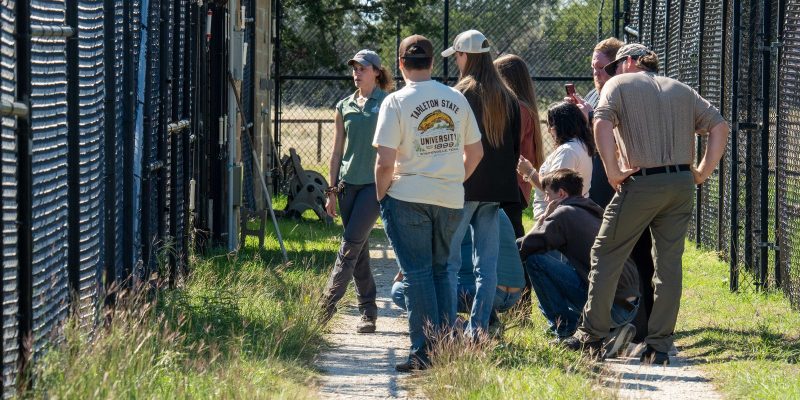
On October 21, Fossil Rim Wildlife Center gave a university carnivore ecology class the one thing the subject almost never provides: the animals, in front of them, at a distance where you can see how they are kept. Professor Kaileigh Henry brought her Carnivore Ecology and Conservation students from Tarleton State University to the center in Glen Rose, Texas, and Fossil Rim’s carnivore care specialists spent the day walking them through how the collection is managed.
It is a small event with a real problem behind it, and Henry named the problem herself.
Why a carnivore class rarely sees a carnivore
Students in an avian or pollinator ecology course can go outside and find their subjects. Carnivore ecology does not work that way. The animals are scarce, wide-ranging, largely nocturnal and actively avoid people, so an undergraduate can finish a course on carnivores having studied them entirely through camera trap data, scat surveys and other people’s papers.
“I think the partnership between Tarleton and Fossil Rim is invaluable, especially for the students,” Henry said. She teaches juniors and seniors, and said the chance to be on site hearing from working professionals is “really something that is going to set our students above and beyond.”
A dissertation that had the data but not the yards
The clearest case for the arrangement is a doctoral student. Brianna Cooke has been working with Fossil Rim staff on research into breeding management, stress and disease in cheetah populations, aimed at improving both animal health and conservation outcomes. She had been working with the center’s data for some time. She had never seen the place the data comes from.
“It’s been a huge contextual help for my dissertation,” Cooke said, describing what it was worth to see the cheetahs, their yards and the day to day management in person rather than in a spreadsheet.
The word to hold onto there is yards. A cheetah yard is a fenced enclosure, and at a breeding center the count of yards, their size, and which animals can see, smell or hear each other across them make up the conditions the research is measuring. Breeding management decisions are decisions about which yard an animal is in and who is next door. A researcher studying stress in a captive cheetah population who has never walked the fence line is missing the geometry her own data was generated by.
What the day actually consisted of
Students attended a presentation by Senior Carnivore Care Specialist Jessica Rector, who took them through her daily responsibilities, toured them through the cheetah facility, and talked about how to actually get a job in animal care. Fossil Rim describes the visit as one piece of a standing partnership with Tarleton State built on hands-on education and research.
Why Fossil Rim’s cheetahs are worth a class trip
The cheetah, Acinonyx jubatus, is listed as Vulnerable on the IUCN Red List under criteria A4b and C1, with a global estimate of 6,517 mature individuals and a decreasing trend. That assessment was made in May 2021 and most recently amended in 2024. A species with roughly six and a half thousand breeding adults left in the wild is one where the management of every breeding population, including the ones behind fences in Texas, is doing measurable work.
Fossil Rim has been putting money into that end of its operation. Earlier this month the center received a 2026 Clarke Give to Tomorrow grant toward upgrading its cheetah and black-footed cat habitats, which is the same set of yards these students were standing beside.
That is the quiet argument in a story about a class trip. A conservation breeding center and a university an hour up the road can each do something the other cannot, and the students who walk out of a cheetah facility having seen the fences are the ones who will be running these programs in twenty years. Fossil Rim wrote up the visit on November 23.
Quick answers
- What happened at Fossil Rim on October 21?
Fossil Rim Wildlife Center hosted Tarleton State University professor Kaileigh Henry and her Carnivore Ecology and Conservation class. Carnivore care specialists spent the day with the students and toured them through the cheetah facility.
- Why is field experience hard to get in carnivore ecology?
Carnivores are scarce, wide-ranging, largely nocturnal and avoid people, so students rarely observe them in the wild. Henry contrasted this with avian and pollinator ecology courses, where direct field observation is routine.
- What research is Fossil Rim doing with Tarleton State?
Doctoral student Brianna Cooke is working with Fossil Rim staff on breeding management, stress and disease in cheetah populations, aimed at improving animal health and conservation outcomes.
- What is a cheetah yard?
A fenced enclosure. At a breeding center the number of yards, their size, and which animals can see, smell or hear each other across them are the conditions a breeding-management study is measuring.
- How threatened are cheetahs?
The IUCN Red List lists Acinonyx jubatus as Vulnerable under criteria A4b and C1, with an estimated 6,517 mature individuals and a decreasing trend. The assessment was made in May 2021 and most recently amended in 2024.
- Where is Fossil Rim Wildlife Center?
Glen Rose, Texas.