
Brevard Zoo has two more Florida black bear cubs in rehabilitation, a pair of siblings named Prickly Pear and Pooh Bear, and with their arrival this year’s cohort is almost certainly complete at 11 bears.
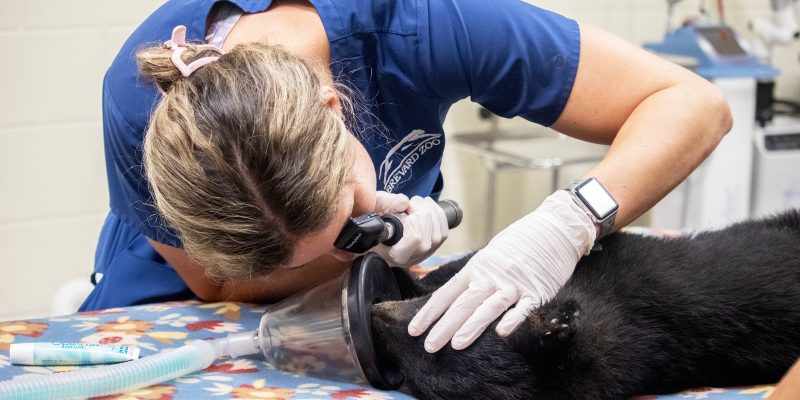
Prickly Pear was found in Marion County in August. His sibling turned up three days later in the same place, and the two were brought in a few days apart. Both arrived in relatively good condition. The veterinary team cleaned what wounds they had and treated both for fleas and ticks, and Prickly Pear had several broken teeth extracted.
Once the siblings were reunited in the zoo’s rehabilitation center they showed an affinity for one another and have been playing together since. They also folded into the wider group of cubs without trouble, which is not a given with young bears that arrive separately.
What happens to the cubs now?
They spend the rest of the year getting bigger and getting better at being bears. The group has spent the months since arriving in a naturalistic habitat, where the point is practicing the survival skills they would otherwise have learned from a mother. Each cub has gained weight and gotten stronger as it heads toward its first birthday.
The exams start soon. Every bear in the cohort is checked to confirm it is ready, and the ones that pass go back to their native range in January.
The bears are cared for in the East Coast Zoological Foundation’s Black Bear Rehabilitation Center, which is behind the scenes rather than on the guest path, and the work runs with the Florida Fish and Wildlife Conservation Commission’s Bear Management Program. FWC decides where a rehabilitated bear goes, and it aims for public conservation areas with high-quality bear habitat and a low density of both bears and people, which gives a young bear the best odds of staying out of trouble once it is on its own. The agency’s Florida black bear program publishes what it does and does not want the public to do when a bear turns up.
This is the second group of cubs we have followed through the center this year. In September we wrote about the fifth cub of the season arriving, when the cohort was still filling up.
Why bother rehabilitating a bear?
Because of what a bear does for everything around it. Black bears are seed dispersers: they eat fruit across a wide range and move those seeds, which is work that shapes a Florida forest over decades. Every cub that goes back out restores that function to its patch of habitat.
Anyone who finds an orphaned, sick, injured or dead Florida black bear should call FWC’s 24-hour Wildlife Alert Hotline at 888-404-FWCC (3922) rather than approaching the animal.
Quick answers
- How many bear cubs is Brevard Zoo rehabilitating?
Eleven. The zoo says it is unlikely to receive more cubs this late in the season, so the year's cohort is effectively complete.
- When will the cubs be released?
January. Every bear in the cohort gets an exam first to confirm it is ready, and the ones that pass go back to their native range.
- Where do rehabilitated Florida black bears go?
The Florida Fish and Wildlife Conservation Commission decides, and it aims for public conservation areas with high-quality bear habitat and a low density of both bears and people.
- What should I do if I find an orphaned or injured bear cub?
Call FWC's 24-hour Wildlife Alert Hotline at 888-404-FWCC (3922) and do not approach the animal.