
Most of what the Cheetah Conservation Fund publishes happens on its own land outside Otjiwarongo. Two recent engagements happened somewhere else, or brought somebody else in, and the Fund has written both of them up: a public lecture in Windhoek, and a day hosting a visiting delegation of science funders at the research center itself.
Neither is a discovery. Both are the part of conservation science that decides whether the discoveries get paid for, and the Fund treats them that way.
The talk: counting an animal that does not want to be counted
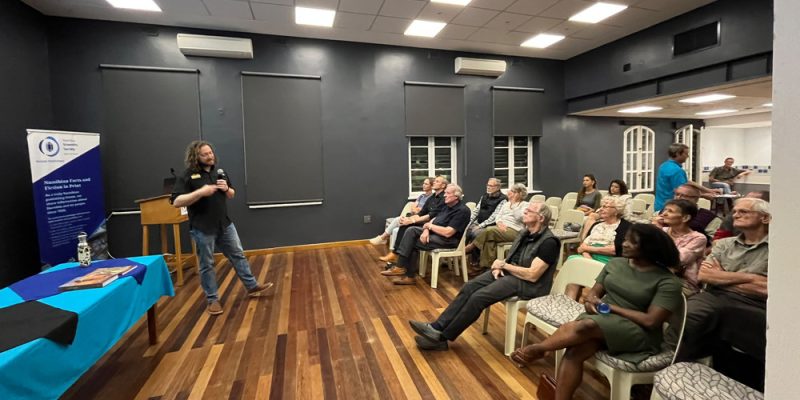
In late September, Dr Tim Hofmann, the Fund’s conservation scientist and canine specialist, spoke at the Namibian Scientific Society in Windhoek on Namibia’s terrestrial carnivores.
The Fund’s summary of the talk is more interesting than the occasion. Hofmann covered the conservation status of Namibia’s carnivore community, how different land use systems shape where those species occur, and the human pressures bearing on them. On the cheetah specifically he went to the measurement problem: the species is naturally sparse and ranges very widely, which makes it genuinely hard to monitor, and monitoring is what population trends are built from. Namibia’s standing as a stronghold for the cats rests on numbers that are difficult to produce.
That difficulty is the reason the Fund keeps investing in methods rather than only in animals. We wrote about its genetics laboratory at Otjiwarongo and the population estimate that came out of it, and the scat detection dogs that supply the samples are the same program Hofmann runs.
The delegation: who was actually in the room
The Fund also hosted representatives of Namibia’s National Commission on Research, Science and Technology and international partners from the Science Granting Councils Initiative, who were in the country for the initiative’s All Partners Forum 2026. The Fund says the forum ran from 28 September to 2 October and brought together more than 170 delegates to work on science and innovation partnerships across Africa.
A science granting council is the body that decides which research proposals in a country get money. Putting that group on a cheetah research station for a day is a different kind of outreach from a public lecture, and the Fund ran it as a tour of capability: Dr Robin Cook on the ecology work, Dr Anahi Hidalgo and Dr Anne Shiimi through the clinic, and Tresia Shihepo with the Fund’s master’s students in the laboratory.
The laboratory is the Fund’s strongest claim and it makes it plainly: it describes Otjiwarongo as the only in-situ genetics laboratory at a frontline conservation center in Africa. In-situ is the term worth keeping. It means the sequencing happens where the samples are collected rather than being shipped to a university in another hemisphere, which changes how fast a field question can be answered and who gets trained answering it.
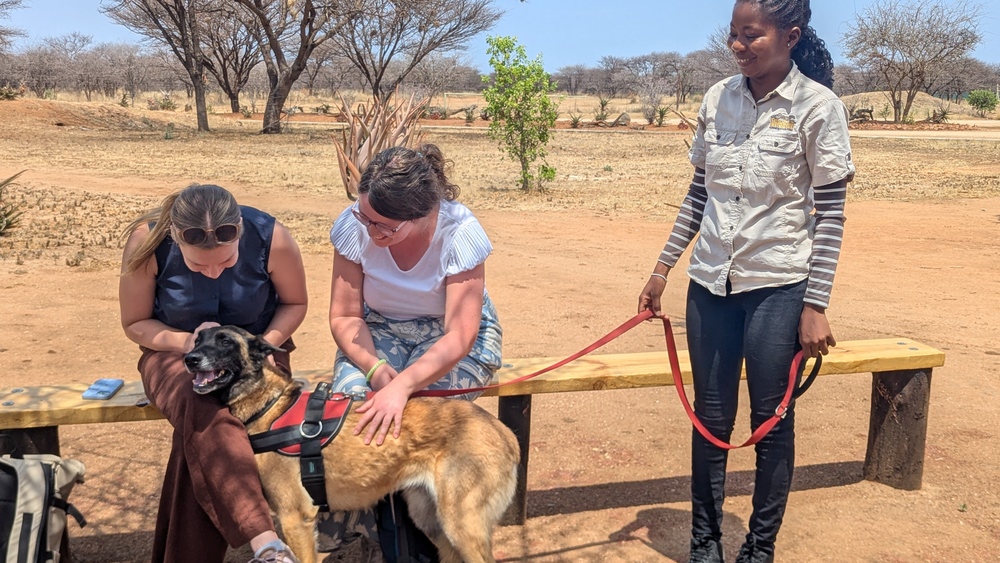
The group also met the working dogs, which are two separate programs that outsiders routinely merge. Tim Hofmann and Ruusa Uugwanga demonstrated the wildlife detection dog Enya, who finds biological samples. Modesta Fabianus introduced the livestock guarding dog program and a dog called Tiger, who does the opposite job: he lives with a farmer’s herd and keeps predators away from it, so the farmer does not shoot the predator. Abraham Shihepo and Dr Matti Nghikembua showed the Bushblok project, which turns encroaching thornbush into fuel briquettes. The day finished at the cheetah feeding with the keepers Justin Moya, Elifas Nashini and Kay Kahuure.
Which zoos or aquariums fund this
None that we can tie to either engagement, and the Fund names none. A public talk and a hosted site visit are not the kind of activity that carries a sponsor line, and nothing in the Fund’s account points to one.
The broader picture is better documented than usual for this region, and it is worth stating accurately. The Fund’s own corporate giving page names a long list of zoological institutions among its supporters, including Columbus Zoo and Aquarium, Saint Louis Zoo, Dallas Zoo, Toronto Zoo, Indianapolis Zoo, Kansas City Zoo, Metro Richmond Zoo, Nashville Zoo at Grassmere, Caldwell Zoo, Little Rock Zoo, Alexandria Zoological Park, Baton Rouge Zoo, Dickerson Park Zoo, The Virginia Zoo, Wildlife World Zoo and Aquarium, The Living Desert Zoo and Gardens, Turtle Back Zoo and Wilhelma in Stuttgart.
That is a real and substantial list. What it is not is a statement about who paid for a lecture in Windhoek or a delegation lunch, and the Fund does not publish project-level funding. We reached the same conclusion about the Fund’s week at the CITES committee in Geneva four days ago. General support for an organization is not evidence of support for a particular piece of its work, and we are not going to attach an institution to this story on the strength of a donor page.
Why a lecture is worth reporting
Because the audience is the point. The Fund notes that those present at the Windhoek talk included its own ecologist Stella Emvula, a former cheetah keeper, and Kelsey Prediger of the Pangolin Conservation and Research Foundation. That is a small conservation community talking to itself in a room, which is how field methods actually move between organizations.
And the granting councils in the other half of the story are the ones who decide whether African research gets funded from inside Africa rather than from outside it. The Fund says it discussed potential areas for future collaboration and left it there, with nothing announced. That is an honest place to leave it, and it is more than most organizations say about a day of meetings.
Quick answers
- What did the Cheetah Conservation Fund do in Windhoek?
Dr Tim Hofmann, the Fund’s conservation scientist and canine specialist, gave a public talk at the Namibian Scientific Society in late September on Namibia’s terrestrial carnivores, covering their conservation status, how land use shapes where they occur, and the difficulty of monitoring a species as sparse and wide-ranging as the cheetah.
- Who visited the research center?
Representatives of Namibia’s National Commission on Research, Science and Technology and international partners from the Science Granting Councils Initiative, who were in the country for the initiative’s All Partners Forum 2026. The Fund says the forum ran from 28 September to 2 October and drew more than 170 delegates.
- What is an in-situ genetics laboratory?
One that sits where the samples are collected rather than in a university elsewhere. The Fund describes its laboratory at Otjiwarongo as the only in-situ genetics laboratory at a frontline conservation center in Africa, which means field questions can be answered locally and Namibian students are trained answering them.
- Which zoos or aquariums funded this work?
None that we can tie to either engagement, and the Fund names none. Its corporate giving page does name many accredited institutions as supporters of the organization, among them Columbus Zoo and Aquarium, Saint Louis Zoo, Dallas Zoo, Toronto Zoo and Wilhelma in Stuttgart, but general support for an organization is not evidence of support for a particular lecture or site visit.