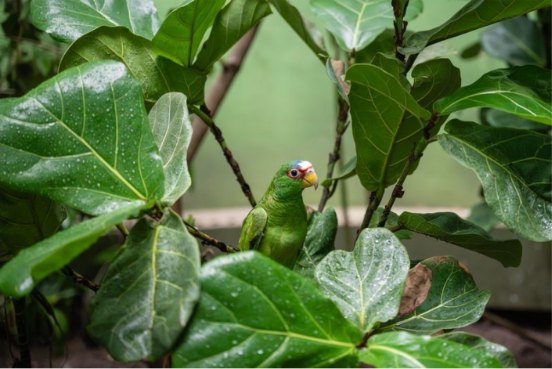
Dozens of parrots confiscated by the U.S. Fish and Wildlife Service at the U.S.-Mexico border have been examined, treated and placed by the Wildlife Conservation Society’s Bronx Zoo. Two species are involved: orange-fronted conures and white-fronted Amazons. All of the birds came through veterinary examination in good condition.
This is not a one-off. Since 2022 the Bronx Zoo has assisted the agency with nine separate parrot confiscations, involving dozens of birds across seven species, some of them classified as Endangered.
What a zoo actually does with a confiscated bird
A seizure at a border crossing creates an immediate problem that law enforcement is not equipped to solve. The birds are evidence, they are alive, they are frequently in poor condition, and they cannot simply be sent back.
What the zoo supplies is the part in the middle: quarantine space, veterinary assessment, treatment where it is needed, and then the search for somewhere each bird can live out its life. Animals that cannot be returned to the wild need a permanent, professionally staffed home, and finding dozens of those at once is its own logistical exercise.
“These animals were stolen from the wild and are victims of the illegal wildlife pet trade, and our responsibility is to give them the best possible chance for a healthy future,” said Chuck Cerbini, WCS Bronx Zoo Curator of Ornithology.
The orange-fronted conures arrived through three separate confiscations over 17 months. They have since passed their examinations and moved on to another institution accredited by the Association of Zoos and Aquariums. The white-fronted Amazons, more than a dozen of them, came in over the last several months; some are now in the Bronx Zoo’s World of Birds and the rest are at WCS’s Central Park Zoo.
Is the orange-fronted conure actually threatened?
Yes, and the name is worth untangling first. Aviculture calls this bird the orange-fronted conure. The IUCN Red List calls it the orange-fronted parakeet. Same animal, Eupsittula canicularis, and the second name is the one you need to look it up.
The assessment, dated August 17, 2020, lists it as Vulnerable with a decreasing population trend. The estimate of mature individuals is enormous and enormously wide, somewhere between 500,000 and roughly 5 million, which looks like an odd basis for a threat category until you see the criteria the assessment used. The listing turns on rate of decline, not on scarcity. This is a bird that was once among the most abundant parrots in Central America and has disappeared outright from parts of its former range on the Pacific slope from western Mexico to Costa Rica.
Trapping for the pet trade is a principal reason. That is the thread that connects an assessment document to a crate at a border crossing: the birds in the Bronx are a sample of the mechanism the Red List is measuring.
White-fronted Amazons are the smaller story conservation-wise and the more charming one ornithologically. They are the smallest of the Amazon parrots, they range from Mexico through Central America into northwestern Costa Rica, and they are one of the few parrot species in which males and females look visibly different. They are listed on Appendix II of the Convention on International Trade in Endangered Species, as are the conures, which is the legal instrument the confiscations rest on.
The same work, repeatedly
Confiscation cases are a recurring part of the Bronx Zoo’s year rather than an occasional emergency. The zoo has previously taken in trafficked keel-billed toucans and a group of confiscated box turtles, through the same partnership with the same agency.
It is unglamorous, and it is one of the clearest answers available to the question of what an accredited zoo is for. A government agency intercepts smuggled animals; somebody has to have the quarantine barn, the avian vet and the Rolodex of accredited institutions willing to take fifteen parrots. Very few organizations have all three.
Some of the white-fronted Amazons are on exhibit in World of Birds now, which means a visitor can go and look at them. They are not labeled as evidence from a federal case, and there is no reason they should be. They are parrots, in a building full of parrots, having a considerably better year than the one they were having when they crossed the border.
Quick answers
- What happened?
The Wildlife Conservation Society's Bronx Zoo helped rescue dozens of parrots confiscated by the U.S. Fish and Wildlife Service at the US-Mexico border. Two species were involved: orange-fronted conures and white-fronted Amazons.
- How often does the Bronx Zoo do this?
Since 2022 it has assisted the U.S. Fish and Wildlife Service with nine parrot confiscations involving dozens of birds across seven species, some of them classified as Endangered.
- What does the zoo actually do for confiscated birds?
It assesses their health, provides veterinary treatment where it is needed, and helps find appropriate permanent homes for animals that cannot be returned to the wild.
- Where are the birds now?
The orange-fronted conures have gone to another zoo accredited by the Association of Zoos and Aquariums. Some white-fronted Amazons are in the Bronx Zoo's World of Birds and the rest are at the Central Park Zoo.
- Is the orange-fronted conure threatened?
Yes. The IUCN Red List assessment dated August 17, 2020 lists Eupsittula canicularis as Vulnerable with a decreasing trend. The Red List calls the species the orange-fronted parakeet.
- Why is a bird with millions of individuals listed as Vulnerable?
The listing turns on rate of decline rather than scarcity. The assessment gives a wide estimate of 500,000 to roughly 5 million mature individuals, and the species has disappeared from parts of its former range.
- What is a white-fronted Amazon?
The smallest of the Amazon parrots, native from Mexico through Central America into northwestern Costa Rica, and one of the few parrot species in which males and females look visibly different.
- What is CITES Appendix II?
A listing under the Convention on International Trade in Endangered Species that regulates international trade in a species. Both the conures and the white-fronted Amazons are listed on it.