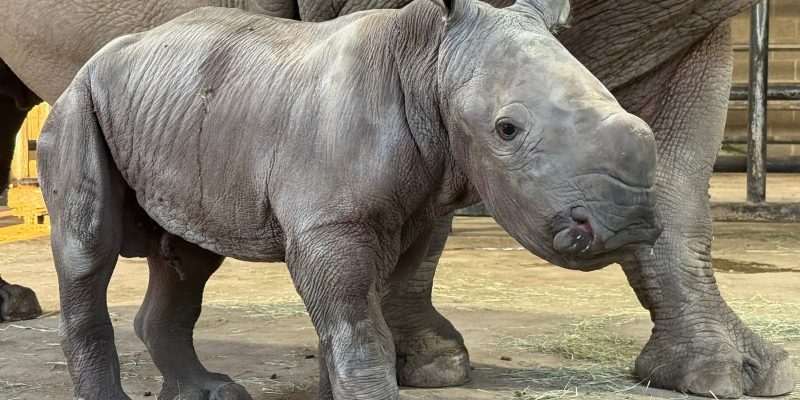
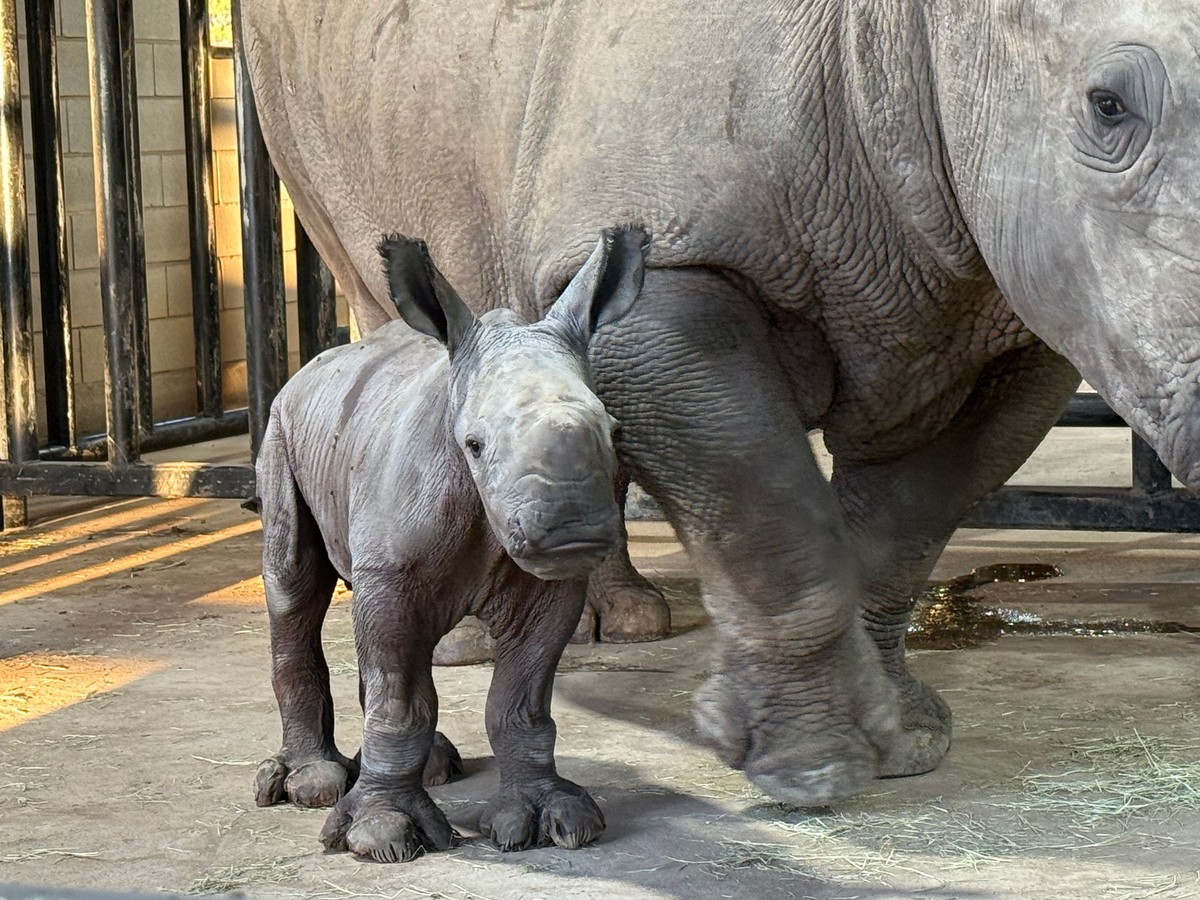
A male southern white rhinoceros calf has been born at Natural Bridge Wildlife Ranch in New Braunfels, Texas. He is called Conrad, he arrived on October 26 to a female named Helga and a bull named Kutu, and he is the fourth southern white rhino born at the ranch in three years.
He is also the second in under seven weeks. His half-sister Twuda, who shares the same father, was born on September 8 to a female named Gertie. For the first time the ranch has two rhino calves on the ground at once, and the pair have started to play together.
At birth Conrad weighed about 150 pounds and measured 26 inches tall and 30 inches long. A young white rhino can put on roughly 100 pounds a month through its first year, so none of those numbers will last.
Twenty years to the first calf, three years to the next three
The run reads differently once you know what came before it. Natural Bridge worked toward a southern white rhino birth for more than two decades before its first calf arrived in late 2023. We covered that calf and the twenty years behind it at the time.
Southern white rhinos are hard to breed consistently under human care. A pregnancy runs roughly 16 months and almost always produces a single calf, and females generally leave two to three years between births. The ranch puts the annual birth rate for adult females in zoological settings at about 8.6 to 10 percent, against something closer to 40 percent in some studied wild populations. Four calves in three years from one herd is not a routine result, and it follows twenty years in which the same program produced none.
“Every calf represents years of patient work and a commitment to the future of these animals,” said Tiffany Soechting, Animal Specialist at Natural Bridge Wildlife Ranch.
Why is it called a white rhino?
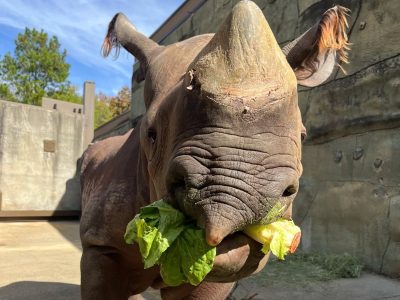
Not for its color. Both African rhino species are gray. The name is usually traced to the Afrikaans word wyd, meaning wide, which English speakers heard as “white,” and the wide part is the mouth. A white rhino carries a broad, square upper lip built to crop grass close to the ground, which makes it a grazer. The animal is also called the square-lipped rhinoceros, which is the more useful of the two names.
That is the opposite arrangement to the one in the Eastern black rhino who went on view at the Birmingham Zoo this week, whose pointed, prehensile upper lip grips leaves and twigs and makes him a browser. Same continent, same gray hide, two different mouths and two entirely different diets.
The numbers, and which number is which
The ranch cites the International Rhino Foundation’s estimate of about 15,752 white rhinos and dates it to 2024, down from 17,464 the year before. The foundation’s own species page puts that 15,752 figure at August 2025, attributes it to the IUCN Species Survival Commission’s African Rhino Specialist Group, and describes it as a further 9.8 percent decline. We follow the foundation’s dating. Either way the direction is the same, and poaching is the reason.
The IUCN Red List counts something else again. Its 2020 assessment of Ceratotherium simum ssp. simum lists the southern white rhinoceros as Near Threatened, with 10,080 mature individuals across 422 locations and a decreasing trend. Mature individuals and total population are different quantities, so the two figures are not in conflict and neither is wrong. The assessment is also six years old, which is worth knowing before leaning on it.
Near Threatened is a milder category than most people expect for a rhinoceros, and it is itself a conservation result: the southern white rhino came back from fewer than 100 animals in the early 1900s. South Africa holds the native population, five more countries hold reintroduced herds, and three others hold animals moved there deliberately.
Seeing both calves
The ranch runs a Rhino VIP Experience, a private guided safari across its 500 acres that ends with a close encounter at the rhino herd. It takes about two hours and is open to guests aged 3 and older. With Conrad and Twuda both on the ground, it is for now a rare chance to meet two rhino calves in one visit, and the ranch says Conrad’s mother appears happy to bring him over when VIP guests arrive.
Conrad is gaining about a hundred pounds a month, and Twuda has a seven week head start on him. The window in which either of them is small is not a long one.
Quick answers
- When was Conrad born?
October 26, 2026, at Natural Bridge Wildlife Ranch in New Braunfels, Texas, to a female named Helga and a bull named Kutu.
- How many rhino calves have been born at Natural Bridge Wildlife Ranch?
Four in three years. The first arrived in late 2023, after more than twenty years of work toward it, and Conrad is the fourth.
- Who is Twuda?
Conrad's half-sister, born September 8 to a female named Gertie. She and Conrad share a father, Kutu, and they are the first two calves the ranch has had on the ground at the same time.
- Why is it called a white rhino if it is gray?
The name is usually traced to the Afrikaans word wyd, meaning wide, which English speakers heard as white. The wide part is its square upper lip, which is built for cropping grass. The animal is also called the square-lipped rhinoceros.
- What is the difference between a white rhino and a black rhino?
The mouth. A white rhino has a broad square lip and grazes on grass. A black rhino has a pointed, prehensile upper lip that grips leaves and twigs, which makes it a browser. Both animals are gray.
- How endangered is the southern white rhinoceros?
The IUCN Red List's 2020 assessment lists Ceratotherium simum ssp. simum as Near Threatened, with 10,080 mature individuals across 422 locations and a decreasing trend. The International Rhino Foundation puts the total white rhino estimate at about 15,752 as of August 2025.
- How big is a newborn white rhino?
Conrad weighed about 150 pounds at birth and measured 26 inches tall and 30 inches long. A young white rhino can gain roughly 100 pounds a month through its first year.
- Can visitors meet the calves?
The ranch's Rhino VIP Experience is a private guided safari across its 500 acres that ends with a close encounter at the rhino herd. It takes about two hours and is open to guests aged 3 and older.