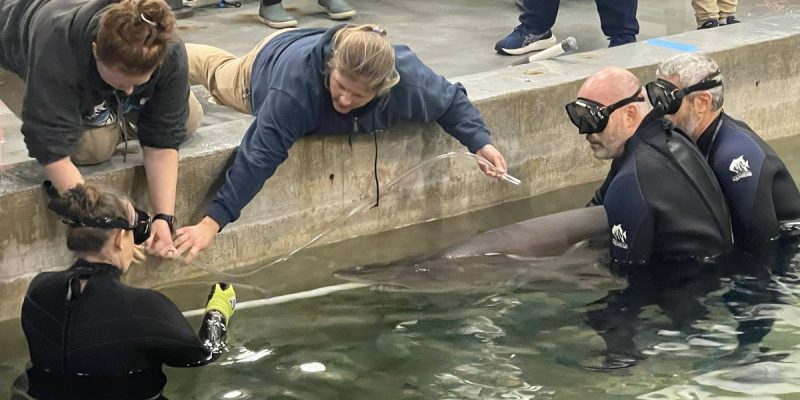
Moving a 282-pound shark out of a building takes a cargo net, a telehandler and a rehearsal. The North Carolina Aquariums needed all three, plus a mobile aquarium borrowed from Georgia, to move two sand tiger sharks out of the tank they had outgrown and into two larger ones a few hours up the coast.
The aquariums described the move on January 21, 2026. Two animals, four institutions, one day.
The route
Both sharks had spent almost a decade at the North Carolina Aquarium at Fort Fisher, in the 235,000-gallon Cape Fear Shoals habitat. The female weighed 282 pounds and the male 165.
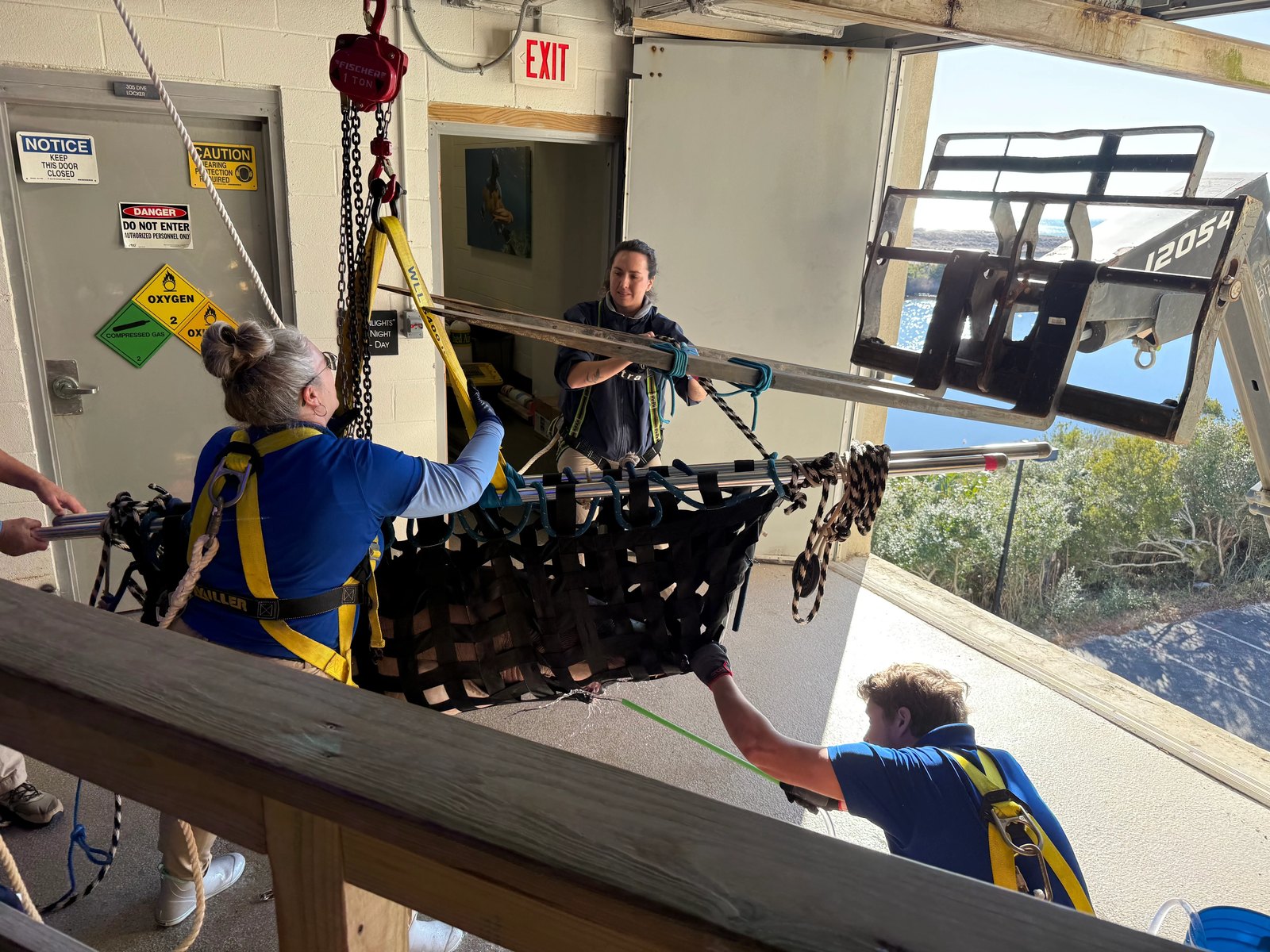
The day began at Fort Fisher. Each shark was secured in a purpose-built cargo net, the net was attached to a telehandler, and the telehandler carried it out to a flatbed truck. A telehandler is a hydraulic lifting machine with a extending boom, the kind of thing that normally moves pallets on a construction site, and it is in this story because a quarter-ton animal in a sling has to be lifted smoothly and set down in exactly one spot.
The flatbed carried a mobile aquarium supplied by the Georgia Aquarium, which sent a crew with it. First stop was the North Carolina Aquarium at Pine Knoll Shores, where the male went into the Living Shipwreck, a 306,000-gallon habitat. The Georgia team then drove north to the North Carolina Aquarium on Roanoke Island, where the female went into the 285,000-gallon Graveyard of the Atlantic.
The arithmetic is the point of the exercise. The two sharks left a 235,000-gallon tank they shared and arrived in habitats of 306,000 and 285,000 gallons, with one shark in each. Both animals are still growing.
Why it was rehearsed
The veterinary team was present at every stage, from the initial catch at Fort Fisher through both arrivals. The animal care and veterinary teams had run the process several times beforehand, for one reason: every step had to fit inside a short window so the sharks spent as little time out of the water as possible.
“The transport of these two special sharks was amazing to watch,” said Joanna Zazzali, the Fort Fisher aquarium’s director. “We are grateful for the excellent preparation and planning from everyone on the team to execute the transport as flawlessly as possible and especially appreciate the assist from our friends at the Georgia Aquarium.”
What a sand tiger is and why these aquariums keep them
The sand tiger shark is the one most people picture when they picture a shark in an aquarium: heavy-bodied, slow-moving, with a mouth that does not fully close over a set of needle teeth. Off North Carolina they gather around the shipwrecks that litter the coast, which is why divers travel to the state to see them and why all three North Carolina aquariums put the species in a signature habitat.
The aquariums also work on the species in the water. Spot A Shark USA is a community science program that has recreational divers photograph sand tigers along the Atlantic coast, using the spot patterns on each animal’s flank as a fingerprint to identify individuals over time. The aquariums take part in AZA SAFE: Shark and Ray, the Association of Zoos and Aquariums program for sharks, skates and rays.
The listing, checked
The announcement says the IUCN listed the sand tiger shark as Critically Endangered in 2021. That is correct, and it is worth adding where the number sits now. The current global assessment of Carcharias taurus lists it as Critically Endangered under criteria A2bd with a decreasing population. The assessment was made on December 7, 2020, published in 2021, and carried forward in an amended version published in 2025, so the 2021 figure the aquariums quote is still the live one.
One number in that assessment explains the category better than the category does. The Red List puts the sand tiger’s generation length at 24.8 years. A population of animals that take roughly a quarter of a century to turn over cannot replace losses quickly, which is why a species that is not rare to look at can still be in serious trouble, and why the ones in tanks in North Carolina are worth the trouble of a cargo net.
If this sounds familiar, it is a pattern. The Two Oceans Aquarium in Cape Town released four spotted gully sharks that had outgrown their exhibit in October, wearing acoustic tags. The North Carolina aquariums also work with universities on raising marine fish from larvae so fewer come off the reef.
The male is in the Living Shipwreck at Pine Knoll Shores. The female is gliding through the Graveyard of the Atlantic on Roanoke Island. Both are visible from the public side of the glass, which is the whole point of having moved them.
Quick answers
- Which aquariums moved the sand tiger sharks?
Four. The move began at the North Carolina Aquarium at Fort Fisher, the male went to the North Carolina Aquarium at Pine Knoll Shores and the female to the North Carolina Aquarium on Roanoke Island. The Georgia Aquarium supplied the mobile aquarium and sent a crew.
- How were the sharks actually moved?
Each shark was secured in a purpose-built cargo net, lifted by a telehandler, a hydraulic machine with an extending boom, and carried to a flatbed truck holding a mobile aquarium. Veterinary and animal care teams rehearsed the sequence repeatedly to keep each animal's time out of water short, and the veterinary team was present at every stage.
- How big are the sharks and the habitats?
The female weighed 282 pounds and the male 165. They had shared the 235,000-gallon Cape Fear Shoals habitat at Fort Fisher for almost a decade. The male now has the 306,000-gallon Living Shipwreck and the female the 285,000-gallon Graveyard of the Atlantic.
- Why move them at all?
Both animals are still growing and the new habitats are larger, so each shark has more room than the two of them shared before.
- Is the sand tiger shark endangered?
The IUCN Red List lists Carcharias taurus as Critically Endangered under criteria A2bd with a decreasing population. The assessment was made on December 7, 2020, published in 2021 and carried forward in an amended version published in 2025.
- What is Spot A Shark USA?
A community science program in which recreational divers photograph sand tiger sharks along the Atlantic coast. The spot pattern on each shark's flank works like a fingerprint, so individuals can be identified and followed over time.