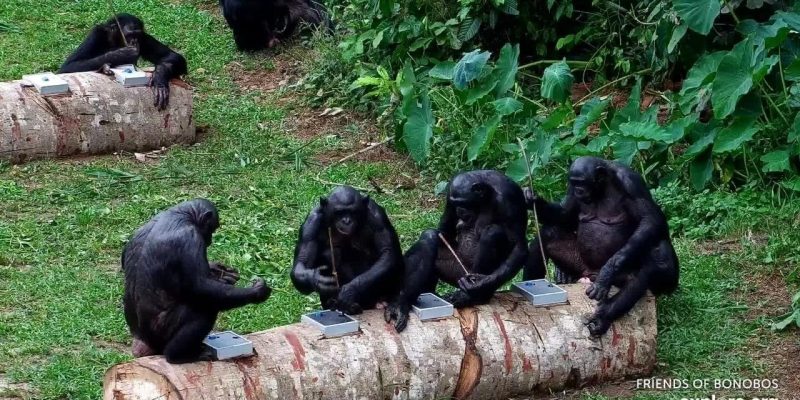
At Lola ya Bonobo, the world’s only bonobo sanctuary, a team of researchers has spent this year watching to see which bonobos learn a new skill by working it out alone and which learn it by watching somebody else. The test is a hollowed log fitted with locking puzzles, and the reward inside is peanut butter.
The study is being run at the sanctuary outside Kinshasa, in the Democratic Republic of Congo, by researchers from Utrecht University and the Max Planck Institute for Evolutionary Anthropology. Friends of Bonobos, the sanctuary’s United States arm, published an account of the work on October 21, 2026, built around an interview with the researcher leading it.
What is actually on the log
Earlier work at Lola ya Bonobo had already shown that bonobos can learn to use a stick to reach food pushed into a hole, in the way wild chimpanzees fish for termites or extract honey. The new puzzles put a lock in front of that.
In the first phase the bonobos get two logs at once, each carrying four identical puzzles. One log requires them to slide a knob sideways and hold it there while they insert the stick. The other requires them to rotate a knob, hold it open, and then use the stick. In the second phase the two steps are combined: slide one knob, rotate a second, then reach in. The food inside is locally made peanut butter mixed with a little sunflower oil.
The sequence is fixed but the technique is not. Some bonobos hold the locking mechanism open with one hand. Others open the knob with a hand and then hold it with a foot.
One bonobo picked up a branch
Not every solution was the one the equipment was designed for. After repeatedly failing to open a puzzle box, one female picked up a large branch and smashed it open.
It was not the designed answer. It worked, and she got the peanut butter.
What the researchers are trying to find out
The question underneath the puzzle logs is whether a behavior that one individual discovers can travel through a group and become something the group shares. The word the team uses for the mechanism is peering, which is the close, sustained watching of another animal at work, and the reason it matters here is that peering is the thing you can count. If the bonobos who solve a puzzle are disproportionately the ones who watched a skilled animal solve it first, that is social learning rather than parallel invention.
Lou Savigny, the PhD student leading the work, set out the questions directly.
“Do bonobos acquire these new behaviors predominantly through individual exploration, or social learning? If social learning occurs, what are the pathways involved? Which individuals are most likely to learn from whom? Do bonobos preferentially observe close social partners, high-ranking individuals, or skilled individuals? As tasks become more challenging, do bonobos rely more on social information?”
Savigny also wants to know whether the earlier stick work helps. Some younger bonobos had not yet joined their social groups when the first tree log study ran and others had. The combined puzzles appear harder for the animals without that background, which is itself a result worth having.
What has happened so far
In one of the study groups the sliding puzzle was solved on the first day of testing and the rotating puzzle on the third. More individuals have picked up both techniques since.
More of them have been female. The team is careful about what that does and does not mean: it says it does not yet know whether the pattern reflects differences in learning, differences in who can get to the logs under the bonobo social system, or simply the sex ratios of the groups. Those are questions for the formal analysis, once the study is finished.
The moment Savigny picks out is one the team will not draw a conclusion from. A female had struggled with the rotating puzzle for several days. One morning she spent a long time closely watching the animals who could already do it, and later the same day she solved it herself for the first time.
“Whether this event reflects social learning is exactly what our analyses aim to determine, so we cannot draw conclusions from a single observation. Nevertheless, it was a fascinating moment to witness.”
Why a sanctuary is running a cognition study at all
The conservation argument is that what you are protecting when you protect an endangered species is not only a number of animals. Socially learned behaviors, and the local traditions built out of them, are increasingly treated as part of a species’ repertoire and part of what is lost when a population goes. Cultural transmission also moves faster than genetic evolution, which means a learned behavior can let a population respond to a changing environment on a timescale that natural selection cannot.
The definition the team works from comes from a 2021 paper in Proceedings of the Royal Society B by Philippa Brakes and colleagues, which treats animal culture as the sum of behaviors and knowledge acquired and passed on within and between generations through social learning, and argues that conservation should take it into account. Savigny’s hope is that understanding how these behaviors arise at Lola will help identify cultures in wild bonobo populations.
The work is being carried out by Savigny alongside masters student Lola Lemaire and research assistant Zoe Danis. The puzzles themselves were built by Sebastian Schutte, a research technician at the Max Planck Institute for Evolutionary Anthropology. The project is supervised by Dr Edwin van Leeuwen of the Animal Behavior and Cognition group at Utrecht University, as part of a wider effort looking at culture across several primate species.
Which zoos pay for this
No zoo or aquarium is named as a funder of the study itself. It runs through two European universities and a Max Planck institute, and the account of it names no zoological institution among its backers.
The sanctuary around it is a different matter, and the researchers say so themselves. Their closing note thanks “all the staff at Lola ya Bonobo, without whom the installation of the logs and the observations we carried out would not have been possible.” Those staff are paid for, in part, by accredited zoos.
The Columbus Zoo and Aquarium has given more than 500,000 dollars to Lola ya Bonobo since 2000, and in March 2023 announced a three-year operations grant covering veterinary medicine, bonobo food, cleaning supplies, staff costs and preparing bonobos for release at the sanctuary’s Ekolo ya Bonobo site. The zoo listed the sources of that money, and admissions and memberships are among them. Twycross Zoo in the United Kingdom says it has helped with the sanctuary’s daily running since 2007 through its Conservation Welfare fund. Jacksonville Zoo and Gardens lists Lola ya Bonobo as a conservation project without giving figures.
One honest caveat travels with all of that. Friends of Bonobos names no institutional funders on its own pages, so the chain is documented from the zoos’ side rather than the recipient’s. That is common, and it is worth saying out loud, because it means the public picture of who pays for conservation is assembled from whoever chooses to publish.
For the specific question of who paid for the puzzle logs, the answer is a research budget. For the question of who pays for the sanctuary those logs were installed in, and the keepers who installed them, the answer includes two accredited zoos that have been doing it for years.
The full account of the study, including the researchers’ own video of the bonobos working the logs, is on the Friends of Bonobos site.
Quick answers
- What is the bonobo puzzle log study?
A study at Lola ya Bonobo in the Democratic Republic of Congo testing whether a new behavior discovered by one bonobo spreads through its group by social learning. The bonobos are given hollowed logs fitted with locking puzzles that must be opened before a stick can be used to reach peanut butter inside.
- What is peering in bonobos?
Close, sustained watching of another animal while it works at something. It is the behavior the researchers can count, and it is how they expect to tell social learning apart from several animals inventing the same solution separately.
- How hard are the puzzles?
In the first phase one log requires sliding a knob sideways and holding it while inserting a stick, and a second log requires rotating a knob, holding it open, then using the stick. In the second phase the two steps are combined: slide one knob, rotate another, then reach in.
- Did any bonobo solve a puzzle a different way?
Yes. After repeatedly failing to open a puzzle box, one female picked up a large branch and smashed it open. It was not the solution the equipment was designed for and it worked.
- Who is running the research?
PhD student Lou Savigny, with masters student Lola Lemaire and research assistant Zoe Danis. The puzzles were built by Sebastian Schutte of the Max Planck Institute for Evolutionary Anthropology, and the project is supervised by Dr Edwin van Leeuwen of the Animal Behaviour and Cognition group at Utrecht University.
- What has the study found so far?
In one study group the sliding puzzle was solved on the first day of testing and the rotating puzzle on the third, and more individuals have acquired both techniques since. More of them have been female, and the team says it does not yet know whether that reflects learning, access to the logs under the bonobo social system, or group sex ratios.
- Which zoos fund Lola ya Bonobo?
No zoo is named as a funder of this study, which runs through Utrecht University and the Max Planck Institute. The sanctuary around it is funded in part by accredited zoos: Columbus Zoo and Aquarium has given more than 500,000 dollars since 2000, including a three-year operations grant covering staff costs, and Twycross Zoo says it has helped with the sanctuary’s daily running since 2007.