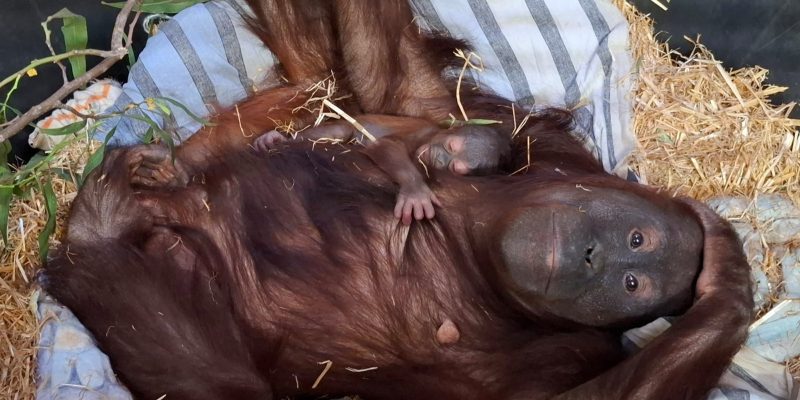
The Tisch Family Zoological Gardens, which almost everybody calls the Jerusalem Biblical Zoo, has orangutans on exhibit and has had for years. Until April 2026 it had never had one born there. It does now, and the zoo has given him an Indonesian name: Cahaya, which it glosses as “light.”
The zoo’s own announcement is short and it is written for visitors rather than for the record, so it is worth setting out what is in it and what had to be found elsewhere. It says the infant was born in April, that he is to be looked for in the arms of his mother Suga in the orangutan exhibit, that orangutans are critically endangered in the wild, that the zoo is a partner in the breeding program run by the European Association of Zoos and Aquaria, and that there is a special activity at the orangutan exhibit every day at 2 p.m.
Which orangutan is this?
The announcement does not say, which matters, because there are three orangutan species and they are not interchangeable. The zoo’s own species page settles it: Pongo pygmaeus, the Bornean orangutan, described there as living in the tropical rainforests of Borneo and listed on the same page as critically endangered.
That page is also where the zoo puts the detail its news post leaves out. An orangutan infant is born at an average weight of about 1.5 kilograms. The mother carries and raises it until it is around seven years old. Fruit makes up about 60 percent of the adult diet, which is why orangutans end up dispersing seeds and regenerating the forest they live in. The zoo gives a lifespan of up to 35 years in the wild and up to 50 in zoos.
Who are the parents?
Suga, the mother, was 13 at the time of the birth and was born in a Swedish zoo. She arrived in Jerusalem through the European breeding program, which is the mechanism by which a Swedish-born female comes to have her first infant in Israel: the association matches animals across its member collections on genetics and age rather than leaving each zoo to breed from whatever it happens to hold.
Paternity was not settled at the time of the birth. The zoo’s post names no father. Israeli coverage in late April reported that keepers suspected Ito, the older of the zoo’s two adult males, rather than Kesato, the younger, and we are not going to print an age for either when the two reports we have disagree on Ito’s. A third female, Sinta, has not given birth.
Cahaya is male. The zoo’s Hebrew post uses masculine forms throughout and the Times of Israel reported the same at the end of April, after an earlier account had said the sex was not yet known. That paper spells the mother’s name Soga; we have used the transliteration of the zoo’s own Hebrew, Suga.
Is he still all right?
As far as anything published can tell us, yes. We checked, because a birth announcement from six months ago is exactly the kind of story that can go stale quietly. Nothing has been published about Cahaya since the April coverage, by the zoo or by anyone else, and the zoo’s own page as of today still presents him as an animal to come and see, with the daily 2 p.m. activity at the orangutan exhibit still advertised. That is the facility’s own current statement about its own animal, which is the strongest thing available short of asking.
Why had it never happened here before?
Because a zoo can hold orangutans for decades and never see one born. They breed slowly even by great ape standards, and the reason is in the zoo’s own species page: a female carries and raises a single infant until it is about seven years old. A species with that spacing produces very few opportunities, and a European program that moves animals between collections to pair them sensibly is the main reason any of those opportunities arrive at all.
The zoo’s claim that every infant born to the species is hope for its conservation is the sort of line that goes into every birth release everywhere, and it is worth being precise about it. No Bornean orangutan born in a European zoo is going to Borneo. What the breeding program maintains is a genetically managed population held outside the species’ range, and Lior Luzon, who heads the zoo’s carnivore department and is also responsible for its orangutans, told the Times of Israel in April that orangutans from the European program could eventually be reintroduced to help replenish wild populations. That is an expectation rather than a plan with a date on it, and we are reporting it as his.
This is the second story we have run from this zoo. The first, on nine Persian fallow deer it released into the Judean Hills, is the other half of what a zoo like this does: a species it breeds for release, and a species it does not.
The announcement is on the zoo’s own news page, in Hebrew. Facts and paraphrase here are translated from that page; no direct quotation from it has been used.
Quick answers
- What is the name of the Jerusalem Biblical Zoo’s first orangutan?
Cahaya, which the zoo glosses as meaning “light” in Indonesian. He was born in April 2026 and is the first orangutan ever born at the Tisch Family Zoological Gardens in Jerusalem.
- Which species of orangutan is he?
A Bornean orangutan, Pongo pygmaeus. The zoo’s news post does not name a species; its own species page does, and lists the Bornean orangutan as critically endangered and native to the tropical rainforests of Borneo.
- Who are his parents?
His mother is Suga, who was 13 at the time of the birth and was born in a Swedish zoo. Paternity was not settled at the time: Israeli coverage in April reported that keepers suspected Ito, the older of the zoo’s two adult males, rather than Kesato, the younger. The zoo’s own post names no father.
- How did a Swedish-born orangutan come to give birth in Israel?
Through the breeding program run by the European Association of Zoos and Aquaria, which matches animals across member collections on genetics and age and moves them between zoos accordingly. The Jerusalem Biblical Zoo says on its own announcement that it is a partner in that program.
- Why had the zoo never had an orangutan born before?
Orangutans breed slowly. The zoo’s own species page says a female carries and raises a single infant until it is about seven years old, which leaves very few opportunities in a collection of this size.
- Can visitors see him?
The zoo says to look for him in his mother’s arms in the orangutan exhibit, and advertises a special activity there every day at 2 p.m.
- Will orangutans born in European zoos be released into the wild?
Not at present. The program maintains a genetically managed population held outside the species’ range. Lior Luzon, who heads the zoo’s carnivore department and is also responsible for its orangutans, told the Times of Israel in April that animals from the program could eventually be reintroduced to help replenish wild populations, which is an expectation rather than a dated plan.