When several elephants rumble at the same time, the overlapping sound is not just a pile of separate messages. It carries information of its own about what the group is doing. That is the finding of a study published in Scientific Reports on 1 October 2026, built on recordings of individually known wild African elephants in Amboseli National Park, Kenya, and its funding statement names an American zoo.
The study was funded by grants to Joyce Poole and Petter Granli from the National Geographic Society, The Elephant Sanctuary in Tennessee, the Oakland Zoo, the David J. Reuben Revocable Trust, and the Crystal Springs, Aall and Marshal Frankel foundations, plus anonymous donors. Oakland Zoo is the accredited zoological institution in that list, and it is there in the paper’s own words rather than in anyone’s summary of them.
What did the researchers actually do?
Louis Mahon, Michael A. Pardo, Marius Miron, Emmanuel Chemla, Petter Granli, Norah Njiraini, Cynthia Moss, Sara C. Keen and Joyce Poole worked from an archive almost nobody else could assemble. The Amboseli Elephant Research Project has monitored the same population continuously since 1972, and every animal in it can be identified individually by the shape of its ears. The recordings used here were made from a vehicle in 1986 to 1990, 1998 to 2009, 2020 and 2022.
That span matters because the population changed underneath it. The paper puts Amboseli at roughly 600 elephants in about 28 families in the 1990s and roughly 2,000 in 60 families by 2020.
Most elephant acoustics research has looked at single, non-overlapping calls, because they are the easy ones to isolate and measure. The paper’s own estimate is that around 60 percent of rumbles happen in choruses, with two or more voices on top of each other. So the easy half of the problem has had most of the attention, and the common case has had less.
What is a rumble, and why can we not hear all of it?
A rumble is a low-frequency call produced by vibration of the vocal folds. Parts of some rumbles sit below about 20 hertz, which is roughly the bottom of human hearing, so a person standing next to a calling elephant hears some of the call and not the rest of it. Low frequencies carry well through vegetation and over distance, which is exactly what an African elephant needs when it lives in a large social network and cannot see most of it.
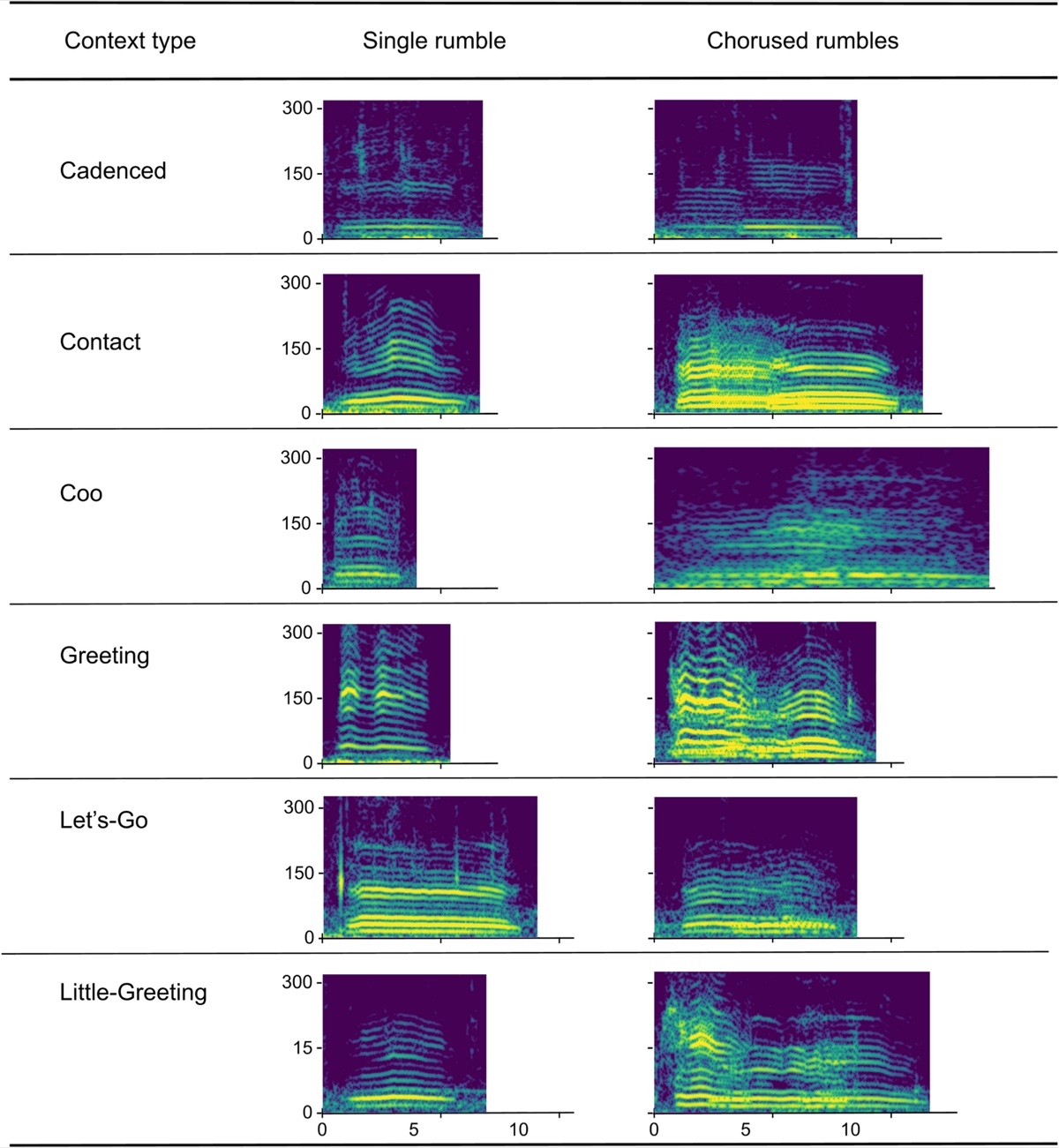
The researchers sorted their recordings into six behavioral contexts, each with a name the Amboseli project has used for decades: Cadenced, Contact, Coo, Greeting, Let’s-Go and Little-Greeting. Then they asked whether a classifier could tell those contexts apart from the sound alone.
Could a computer tell a greeting from a contact call?
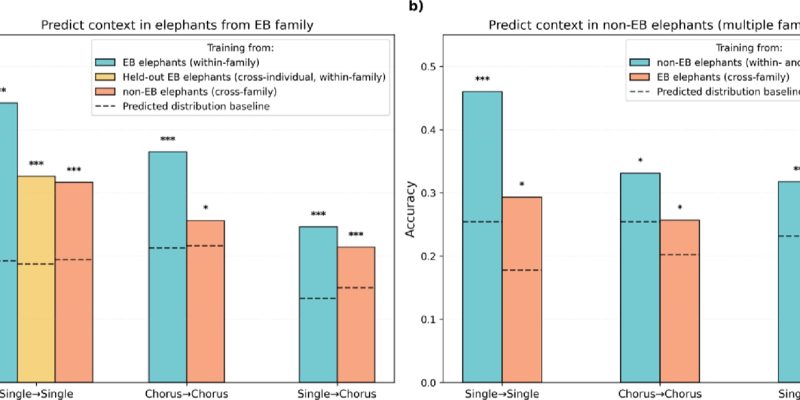
Better than chance, and not much better than that. Within the EB family, the one the team recorded intensively in 1999 and 2000 and which runs to 28 individuals, single rumbles were classified with weighted average precision of 0.47 and recall of 0.44, against a predicted-distribution baseline of 0.19. Choruses came in lower, at 0.37 precision and 0.36 recall against a baseline of 0.21. Across the other 39 families the numbers were 0.45 and 0.46 for single calls, 0.31 and 0.33 for choruses.
Those are real results and they are modest ones, and the paper says so. Coo, Let’s-Go and Little-Greeting were frequently confused with one another. Contact rumbles were the hardest to mistake for anything else when heard singly, and among choruses Contact and Greeting were the pair that tripped the classifier most often.
The honest reading is the one the authors give: elephant choruses contain measurable acoustic patterns tied to social context. It does not follow that anybody can now listen to a recording and say what the elephants meant.
What is acoustic convergence?
It is what happens when animals in an interaction adjust their calls so that they become more alike in particular acoustic features. It has been described in dolphins, parrots, songbirds and primates, and it has been linked variously to social bonding, to territorial behavior and to coordination.
The Amboseli team found evidence of it in three of their six contexts: greetings, contact rumbles and cadenced rumbles, the last of these being the exchange associated with coordinating what the group does next. They also found that an individual rumble produced in a given context shares structural features with the chorused rumbles produced in that same context, which is what led them to describe a chorus as context-matched individual parts adding up to a distinct multi-caller signal.
The analysis code and the acoustic features are published, which is the part that lets somebody else check this.
Which zoo is behind this work?
Oakland Zoo, by name, in the paper’s funding statement and again in its acknowledgements. We looked for others and did not find any: no other accredited zoo or aquarium appears anywhere in the funding line, and The Elephant Sanctuary in Tennessee, which does appear, is a sanctuary rather than a zoological institution. The Earth Species Project, whose donors are also acknowledged, supplied the machine-learning side of the analysis and is not a zoo either.
That is a short list, and it is worth saying plainly what it means. Recordings gathered across thirty-six years, from one of the best-studied elephant populations on earth, were analyzed with, among other money, a grant from a zoo in Oakland, California. Readers who want more of this kind of work in Kenya now know one of the places it comes from.
For the other end of the same beat, our report on what Mount Elgon’s elephants eat when they are sick covers a different Kenyan elephant paper published in the same journal a week earlier, and is built on human expert testimony rather than on recordings.
The paper is open access. It is Mahon, L., Pardo, M. A., Miron, M., Chemla, E., Granli, P., Njiraini, N., Moss, C., Keen, S. C. and Poole, J., “Social context information and acoustic convergence in elephant vocal choruses,” Scientific Reports 16, 27961 (2026).
Quick answers
- What did the elephant chorus study find?
That when several elephants rumble at once, the overlapping call carries information about the social context it was produced in, not just a pile of separate individual messages. A classifier could predict the behavioral context of a chorus from its acoustic structure better than chance, and in three contexts the individual rumbles within a chorus became more acoustically similar to each other as the exchange went on.
- What is an elephant rumble?
A low-frequency call produced by vibration of the vocal folds. Parts of some rumbles fall below about 20 hertz, roughly the bottom of human hearing, so a person next to a calling elephant hears some of the call and not the rest of it. Low frequencies travel well through vegetation and over distance.
- How often do elephants rumble together?
The paper puts it at around 60 percent of rumbles, meaning most elephant calling happens in choruses of two or more overlapping voices. Research has concentrated on the other 40 percent because single calls are easier to isolate and measure.
- Where did the recordings come from?
Amboseli National Park in Kenya, from a vehicle, in 1986 to 1990, 1998 to 2009, 2020 and 2022. The Amboseli Elephant Research Project has monitored the same population continuously since 1972 and every animal in it can be identified individually by the shape of its ears.
- What is acoustic convergence?
When animals in an interaction adjust their calls so they become more alike in particular acoustic features. It has been described in dolphins, parrots, songbirds and primates. The Amboseli team found evidence of it in greetings, contact rumbles and cadenced rumbles, three of the six contexts examined.
- Can scientists now tell what elephants are saying?
No, and the authors are explicit about it. Classification was better than chance but modest, with weighted average precision between 0.31 and 0.47 depending on the test, and several context types were frequently confused with one another. The finding is that choruses contain measurable patterns tied to context, not that a recording can be read as a sentence.
- Which zoo funded this research?
Oakland Zoo, named in the paper’s own funding statement and again in its acknowledgements, alongside the National Geographic Society, The Elephant Sanctuary in Tennessee, the David J. Reuben Revocable Trust and three private foundations. No other accredited zoo or aquarium appears anywhere in the funding line.