Ask twelve villages around the Serengeti whether there is less bushmeat around than there was in 2018, and they agree. Ask them why, and they split cleanly in two. Villages inside a conservation benefit program credit education and the things conservation has given them. Villages outside one credit rangers and the fear of being caught.
The mechanism that resolves the apparent paradox is in the method, not in the villages: the study measured what people believe caused a change, not how much hunting actually fell. Two communities can arrive at the same place and tell different stories about the road, and both can be telling the truth about their own road.
That is the finding Tsavo Trust picked up this week, from a different ecosystem in a different country, because the question underneath it is the question the Trust spends its budget on.
What the study did
The paper is “Divergent narratives: community perceptions of illegal bushmeat hunting dynamics in the Serengeti-Mara ecosystem,” published in Frontiers in Conservation Science on October 2, 2026 by Mariam R. Michael and Richard A. Giliba of the Nelson Mandela African Institution of Science and Technology, George G. Lohay of the same institution and the Grumeti Fund, and Katharine E. T. Thompson of Pennsylvania State University and Stony Brook University.
The fieldwork ran from late January to early July 2025 on the Tanzanian side of the ecosystem, across twelve villages in the Bunda, Serengeti and Tarime districts. Six of those villages receive direct benefits from conservation outreach programs and six do not. The team surveyed 360 households, split evenly between the two groups, ran twelve focus groups of eight people each, and interviewed 24 key informants. Respondents were asked how illegal bushmeat hunting had changed between 2018 and 2024.
Both groups said bushmeat had become less available. The difference between them on that point was not statistically significant.
The differences in explanation were, and they were large. Attributing the change to protection and enforcement, to conservation education, and to tangible benefits and livelihood alternatives all separated the two groups at p below 0.001. Non-beneficiary households reached mostly for enforcement and the fear of punishment. Beneficiary households reached for enforcement as well, and added education and the benefits they could see.
One more difference is worth the space. Beneficiary respondents named a wider range of animals: an average of 3.03 distinct species associated with bushmeat hunting against 2.29 among non-beneficiaries. The five named most often across all 360 households were wildebeest, at 78.3 percent of respondents, zebra at 51.7, impala at 43.3, African buffalo at 31.9 and topi at 14.7. The authors are careful that these are proportions of people who mentioned a species, not counts of animals killed.
That list is the shape of the problem. The wildebeest and the zebra are the migration, which is to say they are the reason the ecosystem has a name, and they are also the two animals nearly every household associates with illegal hunting. The paper groups the reported species by Red List category: elephant, rhino and giraffe as threatened, buffalo, hippopotamus and eland as near threatened, and wildebeest, zebra, impala, topi, warthog, hare, dik-dik and duiker as least concern. Ninety percent of respondents named at least one least-concern species; 8.9 percent named a threatened one. Bushmeat hunting here is overwhelmingly about abundant animals, not about rhino horn.
What the study does not say
It does not say community programs reduce hunting more than enforcement does. The authors say so directly, and Tsavo Trust repeats it rather than trimming it: the research did not establish that conservation programs caused a greater reduction, and it found no significant difference between the two groups in reported change in bushmeat availability.
It also rests on recollection. People were asked to remember six years, and perceived availability is not measured offtake. A study of what communities believe is a study of what communities believe, and its value is that nobody usually measures that at all.
Why a Kenyan trust is reading a Tanzanian paper
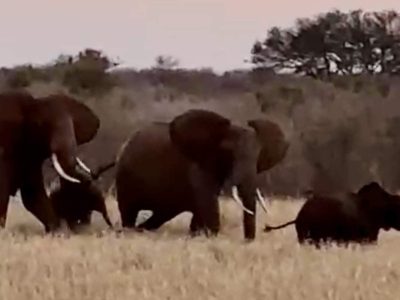
Because Tsavo Trust runs both halves of the thing being compared. Anti-poaching patrols, aerial surveillance and joint operations with the Kenya Wildlife Service address the immediate threat, and its Big Tusker Project monitors the African elephants carrying the largest tusks left in the ecosystem. The Kamungi Conservancy partnership addresses employment, education, healthcare, livelihoods and the costs of living next to wildlife. The Trust can count what each arm does. What it cannot count, and says so, is how either changes what a person decides.
Its own framing is the sharper version of the paper’s: the long-term goal is not a landscape where illegal hunting carries consequences, but one where protecting wildlife is supported by the people who share it. Enforcement is still necessary in that sentence. It is just not sufficient, and the Trust does not pretend otherwise.
Which zoo pays for this
One does, and this time the money lands on the subject.
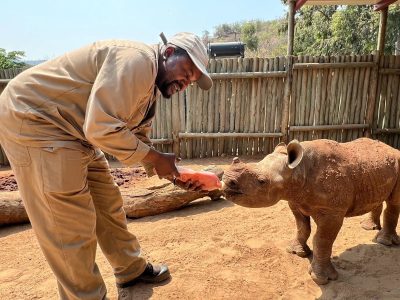
Cheyenne Mountain Zoo in Colorado Springs has partnered with Tsavo Trust since 2016 and announced in October 2024 that it had passed a million dollars given to the organization, raised through its Quarters for Conservation program and through daily elephant and rhino feeding experiences. By the zoo’s own account that money bought protection for African elephants, including Tsavo’s super tuskers, and for eastern black rhinos, maintenance of anti-poaching aircraft and ground vehicles, an anti-poaching helicopter, an aircraft hangar, boreholes and sand dams, staff housing, and staff salaries, pilot hours and operating costs.
We have twice reported the limits of that trace. When the subject was the Trust’s six wild cat species, no zoo money was attached to it and we said so. When the subject was thirteen sand dams, the partners were the Kenya Wildlife Service and two water charities. Here the subject is the anti-poaching apparatus itself, which is the line item the zoo’s published account names first. On that narrow point the chain holds, and the hub on this story is earned rather than assumed.
The honest qualification stays attached: the Trust’s partners and supporters page carries about forty logos and more than half are published as unlabeled image files with no name in the markup. We identified the labeled ones and none is a zoological institution. We cannot rule out that one of the unlabeled ones is.
For scale on the sector, the Association of Zoos and Aquariums reports that in 2025 its 235 accredited and certified facilities spent approximately 372.4 million dollars on conservation across 139 countries. No published breakdown isolates the African share, so we will not print one.
Source: Tsavo Trust, “What really makes people stop poaching?”, published 16 October 2026. The underlying paper is Michael et al. 2026, doi:10.3389/fcosc.2026.1901135, read in full.
Quick answers
- What did the study actually find?
That communities around the Serengeti-Mara ecosystem broadly agree bushmeat has become less available between 2018 and 2024, and explain the change very differently depending on whether they receive benefits from conservation programs. Households outside a benefit program credited enforcement and fear of punishment. Households inside one credited enforcement plus conservation education and visible benefits.
- Does it show community programs work better than enforcement?
No, and the authors say so. The study did not establish that conservation programs caused a greater reduction in hunting, and found no statistically significant difference between the two groups in reported change in bushmeat availability. It is a study of perceptions, not of measured offtake.
- How big was the study?
360 households, split evenly between six beneficiary and six non-beneficiary villages in the Bunda, Serengeti and Tarime districts on the Tanzanian side of the ecosystem, plus twelve focus groups of eight people each and 24 key informant interviews. Fieldwork ran from late January to early July 2025.
- Which animals are hunted for bushmeat there?
The five species named most often by respondents were wildebeest, at 78.3 percent, zebra at 51.7, impala at 43.3, African buffalo at 31.9 and topi at 14.7. Ninety percent of respondents named at least one species the Red List treats as Least Concern; 8.9 percent named a threatened one.
- Who wrote it?
Mariam R. Michael, Richard A. Giliba and George G. Lohay of the Nelson Mandela African Institution of Science and Technology, with Lohay also at the Grumeti Fund, and Katharine E. T. Thompson of Pennsylvania State University and Stony Brook University. It was published in Frontiers in Conservation Science on 2 October 2026.
- What does Tsavo Trust do with this?
It runs both of the things the study compares. Anti-poaching patrols, aerial surveillance and joint operations with the Kenya Wildlife Service on one side, and the Kamungi Conservancy partnership covering employment, education, healthcare and livelihoods on the other. Its stated goal is a landscape where protecting wildlife is supported by the people who share it, not only one where hunting carries consequences.
- Which zoo funds Tsavo Trust?
Cheyenne Mountain Zoo in Colorado Springs, since 2016, passing a million dollars donated by its own October 2024 account. That money is attached to protection for African elephants and eastern black rhinos, anti-poaching aircraft and vehicles, a helicopter, a hangar, boreholes and sand dams, staff housing and operating costs. The anti-poaching apparatus described in this story is the first item on that list.