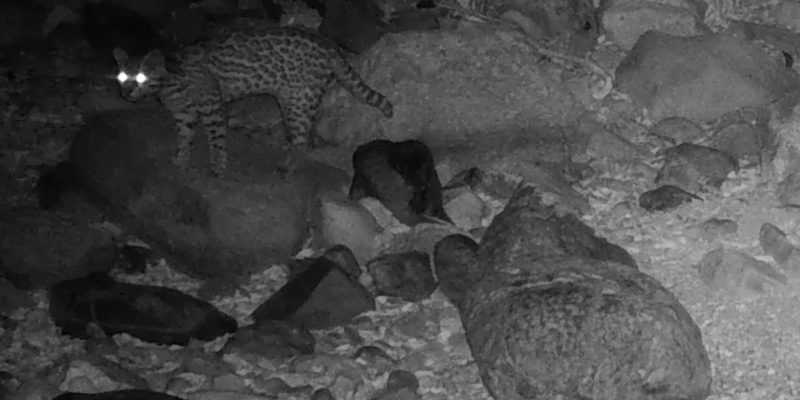
In June 2024, a field camera bolted to a tree in the Coronado National Forest recorded an ocelot walking through desert scrub in southern Arizona. A multi-agency review team compared the footage against every ocelot known to the state and concluded this was not one of them. It was the first confirmed ocelot in the Atascosa Highlands in at least 50 years.
The camera belonged to the Phoenix Zoo. Its Atascosa Complex Wildlife Study had been running cameras in the Nogales Ranger District since April that year under a research permit from the US Forest Service, and nobody checking them that summer was expecting this.
How do you prove an ocelot is a new ocelot?
You read its coat. The Arizona Game and Fish Department ran what its regional nongame specialist, Tracy McCarthey, called a pelage spot analysis: pelage is an animal’s coat, and on a spotted cat the arrangement of those spots is as individual as a fingerprint and stays that way for life. Line up the new footage against the archive and the pattern either matches a known animal or it does not.
“AZGFD has conducted a pelage spot analysis comparing this ocelot with the current known ocelot in the state, as well as previous ocelots and concludes that this is indeed a new ocelot,” McCarthey said.
That is why the claim can be made at all. Without the spot comparison, a camera record is an ocelot. With it, the record is this ocelot, never photographed before, which is a different and far more useful fact for anyone deciding which stretches of land matter.
Found on a routine battery run
Kinley Ragan, the zoo’s field research project manager, was in the study area in July with volunteer Ali Lofti, visiting 23 of the project’s 50 cameras to swap batteries and SD cards before the worst of the summer. Scanning footage on site is housekeeping, done to check that a camera is still aimed where it should be.
“This particular location required a 40 minute hike to the site as the temperature was reaching 95 degrees,” Ragan said. “The ocelot video was one of the last videos I reviewed and sent full chills through my body at the excitement and pride in what we had recorded. I was in disbelief at first, watching the video over and over again, but soon a big smile spread across my face as the full impact of this discovery for the important region set in.”
Why the Atascosa Highlands
The Atascosa Highlands take in the Atascosa, Tumacácori and Pajarito mountains, close to the Mexican border. They are a known wildlife corridor and, compared with other corridors in southeastern Arizona, barely studied.
The zoo’s field conservation research team, working with Arizona State University’s Dr. Jan Schipper, ran a pilot there in 2023 with 30 cameras. It recorded 21 species of mammals and no ocelots and no jaguars. The range and number of animals it did find were enough to justify expanding the study in 2024 with more cameras across more habitat types, which is the expansion that caught this cat.
Where it turned up matters as much as that it turned up. The animal was in desert scrub, at lower elevation than most historical ocelot records in Arizona. The only other ocelot recorded consistently in the state in the preceding year was in the Huachuca mountains, more than 50 miles away. Data from the University of Arizona’s Jaguar and Ocelot Monitoring Project supplied the context for placing the new record against the old ones.
Ocelots have been listed as endangered in the United States under the Endangered Species Act since 1972, and they turn up in Arizona only intermittently. They eat rabbits, rodents, lizards and birds, and they depend on dense forest and grassland for shelter and for moving across country without being seen. Habitat fragmentation and loss are the main threats, which is precisely the question a corridor study is built to answer.
“Finding evidence of a new ocelot in southern Arizona reinforces our commitment to collaborative efforts to conserve wildlife and their habitats in the region,” said Bert Castro, president and CEO of the Arizona Center for Nature Conservation and the Phoenix Zoo. “We’re eager to review additional camera data from this study to see what else we can learn about species of conservation concern in the borderlands and what they need for their continued survival.”
What the zoo did next
The cameras were due to come out in October 2024. Instead the team said it hoped to extend the study by another full year, to catch seasonal differences across two monsoons that differed sharply in volume and intensity. It also planned to collect environmental DNA from area waterways, which reads the genetic traces animals leave in water and fills in the mammals a camera never happens to face.
Findings go to the wildlife managers and researchers working out how animals actually use southern Arizona’s corridors. The zoo does this kind of work close to home as well as abroad, including a partnership with the City of Phoenix park rangers at Papago Park.
A single cat on a single night of video does not make a population. It does establish that an understudied range of mountains is carrying an endangered cat that nobody had documented there in half a century, and that is the kind of finding that decides where the next 50 cameras go.
Quick answers
- What did the Phoenix Zoo record?
A video of an ocelot in southern Arizona in June 2024, captured by a field camera in the Coronado National Forest’s Nogales Ranger District. A multi-agency review team concluded it was a cat not previously seen in the state, and the first confirmed ocelot in the Atascosa Highlands in at least 50 years.
- How can anyone tell one ocelot from another?
By its coat. The Arizona Game and Fish Department ran a pelage spot analysis: pelage is an animal’s coat, and on a spotted cat the arrangement of the spots is individual and stays that way for life. Regional nongame specialist Tracy McCarthey compared the footage against the state’s known and previous ocelots and concluded this was a new animal.
- Where are the Atascosa Highlands?
In southern Arizona near the Mexican border, taking in the Atascosa, Tumacácori and Pajarito mountains. They are a known wildlife corridor and are barely studied compared with other corridors in southeastern Arizona.
- Are ocelots protected in the United States?
They have been listed as endangered in the United States under the Endangered Species Act since 1972, and they are recorded in Arizona only intermittently.
- How big is the study?
Fifty field cameras, running since April 2024 under a US Forest Service research permit. A 2023 pilot with 30 cameras recorded 21 species of mammals and no ocelots and no jaguars, which is what justified expanding it.
- What happened to the study after the sighting?
The cameras were due to come out in October 2024. The team said instead that it hoped to extend the study another full year to compare two monsoons that differed sharply in volume and intensity, and to collect environmental DNA from area waterways.
- Was there another ocelot in Arizona at the time?
One other was being recorded consistently in the Huachuca mountain range, more than 50 miles away. This animal was in desert scrub at lower elevation than most historical Arizona records.