
The migration that African Parks and the government of South Sudan describe as the largest terrestrial mammal migration on Earth is not the one in East Africa that everybody has heard of, and until 2024 nobody had counted it properly. On July 24, 2026 the government of South Sudan announced that the Boma-Badingilo Migratory Landscape had been inscribed on the UNESCO World Heritage List, the country’s first such site.
The landscape spans Boma National Park, Badingilo National Park and the corridors that connect them: roughly 12 million hectares of savanna, floodplain, wetland and woodland, one of the largest intact and ecologically functional landscapes left in Africa. It is the heart of what is now called the Great Nile Migration.
Six million antelope, counted for the first time in 2024
The scale of the thing was suspected for years and never quantified. The first comprehensive aerial survey of the landscape, in 2024, put roughly six million antelope on the move across it each year, following seasonal rainfall along routes that reach beyond South Sudan’s borders into Ethiopia.
The animals doing the moving are white-eared kob, tiang, Mongalla gazelle and Bohor reedbuck. The white-eared kob is the one the migration is usually counted in, and it is already recognized internationally as a migratory animal in its own right: in 2014 the government of Ethiopia submitted a proposal to list Kobus kob leucotis on Appendix II of the Convention on the Conservation of Migratory Species, the appendix for species that need international cooperation across the borders they cross. That proposal was made a decade before anyone had an aerial count to put behind it.
Neither the inscription announcement nor the government statement attaches an IUCN Red List category to any of the four species, so we are not printing one. The assessments exist and we could not open them in this pass, and a category quoted from memory is not a citation.
What a World Heritage listing is actually for here
It is tempting to read an inscription as a trophy. In this case it is closer to an instrument. South Sudan is a country where new infrastructure and investment are both necessary and imminent, and the landscape sits across a large part of the Nile Basin, where seasonal flooding, grazing and nutrient flows are the processes that keep the system working at all.
African Parks, which has worked in the landscape since 2022, is blunt about the pressure in its own account of the inscription: extractive interests and, in particular, commercial poaching have risen to a scale not seen before, and the effects of a changing climate are mounting alongside them. World Heritage status does not stop any of that. What it does is give the government, the communities and the conservation partners a recognized framework to argue from, and a reason for outside money to show up.
The nomination itself was not done over the heads of the people who live there. Local communities were consulted extensively through the process and helped shape what the landscape’s future is supposed to look like, which the inscription explicitly recognizes.
The European Union, which funds work in the landscape, welcomed the listing publicly through its delegation in South Sudan. Independent confirmation of the inscription is available from South Sudanese outlets including Radio Tamazuj and Eye Radio, both of which reported it at the time.
We looked for the zoos behind this and did not find any
Our standing practice on an African conservation story is to find which accredited zoos and aquariums are paying for the work and name them. On this one there is nobody to name.
The parties to the inscription are the government of South Sudan, UNESCO, African Parks and the communities of the landscape, with the European Union among the funders of the underlying conservation program. African Parks’ own partners page lists no zoo or aquarium. We looked for an accredited zoological institution behind the Boma-Badingilo nomination and did not find one, and we would rather report that than manufacture a link.
The number that is safe to cite sits on the other side of the ledger: the Association of Zoos and Aquariums reports that in 2025 its 235 accredited and certified facilities spent approximately $372.4 million on conservation across 139 countries. No published breakdown isolates the African share of it, so no Africa figure appears here. When the chain does reach a zoo we say so, as it did on Kenya’s mountain bongo recovery plan.
The animal in the photograph is not in the headline count
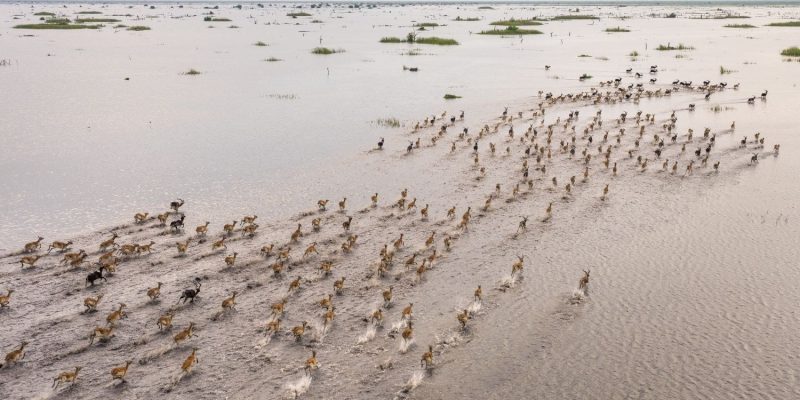
The image African Parks issued with the announcement is not of kob. It is an aerial of Nile lechwe, Kobus megaceros, running across flooded ground, the dark-coated males scattered among the tawny females. The Nile lechwe is a wetland specialist of the Sudd and the floodplains that feed it, and it is one of the species the inscription is quietly about: a listing that protects the hydrology protects the lechwe whether or not anyone counts them.
That is the useful way to read this. Six million antelope are a headline. The thing being inscribed is the floodplain that moves them.
Quick answers
- What was inscribed on the UNESCO World Heritage List?
The Boma-Badingilo Migratory Landscape in South Sudan, announced on July 24, 2026. It is the country’s first UNESCO World Heritage Site. The landscape spans Boma National Park, Badingilo National Park and the corridors between them, roughly 12 million hectares in all.
- How big is the migration?
The first comprehensive aerial survey of the landscape, carried out in 2024, put roughly six million antelope moving across it each year in response to seasonal rainfall. African Parks and the government of South Sudan describe it as the largest terrestrial mammal migration on Earth.
- Which species make up the migration?
White-eared kob, tiang, Mongalla gazelle and Bohor reedbuck. The white-eared kob is the species the migration is usually counted in. The Nile lechwe, a wetland specialist of the Sudd, lives in the same landscape but is not part of that headline count.
- Does the migration cross international borders?
Yes. The routes reach beyond South Sudan into neighboring Ethiopia. In 2014 the government of Ethiopia submitted a proposal to list the white-eared kob, Kobus kob leucotis, on Appendix II of the Convention on the Conservation of Migratory Species, the appendix for species needing international cooperation.
- What does World Heritage status actually change?
It does not by itself stop any threat. It gives the government, the communities and the conservation partners a recognized framework to protect the landscape with, and a reason for outside funding to arrive. African Parks names commercial poaching and extractive interests as pressures now at a scale not seen before.
- Which zoos are behind this?
None that we could verify. The parties are the government of South Sudan, UNESCO, African Parks and the communities of the landscape, with the European Union among the funders of the underlying conservation work. African Parks lists no zoo or aquarium on its partners page, and we report that rather than manufacture a link.
- How long has African Parks worked there?
Since 2022, under an agreement with the government of South Sudan covering the Boma-Badingilo landscape. The European Union delegation in South Sudan welcomed the inscription publicly.