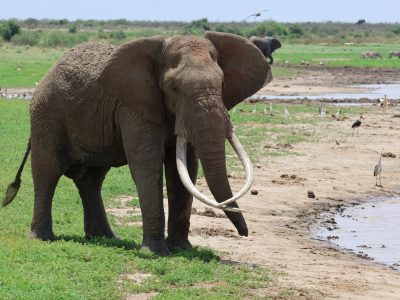

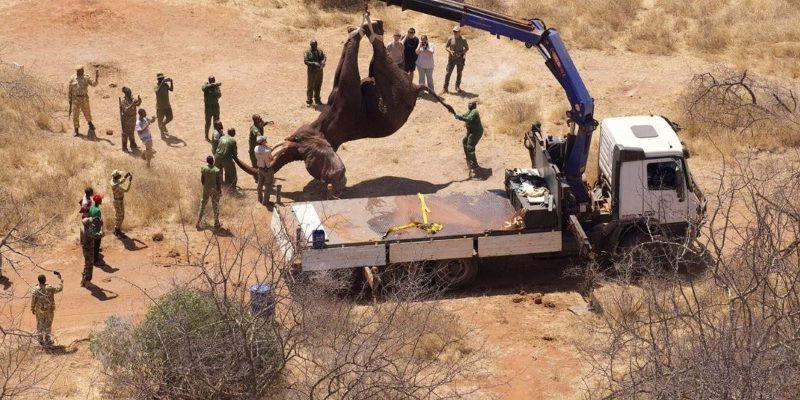
For months, a one-eyed African savanna elephant bull had been causing trouble around Subati and the Lukenya University area outside Kenya’s Tsavo Conservation Area. He had resisted every attempt to move him on by helicopter, and he had already appeared in one of the Sheldrick Wildlife Trust’s monthly reports as an unresolved case.
On August 10 the fixed-wing aircraft found him, the helicopter darted him, and the ground team brought a crane truck close enough to lift him. Once he was down, the veterinarian, Dr. Limo, examined the damaged eye and found the reason for the whole long story: an extremely large arrowhead lodged deep in the socket.
The eye could not be saved. The arrowhead came out, and the bull was translocated to Tsavo West, near Kamboyo, a long way from the community he had been in conflict with.
What 236 hours in the air looks like
That case is one entry in the trust’s Aerial Unit report for August 2026, published on September 13. The month’s totals are 236.6 flying hours and 30,180 kilometers covered, which is roughly three quarters of the way around the planet, flown over one dry ecosystem in one month.
August was the height of the dry season. Water pans had shrunk, the bush had opened up, and wildlife and livestock alike were concentrated within reach of the few permanent water sources left. That concentration is what shaped the month’s work.
Two problem bulls were moved in all. The first was darted on August 8 near Lukenya University, with the helicopter, ground teams, a crane truck and the Kenya Wildlife Service veterinary team from Voi all working the same animal. The one-eyed bull followed two days later.
The rhino operation
From August 11, across roughly ten days, the unit supported a rhino notching and tagging operation spanning the Ngulia Rhino Sanctuary and the Tsavo West Intensive Protection Zone. A number of black rhinos were located, notched and tagged.
Notching is exactly what it sounds like: small marks cut into the ear in a pattern that identifies the individual from a distance or from a camera trap, for the rest of its life. It is unglamorous and it is the foundation of knowing whether a rhino population is growing. The black rhino, Diceros bicornis, is assessed as Critically Endangered on the IUCN Red List, and an animal nobody can tell apart from its neighbors is an animal nobody can protect by name.
The veterinary caseload, including one that is not resolved
Three elephant cases ran through August, and they are worth reading in the order the trust gives them.
On August 10 a juvenile elephant near Ndara was treated for injuries thought to come from an attempted lion predation. The report gives the prognosis as favorable.
On August 15 at Ziwani a calf was found with a severe break to the back left knee joint. The mother had to be immobilized first so the team could reach the calf safely. The calf was treated, and the trust records the prognosis as guarded. No update on that animal has been published since, and we are not going to assume one. Guarded means guarded.
On August 27 the veterinary team was flown to Ithumba to treat three elephants carrying wounds, two from arrows and one from a spear.
That last entry is a pattern rather than an incident. The trust reports a recurrence of arrow and spear injuries through the month, with further arrowed animals seen around Kulalu, and reads it as evidence of continuing conflict and illegal activity along the park’s margins.
A calf on a riverbank for three days
On August 17 an orphaned elephant calf was rescued from Kulalu Ranch. Staff of the Agricultural Development Corporation had been watching the calf alone on the river bank for three days before trust and Kenya Wildlife Service rangers went in. The calf was taken to the Lali Hills airstrip and flown on to Kaluku for care.
Those three days of observation are not a delay. A calf standing alone is not automatically an orphan, and a rescue that separates a calf from a herd still coming back for it does more harm than leaving it. Somebody has to watch long enough to be sure.
Six thousand head of livestock
The other half of the month was enforcement. Illegal activity stayed concentrated across the Galana landscape and the northern ranches, where livestock encroachment and charcoal production ran together through August, and very large livestock concentrations stayed anchored to the permanent water points.
On August 14, a joint operation involving trust teams from Galana and Kulalu, the drone team, the Agricultural Development Corporation and the Kenya Wildlife Service rounded up more than 6,000 head of livestock from inside the park and conservancy for impounding.
Human and elephant conflict required helicopter responses all month, with animals driven back into the park at Gazi, Kiboko, Kasala and Kanziku. Seven elephants went back at Kasala, thirteen at Gazi on August 27 and ten more at Gazi on August 30.
A smaller action closes the list, and it is the one worth picturing. On August 24 at Lake Jipe the helicopter spotted a boat and four large fish traps inside the park. The team landed and destroyed the traps, which had several terrapins and freshwater crabs in them.
The fire
A serious bushfire burned in the Murka area on August 7 and 8 and took 3,933 acres before it was stopped. The fixed-wing aircraft directed ground teams from the Kenya Wildlife Service, the trust and Tsavo Trust. The firebreak formed by the Kishushe to Ziwani fenceline did much of the work, with crews fighting the eastern and western flanks by hand. The fire was brought under control and finally put out at night.
Which zoo paid for this
None that we can verify, and we have looked more than once.
The Sheldrick Wildlife Trust publishes no funder list naming an accredited zoological institution, and its own corporate partner pages do not carry one. We read the trust’s about pages again this morning and found no zoo or aquarium named anywhere. The Aerial Unit is funded the way the rest of the organization is funded, through adoptions, individual donors and the trust’s own fundraising, and an aircraft is an expensive thing to keep in the air on that basis.
There is also a real difference of position here rather than simply an absence of money. The trust publishes a stance opposing the capture of infant elephants for captivity, which is not a comfortable fit with the zoological sector, and we have said so every time we have written about its work.
For scale on the sector as a whole, the Association of Zoos and Aquariums reports that in 2025 its 235 accredited and certified facilities spent approximately $372.4 million on conservation across 139 countries. No published breakdown isolates the African share of that, so we are not going to produce one.
We have written before about the two fence-breaking bulls the same unit moved in September, and the Voi orphans the trust has been publishing rescue records for.
A note on the elephants
The African savanna elephant, Loxodonta africana, is assessed as Endangered on the IUCN Red List. The trust’s report makes no claim about the species’ status at all, which is the normal and correct thing for a monthly operations report to do. We are naming the category because the arrows and the spears in that caseload are what the assessment is partly made of.
Source: the Sheldrick Wildlife Trust’s Aerial Unit Report for August 2026, published September 13, 2026, read in full on October 5.
Quick answers
- What is the Sheldrick Wildlife Trust Aerial Unit?
A fleet of fixed-wing aircraft and helicopters flown in support of the Kenya Wildlife Service across the Tsavo Conservation Area and beyond, used for anti-poaching patrol, veterinary response, translocation, fire direction and wildlife monitoring. In August 2026 it flew 236.6 hours and covered 30,180 kilometers.
- Why did the one-eyed bull have to be moved?
He had been in conflict with people around Subati and the Lukenya University area for months and had resisted every attempt to herd him away by helicopter. When he was darted on August 10 the veterinarian found an extremely large arrowhead lodged deep in the eye socket, which explained the long history. The eye could not be saved, the arrowhead was removed and he was translocated to Tsavo West near Kamboyo.
- What is rhino notching?
Cutting a small pattern of notches into a rhino's ear so the individual can be identified at a distance or on a camera trap for the rest of its life. It is how anyone knows whether a population is growing. The August operation ran about ten days from August 11 across the Ngulia Rhino Sanctuary and the Tsavo West Intensive Protection Zone.
- Why was the orphaned calf watched for three days before being rescued?
A calf standing alone is not necessarily an orphan. Staff of the Agricultural Development Corporation observed the calf on the Kulalu Ranch riverbank for three days to be sure its herd was not returning, before trust and Kenya Wildlife Service rangers took it to the Lali Hills airstrip to be flown to Kaluku. A rescue that separates a calf from a herd still coming back for it does harm.
- What happened to the injured elephants?
A juvenile near Ndara, treated August 10 for injuries thought to come from an attempted lion predation, had a favorable prognosis. A calf at Ziwani, treated August 15 for a severe break to the back left knee joint, was recorded with a guarded prognosis and no update has been published since. Three elephants at Ithumba were treated on August 27 for two arrow wounds and one spear wound.
- Why were 6,000 livestock impounded?
Livestock encroachment and charcoal production ran together across the Galana landscape through August, with very large herds anchored to the few permanent water points inside the park and conservancy. A joint operation on August 14 by trust teams, the drone team, the Agricultural Development Corporation and the Kenya Wildlife Service rounded up more than 6,000 head for impounding.