
Ask 1,814 people across four American cities how they feel about the animals in their alleys and you get a result that is tidier than anyone expected for one species and messier for the other. Familiarity with coyotes makes people less afraid of coyotes. Familiarity with raccoons does not make people like raccoons.
That preliminary finding comes out of the Urban Carnivores Project, a National Science Foundation study of coupled human and natural systems led by Lincoln Park Zoo scientist Dr. Maureen Murray, and it was written up by Arianna Mistry, an Arizona State University graduate student who spent three weeks at the zoo this summer on a scholarship from its Urban Wildlife Information Network.
What is the familiarity hypothesis?
It is a borrowed idea from risk research: the more experience you have with a hazard, the less threatening you judge it to be. Mistry’s example is weather. Someone who has never been through a tornado tends to rate the danger higher than someone who has sat through several.
Applied to urban wildlife, the question becomes whether people who actually run into coyotes and raccoons worry less about attacks, disease and property damage, and notice more of the benefits, which are real and include pest control and the simple pleasure of seeing something wild on the way to work.
The answer so far splits cleanly. People who encounter coyotes regularly are measurably less worried about the rare possibility of an attack. For raccoons, the pattern breaks, and the research team has a plain explanation for why: most people’s repeated encounters with raccoons happen at the garbage can. Familiarity is not neutral if what you are familiar with is a mess on your driveway at six in the morning.
How you survey a city about its wildlife
The design is the interesting part. Surveys went to residents of Chicago, San Francisco, Phoenix and Washington, D.C., but not at random. Neighborhoods were excluded where census data showed too few people, and also where the network’s own predictive models showed too little wildlife. The point was to reach people who had plausibly had an encounter to report, rather than to measure opinions about an animal nobody in the area had seen.
Those predictive models are what the Urban Wildlife Information Network is for. It runs motion-triggered camera traps across partner cities and uses the images to estimate where urban species are likely to be found. The animal data and the human data are built to be laid over one another.
Three weeks of boots in it
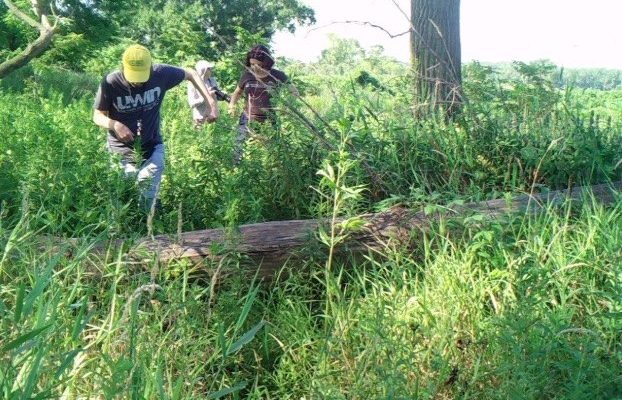
Mistry’s visit was funded specifically to get a social scientist out from behind the survey data and into the field with the ecologists. She pulled camera traps and autonomous recording units out of the Chicago site in July, counted pollinators in community gardens in three-minute observation bouts, and spent time in alleys on a separate Lincoln Park Zoo project testing rat contraception as an alternative to rodenticides, which poison the urban carnivores that eat poisoned rats.
“Looking at the little rat tracks in ink and thinking back to the pollinators, I wondered what makes certain species seem beautiful or fascinating and others pests,” she wrote. “Both are important to the natural ecosystem.”
That is close to the project’s actual question. Her further analysis becomes a master’s thesis later this year, and the Urban Carnivores Project around it is also looking at public support for lethal control, wildlife disease, coexistence attitudes and interviews with the wildlife managers who have to act on all of it.
Zoos are unusually well placed for this work, because the institution that can run camera traps across four cities is also the institution a few hundred thousand people visit each year with their minds already on animals. Akron Zoo made a version of the same argument with its exhibit on the species that thrive in cities. The research reported in Mistry’s account of the visit is the evidence underneath that case.