
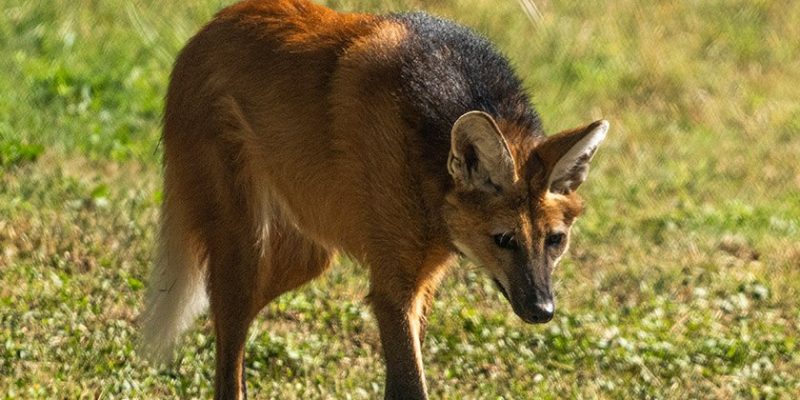
A nearly two-year-old female maned wolf named Ayla has arrived at the Louisville Zoo from the Smithsonian’s National Zoo and Conservation Biology Institute, moved on a breeding recommendation from the Association of Zoos and Aquariums’ Maned Wolf Species Survival Plan. Over the coming months she will be introduced, slowly, to Chrys, the male maned wolf already living at the zoo.
Ayla turns two on December 28. Her name is Turkish for “halo of light around the moon.”
“We are so excited to welcome our newest resident to the Louisville Zoo,” said Louisville Mayor Craig Greenberg. “We look forward to seeing her thrive and provide our community the opportunity to learn more about this incredible species.”
“Every new animal arrival strengthens the Zoo’s role as a leader in conservation, education and inspiring connections with wildlife from around the world,” said Dan Maloney, the zoo’s director. “We are thrilled to welcome Ayla. She will help guests learn about the challenges facing wildlife and the importance of protecting habitats for future generations.”
Why does a maned wolf move across the country?
Because a studbook said so. A Species Survival Plan is a cooperative breeding program run across AZA-accredited institutions, and the working document behind it is a studbook: a pedigree for every animal of that species in the program, tracking who is related to whom and how closely. A population manager reads that pedigree, works out which pairings would keep the most genetic variation in the population over the next generation, and issues breeding and transfer recommendations. Ayla’s move is one of those recommendations. It is the reason a young female leaves a Smithsonian collection and turns up in Kentucky, and it is the reason zoos move animals at all: the population is managed as one population, not as a hundred separate ones.
The introduction will take time. Maned wolves are usually solitary in the wild and form semi-monogamous pairs only through the breeding season, so Ayla and Chrys will be given months to get used to each other rather than simply being put in the same yard. Until they are settled together, guests will see them in the maned wolf habitat on a rotating schedule, one animal at a time. That is worth understanding rather than reading as a scheduling quirk: two animals that would not normally share ground are getting the space in turns.
The animal that is not a wolf
The maned wolf is the only living member of its genus, Chrysocyon. It is not a wolf and it is not a fox, and nothing else alive looks much like it. The legs are the giveaway. They are long out of all proportion, which is what a canid ends up with when it hunts in tall grassland and needs to see over the top of it rather than run animals down.
The diet follows from the same habitat. Maned wolves are omnivores, and roughly half of what they eat is fruit, supplemented by small mammals, birds, reptiles, insects, nuts, eggs and grass. They range across Brazil, Paraguay, Argentina, Bolivia, Peru and Uruguay.
How threatened is the maned wolf?
The IUCN Red List lists the maned wolf as Near Threatened, which is the category the Louisville Zoo used in its own announcement. That is worth saying plainly, because it goes the other way often enough: facilities routinely reach for a scarier category than the assessment supports. Near Threatened means a species is close to qualifying as threatened, and for the maned wolf the pressure is mostly the grassland itself, which is being converted to agriculture across its range.
Louisville has been putting work into the less glamorous end of that problem at home as well. The zoo runs a head-start program for eastern hellbenders, raising Kentucky’s largest salamander to a size where it has a chance in a river. The Smithsonian institution Ayla came from does the same kind of long-horizon work with its own scimitar-horned oryx research herd.
For now, the thing to do is go and look at her. A maned wolf at close range is a genuinely strange animal, and Louisville has two of them.
Quick answers
- Who is Ayla?
A female maned wolf, nearly two years old, who has moved to the Louisville Zoo from the Smithsonian's National Zoo and Conservation Biology Institute. She turns two on December 28. Her name is Turkish for “halo of light around the moon.”
- Why was she moved to Louisville?
On a breeding recommendation from the Association of Zoos and Aquariums' Maned Wolf Species Survival Plan. A population manager reads the studbook for the species, works out which pairings keep the most genetic variation in the managed population, and issues breeding and transfer recommendations to the institutions that hold the animals.
- Will she be introduced to the zoo's other maned wolf?
Yes, gradually. Ayla and Chrys, the zoo's male maned wolf, will be given several months to get used to one another. Until then they will be in the maned wolf habitat on a rotating schedule, one animal at a time.
- Is a maned wolf actually a wolf?
No. The maned wolf is the only living member of the genus Chrysocyon and is neither a wolf nor a fox. It is a long-legged South American canid of open grassland, and roughly half of its diet is fruit.
- Is the maned wolf endangered?
The IUCN Red List categorizes the maned wolf as Near Threatened, which is the category the Louisville Zoo used as well. The main pressure is the conversion of South American grassland to agriculture across its range in Brazil, Paraguay, Argentina, Bolivia, Peru and Uruguay.