
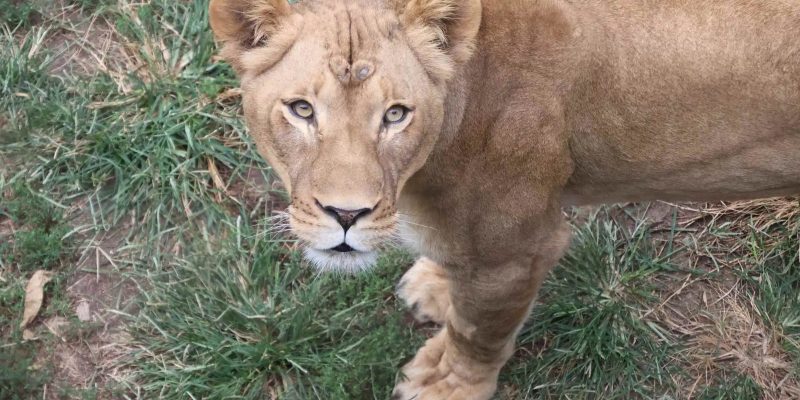
A lion is living in Forest Park again. Araali, a six-year-old female, walked into Big Cat Country on September 22 and became the first lion at the Saint Louis Zoo in more than a year.
She had arrived quietly on September 2 from Denver Zoo Conservation Alliance and spent three weeks behind the scenes before her public debut. A second lion is on the way: Bantu, a twelve-year-old male coming from Lee Richardson Zoo in Garden City, Kansas. The zoo expects him to be visible, and audible, in the public habitat within a few weeks of his arrival.
We’re excited for guests to hear the roar of a lion at the Zoo once again. There’s nothing quite like experiencing the presence of these incredible animals in person. We hope Araali and Bantu give our guests a deeper connection to their counterparts in the wild.
Julie Hartell-DeNardo, Kevin Beckmann Curator of Carnivores, Saint Louis Zoo
Why was the Saint Louis Zoo without lions?
Because the last two reached the end of long lives at nearly the same time. Cabara and Ingozi, the zoo’s most recent longtime residents, each lived into old age and died within a few months of each other in late 2024 and early 2025. The zoo has kept lions since 1914, which makes a year without one an interruption rather than a policy, and filling the gap meant waiting for the right two animals rather than the next two available.
Companions, not a breeding pair
Lions are a social species, so the zoo brought in two. Araali and Bantu were matched to be company for each other, and there are no plans to breed them.
Introductions will be slow and reversible. Keepers will start by giving the two lions access to see, hear and smell one another through a protective barrier, and the animals’ own behavior sets the pace from there. Guests should expect stretches when one or both are off view while that work goes on. That is the process running normally, not a sign that something has gone wrong.
What the zoo does for lions outside the habitat
The Saint Louis Zoo takes part in the Association of Zoos and Aquariums Saving Animals From Extinction (SAFE) African Lion Program, and its WildCare Institute has a long partnership with Lion Landscapes, a nonprofit that builds community-based solutions for coexistence between people and large carnivores in Tanzania and Kenya. That is where the practical end of lion conservation sits: most of the range the species has left is shared with livestock and with the people who own it, so the work is less about fences than about what happens when a lion and a herd meet.
It is the same institutional pattern behind the zoo’s red wolf pups fostered into a wild North Carolina litter. The animals on exhibit and the program in the field are paid for by the same gate.
How much trouble are wild lions actually in?
Enough that the answer is worth getting exactly right. The zoo’s announcement says wild lion populations “have nearly halved in the last 30 years” and that lions have lost “about 85%” of their historic range.
The current IUCN Red List assessment, published in 2025, frames both figures differently. It lists the African lion as Vulnerable on the basis of an estimated 34 percent decline in the species’ range over three lion generations, roughly 21 years, from which a similar population reduction is inferred. Twenty-one years, not thirty, is the window the Red List uses for this animal. On range the assessment is blunter than the zoo: it puts the lion’s remaining territory at 1,566,675 square kilometers, or 6 percent of its historical range, a loss closer to 94 percent than to 85.
Where the two disagree we default to the assessment, which is the document any reader can go and check. Worth adding: the assessment declines to publish a global total at all, saying plainly that it does not aim to provide a new estimate of total lion numbers, and instead cites 22,000 to 25,000 adult and subadult lions in Africa and about 670 in India. Anyone quoting one tidy worldwide lion figure is quoting something else.
None of which changes what the release was getting at. By either accounting, this is an animal that has lost most of the continent it used to occupy.
What guests will see
Araali is on view in Big Cat Country now, and the zoo has said it will post updates on both lions as Bantu settles in. The species is having a good season in North American zoos generally: the Pittsburgh Zoo put its cub Kiazi on public view in August.
For now the news in St. Louis is simpler than any of the numbers. There is a lion in Big Cat Country again, and before long there should be two.
Quick answers
- Can you see the lions at the Saint Louis Zoo right now?
Araali is on view in Big Cat Country. Bantu arrives from Lee Richardson Zoo in Kansas and is expected to be visible within a few weeks of arriving. There will be periods when one or both lions are off view while keepers introduce them.
- Why did the Saint Louis Zoo have no lions for a year?
Its previous lions, Cabara and Ingozi, both reached old age and died within a few months of each other in late 2024 and early 2025. The zoo has kept lions since 1914.
- Will Araali and Bantu have cubs?
No. Lions are social, and the two were paired as companions for each other. There are no plans to breed them.
- Are African lions endangered?
The IUCN Red List assessment published in 2025 lists the African lion as Vulnerable, based on an estimated 34 percent decline in the species' range over about 21 years. It puts the lion's remaining range at 6 percent of its historical range.