
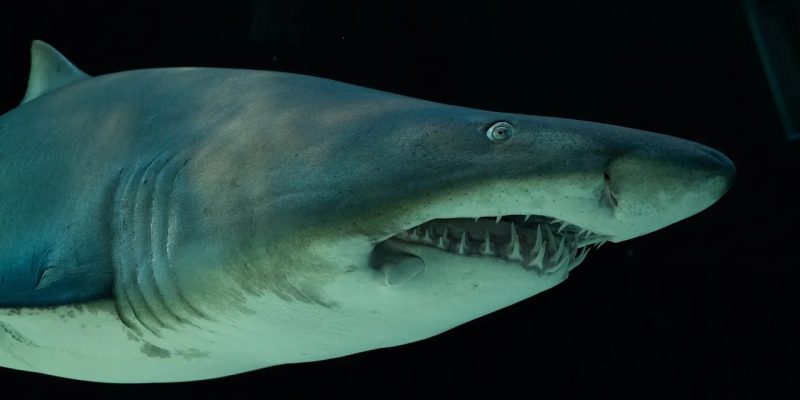
Four ragged-tooth sharks were intercepted at Cape Town International Airport in May 2018, packed for export to the Netherlands without permits. In March 2026 the last of the two survivors held at Two Oceans Aquarium walked back into the surf at Struisbaai.
She weighed 201 kilograms and measured 295 centimeters. When she arrived she was 183 centimeters and under 30 kilograms.
The case that never happened
The seizure was a genuine win, listed among the successes of Operation Thunderstorm, the 2018 INTERPOL wildlife crime operation run with the World Customs Organization, CITES, UNODC and the World Bank. The sharks had been taken at Port Alfred in the Eastern Cape.
Two Oceans is careful about the legal point: ragged-tooth sharks were not CITES-listed in 2018, so the offence was under South Africa’s own marine protection and permitting law, not international trade law.
Then the sharks sat. Two of the four, Blue and Charlie, had to remain at the aquarium as evidence in the case against the traffickers. In the aquarium’s own words, for unknown reasons the case never reached fruition.
Eight years of an animal’s life spent as an exhibit in a prosecution that was never brought.
Why raggies get trafficked
The species has a trick almost no other shark has: it gulps air at the surface and holds it in its stomach, achieving near-neutral buoyancy, and it can pump water over its gills while stationary rather than swimming continuously to breathe. That makes it survivable in a tank and shippable in a way most sharks are not.
The money follows. Seventy-six wild ragged-tooth sharks were legally collected in Delaware for aquariums between 2021 and 2024, roughly 90 percent exported outside the US. An attempted illegal collection in Massachusetts valued the animals at around 10,000 dollars each. One South African exporter sent an adult to a French aquarium in 2000 where the airfreight alone came to about 177,000 rand.
“Had Blue and Charlie’s trafficking story continued without our intervention, it would have resulted in their being kept in the private aquarium trade indefinitely. They would never have left.”
Kevin Spiby, curator of operations and animal husbandry, Two Oceans Aquarium
What the eight years produced
Blue was acoustically tagged a month before release by veterinarian Dr Ilse Jenkinson, and she joins a dataset the aquarium has been building for a decade.
“We are currently tracking approximately 60 sharks, some of whom have given us 10 years of data. We now have a huge dataset that compares the movements of previously captive sharks to those of wild sharks, and they show remarkably similar movements.”
Kevin Spiby
That last clause is the finding, and it is the answer to the obvious objection about releasing a long-held animal.
Standard practice at Two Oceans is to release ragged-tooth sharks after up to eight years in its care. Charlie is still in the Save Our Seas Foundation Shark Exhibit and will follow.
The distinction the aquarium is drawing
The piece is not a defense of aquariums in general. It is quite pointed about the private, unaccredited trade, and about the fact that a shark bought at that price is a shark nobody releases.
The four sharks were named by then-aquarist Leigh De Necker after the velociraptors in Jurassic World: Delta, Echo, Blue and Charlie. The two youngest went back to the Eastern Cape not long after the seizure.
Two Oceans has been a WAZA member since 2019 and is accredited through the African Association for Wildlife in Human Care. Its turtle rehabilitation program takes referrals from SANCCOB.
Source: Two Oceans Aquarium.