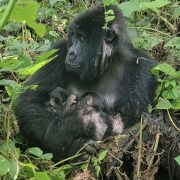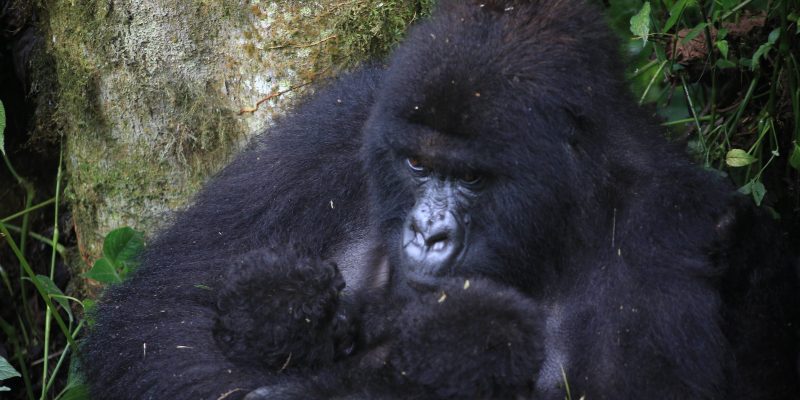
Twin mountain gorillas occur in fewer than one percent of births. Virunga National Park recorded two sets in three months.
The second pair arrived in the Baraka family in the Mikeno sector and were announced on March 24, 2026, at roughly two weeks old, believed to be one female and one male. The Baraka family now numbers 19. The first pair, born to Mafuko in the Bageni family on January 3, were eleven weeks old and thriving.
“Two instances of twin births within 3 months is an extraordinary event and provides another vital indicator that dedicated conservation efforts, which have continued despite the current instability in eastern Congo, continue to support the growth of the endangered mountain gorilla population within Virunga National Park.”
Jacques Katutu, head of gorilla monitoring, Virunga National Park
Read the middle of that sentence
“Despite the current instability in eastern Congo” is doing a great deal of quiet work.
Virunga is a national park in an active conflict zone. Its rangers have been killed doing this job. The monitoring that produced both of these announcements is daily fieldwork by community trackers moving through terrain where armed groups operate, and the park’s own biography of Mafuko records that her mother was assassinated by armed individuals in 2007.
When a park in that position reports two rare births in a quarter, the finding is not really about gorilla reproductive biology. It is that the protection held.
The biology, for what it is worth
Virunga attributes twinning to hyper-ovulation, where two or more ova are released and fertilized, and notes that observations in the park suggest such events may occur when females are in particularly good physical condition, while stating that no direct causal relationship can be established.
That caveat is the correct one and we are keeping it. What can be said without stretching is that well-protected, well-fed gorillas in a growing population are a different proposition biologically from a population under pressure.
The population question
The figure in circulation is 1,063 mountain gorillas, and it needs a date attached. It comes from the 2018 Bwindi-Sarambwe census combined with the 2015 to 2016 Virunga Massif survey. Virunga holds more than a third of the world population.
A new Bwindi-Sarambwe census is underway, led by the International Gorilla Conservation Program, so the 1,063 figure is the most recent published count rather than a current one. At the Kwita Izina ceremony in September 2026 Rwanda’s prime minister put it at more than 1,000 worldwide including more than 600 in the Virunga Massif.
Source: Virunga National Park; Dian Fossey Gorilla Fund.