
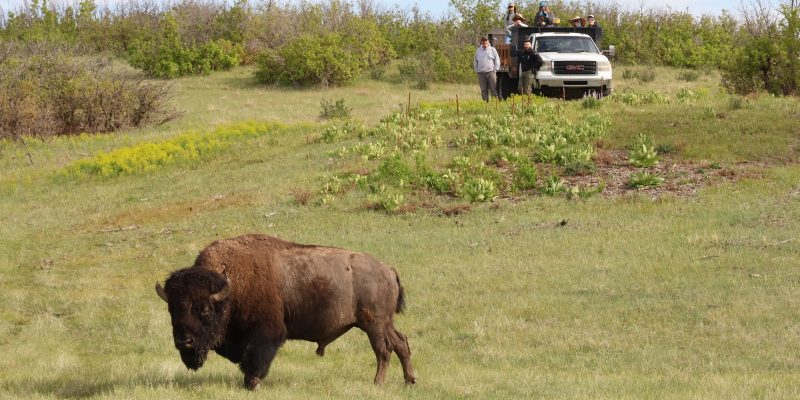
A bison herd that Denver Zoo Conservation Alliance helped rescue more than a century ago now has more room to walk. This summer the herd at Daniels Park had its grazing range extended onto the Highlands Ranch Backcountry Wilderness Area, ground that bison have not roamed in more than 150 years. The alliance announced the expansion on August 6, 2026.
Denver Zoo Conservation Alliance worked with five partners on it: Denver Mountain Parks, the Highlands Ranch Backcountry Wilderness Area, Colorado State University, Sanctuary Golf Course and the TallBull Memorial Council. Denver Mountain Parks has cared for the Daniels Park herd since 1938. The alliance supplied the veterinary and field science.
A herd with an unusually long paper trail
The Daniels Park animals are not an ordinary municipal herd. Their line traces to the very early 1900s, when the organization now called Denver Zoo Conservation Alliance helped preserve some of the last bison left in the state of Colorado. Their descendants have since been used to rebuild herds across Colorado and the rest of the United States.
“This herd are the descendants of animals that were brought to Denver Zoo Conservation Alliance back in the very early 1900s when those bison were the only bison left in the state,” said Tim Luethke, the alliance’s Great Plains Restoration Coordinator. “Today this herd has helped to repopulate Colorado bison herds and bison herds across the United States. This is a hugely important bison herd.”
That puts the Daniels Park herd in the same category as the animals behind Oakland Zoo’s 50th bison calf for the Blackfeet Nation. These are working stock for restoration rather than display animals.
Untilled prairie, which is rarer than it sounds
The reason the new pasture matters is what is growing on it. Connected with the Highlands Ranch Backcountry Wilderness Area and Cherokee Ranch, the grasslands around Daniels Park form one of the largest remnants of untilled prairie in Colorado. Untilled means exactly that: the ground has never been broken by a plow, so the plant community on it is the original one rather than a reseeded imitation. On the Front Range, where subdivisions and irrigated agriculture have taken almost everything, that is close to unrepeatable.
“We want to think about the next 100 to 1,000 years of pasture management for these bison,” Luethke said. “As long as the City of Denver exists, this herd is going to be here, and we want to make sure we’re being as good of stewards as we can for this grassland ecosystem. It’s super diverse. Most of it is in really good shape, and keeping it that way is our responsibility.”
Bison are not passengers on a prairie. Their grazing and their sheer physical movement break up soil, open ground for seed and create the patchy structure that grassland birds, insects and small mammals depend on. Giving them more ground is a habitat project as much as an animal one.
Why is the herd being tracked?
Before any animal walked onto the new pasture, there were two years of field work. Staff from the alliance’s Great Plains field conservation and veterinary medicine teams worked with Denver Mountain Parks, Colorado State University and the TallBulls across two bison immobilization days at Daniels Park, fitting male bison with GPS collars and solar ear tags.
Two systems, deliberately. The GPS collars report a location every 15 minutes; the solar ear tags report hourly. Running both means that if an animal leaves the new pasture, the teams find out from one system even if the other has failed, and they can respond quickly without having to put the animal through another field anesthesia to replace a dead transmitter.
While the bison were immobilized, the veterinary team also took DNA samples and health measurements, building a record of the herd’s condition and its genetic lineage that will shape management decisions for years.
The collars have cameras
The tracking hardware is also a research instrument, and this is where the project stops being about fences.
“The collars also have cameras, so we’ll get vegetation data on what the bison are eating and primarily targeting,” Luethke said. “That’s going to help us understand how they’re influencing these grasslands and influencing biodiversity. There’s a huge lack of information on how bison affect biodiversity in short-grass prairie ecosystems. There’s a lot of data in mixed grass and tall grass, but we want to answer those questions for our herd close to home in Denver.”
That gap is real. Short-grass prairie is the least studied of the North American prairie types, and Luethke’s point is that the science on bison and biodiversity has largely been done somewhere else. The data could also feed into fire management, parasite control and the siting of future dung beetle releases. “Getting those really long-term data sets is going to be super revealing,” Luethke said. “It’ll probably spawn a whole bunch of master’s student projects, PhD student projects, and just a lot of wonderful research for many, many years to come.”
Two organizations, two halves of the job
Shannon Dennison, director of Denver Mountain Parks, was blunt about why the partnership exists at all.
“Denver Mountain Parks doesn’t have the staff and expertise to do veterinary care or to have the number of scientists and wildlife specialists needed to make good management decisions and safely handle the bison,” she said. “And Denver Zoo Conservation Alliance doesn’t necessarily have the amount of land and space that we have here. So it’s really a perfect partnership. We have the land and the animal resources, and Denver Zoo has the people. It works really well.”
Relatives, not livestock
Among those on the ground was Lewis TallBull Jr., of the TallBull Memorial Council, whose family’s connection to these animals predates the park.
“The bison need help. They need a voice. They’ve been forgotten. Nearly erased. Just like my Cheyenne and Arapaho people,” he said. “We consider ourselves bison people. There was no telling where the animal ended and the human began because we would drape ourselves in bison. Everything we used for living came from the bison. The bison was everything to us.”
“We want to look at these bison like a brother or a sister, or a grandma, or a grandpa, or a grandchild,” he said. “We want to look at these bison like a relative. And being able to be amongst my relatives, it’s very empowering.”
What comes next
The summer’s expansion onto the Highlands Ranch Backcountry Wilderness Area is a first step rather than a finished project. The stated goal is to keep restoring bison to native grassland across one of the most significant prairie ecosystems left on Colorado’s Front Range, with the collars and ear tags feeding a monitoring program as the herd learns the new ground.
What that adds up to is a herd descended from the last bison in Colorado, walking out onto prairie that no plow has ever touched, wearing instruments that will tell researchers what a bison actually does to a short-grass ecosystem. Conservation results are usually slower and harder to see than that.
Source: Denver Zoo Conservation Alliance, August 6, 2026.
Quick answers
- Where is the Daniels Park bison herd?
At Daniels Park on Colorado's Front Range. Denver Mountain Parks has cared for the herd since 1938, and in the summer of 2026 its grazing range was extended onto the neighboring Highlands Ranch Backcountry Wilderness Area.
- Why does the new pasture matter?
Bison have not roamed it in more than 150 years. Connected with the Highlands Ranch Backcountry Wilderness Area and Cherokee Ranch, the grassland around Daniels Park is one of the largest remnants of untilled prairie in Colorado, meaning ground that has never been broken by a plow.
- How are the bison tracked?
Male bison were fitted with GPS collars that report a location every 15 minutes and solar ear tags that report hourly. Two independent systems give redundant warning if an animal leaves the pasture. The collars also carry cameras that record what the bison are eating.
- What does Denver Zoo Conservation Alliance contribute?
Veterinary care and field science. Denver Mountain Parks holds the land and the animals; the alliance supplies the veterinarians, scientists and wildlife specialists. The herd also descends from bison the alliance helped preserve in the very early 1900s, when they were the last left in Colorado.