
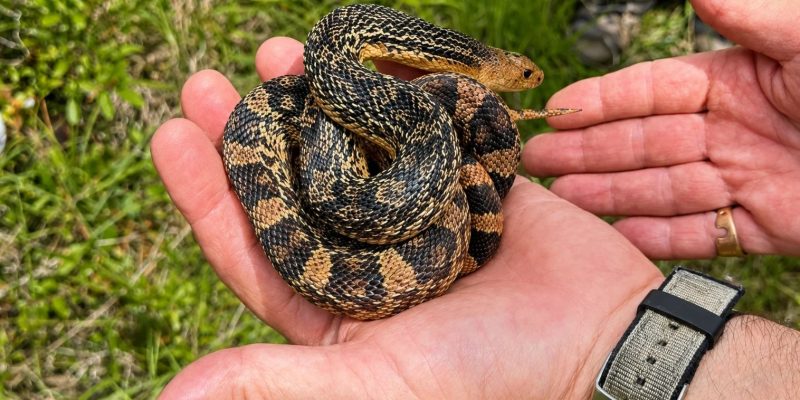
Eighty Louisiana pinesnakes went into the ground at Kisatchie National Forest on June 3, 2026, one at a time, into deep burrows across twelve selected locations.
Memphis Zoo led the release with a coalition that has been working this species for decades: the U.S. Fish and Wildlife Service, the U.S. Forest Service and Kisatchie National Forest, the Louisiana Department of Wildlife and Fisheries, Fort Worth Zoo, Audubon Zoo, Ellen Trout Zoo, and the Department of Defense through Fort Polk.
A snake that lives underground and eats gophers
The Louisiana pinesnake is an animal of the longleaf pine ecosystem, and it is specialized to a degree that made it fragile. It eats Baird’s pocket gophers almost exclusively, it uses their burrow systems, and according to the Forest Service it spends up to about 70 percent of its life below ground.
That means the snake needs a forest that supports pocket gophers, and pocket gophers need open longleaf pine with herbaceous groundcover, and that requires frequent low-intensity fire. Fire suppression and the logging of longleaf pine for timber took the whole chain apart.
You cannot conserve this snake. You can only conserve the fire regime it depends on and let the snake follow.
Two program firsts worth knowing
The release notes two milestones that go beyond one species:
- The first documented natural reproduction of captive-bred Louisiana pinesnakes in the wild. Releasing animals is one thing; animals breeding on their own afterward is what turns a release into a population.
- The world’s first successful artificial insemination using cryopreserved sperm to produce offspring in an endangered reptile species.
The second is the kind of technical result that quietly changes what is possible for every reptile recovery program that follows.
“For more than 40 years, this project has demonstrated what is possible when organizations unite around a shared conservation mission. The Louisiana pinesnake’s story is one of collaboration, innovation, and perseverance. Every release represents decades of work and the commitment of partners who refuse to let this species disappear.”
Dr. Steve Reichling, director of conservation and research, Memphis Zoo
One note on the listing
Memphis Zoo’s announcement describes the Louisiana pinesnake as critically endangered. The formal listings are a step below that: the U.S. Fish and Wildlife Service listed the species as Threatened under the Endangered Species Act in 2018, and the IUCN Red List assesses it as Endangered, with a decreasing trend. Audubon Nature Institute, covering the same release, uses those terms.
We default to the IUCN assessment where a figure or a category is in question, because it is the one number everyone in the field can check. None of it changes what happened in Kisatchie. An Endangered snake put back into restored habitat is a good day either way.
Who supplies the snakes
Audubon Zoo contributed 14 of the 80 and has released 58 in total, from a breeding colony of 21 adults. It is one of only four facilities holding a breeding colony and the only one in Louisiana. Its hatchlings are reared for nearly a year to outgrow the size at which most predators take them, then microchipped, weighed, measured and photographed before release.
“Louisiana pine snakes are an essential part of the longleaf pine ecosystem that is also home to pocket gophers, their primary food source.”
Mallory McKinney, senior herpetology keeper, Audubon Zoo
Memphis Zoo’s own species page credits the zoo and its partners together with more than 700 releases since 2010.
Reptile recovery programs almost always live at zoos, for the same reason hellbender work does: they need a building, a decade, and somebody willing to pay for an animal nobody sells tickets to see.
Source: Memphis Zoo; Audubon Nature Institute; U.S. Fish and Wildlife Service; IUCN Red List; U.S. Forest Service.