
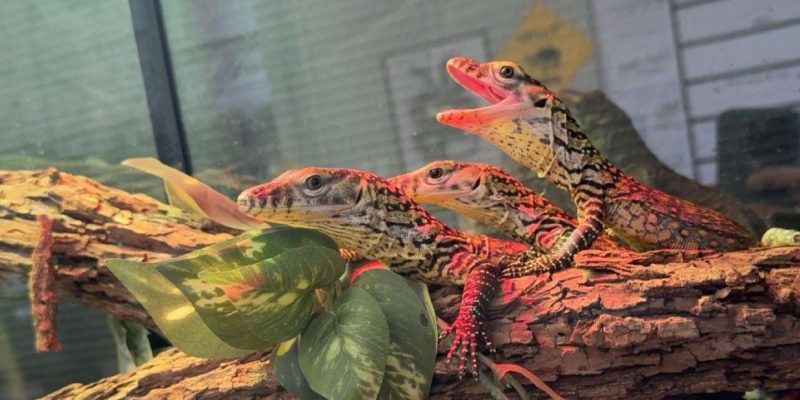
Three Komodo dragons hatched at the Tulsa Zoo this spring, on March 19, March 21 and March 28, after nine months of incubation.
The zoo announced them on April 30, 2026. The parents are a female named Luska and a male named Moloch, both visible in the H.A. and Mary K. Chapman Komodo Dragon Habitat in the Lost Kingdom. The hatchlings are already on view in the zoo’s Conservation Center.
Nine months is the story
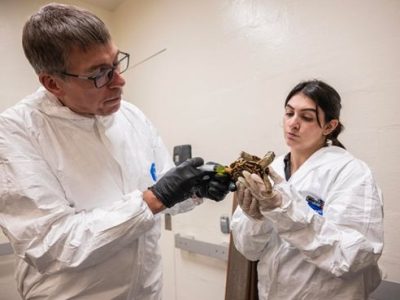
Reptile keepers will tell you that the difficult part of hatching a Komodo dragon is not the hatching. It is the nine months in between, during which a clutch of eggs has to be held at conditions close enough to right that nothing inside them fails, with no way to check and no way to intervene.
“From careful egg collection to supervising nine months of incubation and successful hatching, our animal care team worked tirelessly to give these hatchlings the best chance of survival. We’re thrilled to be one of a small group of AZA institutions to have successfully hatched this endangered species.”
Erik Kalen, zoological curator for herps, aquatics and rainforest, Tulsa Zoo
The habitat gets the credit
Kalen points at the building rather than the technique, which is unusual and probably correct.
“When we built our new habitat in the Lost Kingdom, the priority was to ensure our adults had access to large indoor and outdoor exhibit spaces to ensure they were receiving natural UV light and room for exercise. This is essential to their health, and we believe it was one of many key reasons for our success.”
Erik Kalen
Natural UV is not a comfort feature for a large diurnal lizard. It drives vitamin D synthesis and therefore calcium metabolism, and an animal that cannot metabolize calcium properly does not produce viable eggs. A breeding result years later is one of the few ways a zoo ever finds out whether an exhibit was built right.
What happens in the wild
Neither parent provides care after hatching. Young Komodo dragons spend much of their early life in the forest canopy, which is not a quirk but an avoidance strategy: the main threat to a hatchling Komodo dragon is an adult Komodo dragon.
How many Komodo dragons are left in the wild?
The IUCN assessed the species as Endangered in 2019, published in 2021, with 1,383 mature individuals across eight subpopulations, the largest holding 474. The population trend is listed as stable, but the assessment records a continuing decline in mature individuals and a severely fragmented population. It was classified Vulnerable as recently as 1996.
Tulsa Zoo’s announcement says fewer than 3,500 remain in the wild. That figure likely counts juveniles alongside adults, and the two are not measuring the same thing. Where the counts differ we go with the assessment, so the number to hold onto is 1,383 breeding-age animals on a handful of Indonesian islands. Both readings point the same direction.
The zoo describes itself as a long-time partner of the AZA Komodo Dragon Species Survival Plan. It does not say this clutch came from an SSP breeding recommendation, and we are not going to say so either.
Careful reptile propagation is having a good year across the network, from these hatchlings to 80 Louisiana pinesnakes going back into Kisatchie National Forest.
Source: Tulsa Zoo; IUCN Red List assessment for Varanus komodoensis.