
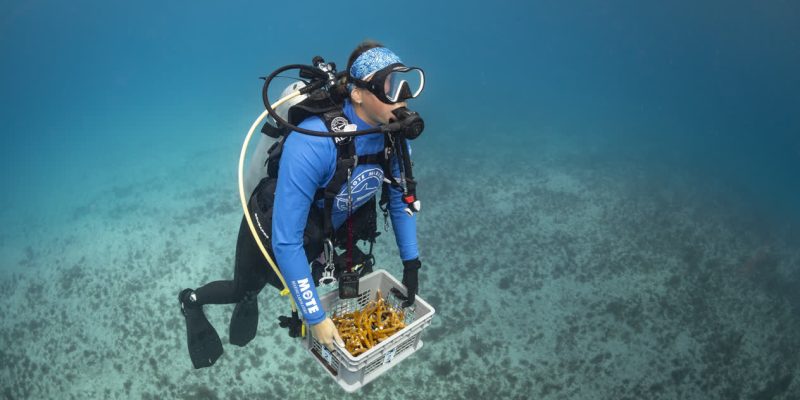
When the water in the Florida Keys gets above 87 degrees for long enough, coral bleaches. Mote Marine Laboratory has spent the summer pulling corals off the reef before that happens.
Mote announced on July 29, 2026 that it had launched a Keys-wide effort to move thousands of vulnerable corals, many of them threatened or endangered species, out of its offshore nurseries and into land-based facilities ahead of prolonged heat stress.
The reason they can do this at all
Evacuating a coral nursery is only possible if you have somewhere to put it. Mote has been investing in coral restoration for more than 30 years, and the land-based capacity is the part of that investment nobody notices until a heat wave.
“Our long-term investment in land-based coral restoration infrastructure allows us to respond quickly when ocean temperatures threaten our offshore nurseries. Protecting genetically diverse corals during these events is essential to advancing restoration science and ensuring we have resilient populations ready to return to Florida’s Coral Reef.”
Dr. Michael P. Crosby, president and CEO, Mote Marine Laboratory
What is being protected is not a quantity of coral. It is a library. Mote’s International Coral Gene Bank holds approximately 10,000 unique coral genotypes across 34 species. A genotype lost in a bleaching event is not replaceable by growing more coral, because the thing that was lost was the genetic variation itself, and variation is the entire basis of the bet that some corals will tolerate warmer water.
The numbers behind the program
- More than 275,000 corals outplanted onto Florida’s reefs over the past decade
- Nearly 75,000 fragments currently growing in the Keys nurseries
- 10,000 genotypes across 34 species in the gene bank
Partners on the response include the Florida Department of Environmental Protection’s Office of Resilience and Coastal Protection, Monroe County, and the Florida Keys National Marine Sanctuary.
They have done this before
In 2023, when backreef temperatures in the Keys exceeded 100 degrees, Mote evacuated corals from four offshore nurseries at Sand Key, Looe Key, Islamorada and Key Largo into land-based nurseries on Summerland Key, Key Largo and Islamorada, and to its 200-acre Aquaculture Research Park in Sarasota. That operation used more than 70 staff and six research vessels, and the species pulled included staghorn and elkhorn coral.
Living coral cover on Florida’s Coral Reef currently sits somewhere between 1 and 5 percent.
What they learn from doing it
“Every extreme heat event provides an opportunity to improve our understanding of coral resistance and resilience. By combining field observations with controlled research, we’re identifying the corals and restoration approaches that will be most successful as ocean conditions continue to change.”
Dr. Jason Spadaro, program manager, Mote’s Coral Reef Restoration Research Program
That is the honest framing. Nobody at Mote thinks hauling coral indoors every summer is a restoration strategy. It is a holding action that buys time to find out which genotypes do not need hauling indoors, which is the only version of this that ends.
Marine institutions doing the same unglamorous arithmetic show up across our coverage, from hellbenders in Missouri rivers to amphibian work nobody fundraises for.
Source: Mote Marine Laboratory. The 2023 comparison figures come from Mote’s own account of that evacuation.