
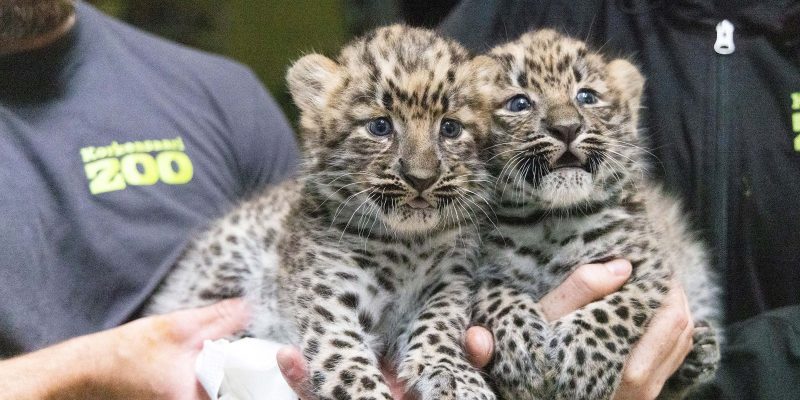
It took five years to find her a mate. When the two Amur leopards were finally put together, according to their keeper, they never so much as growled at each other.
Korkeasaari Zoo in Helsinki announced on September 3, 2026 that two Critically Endangered Amur leopard cubs have survived their first weeks. Three were born in late July. One was stillborn. The two that lived, a male and a female, were about five weeks old and roughly 2.5 kilograms each when the zoo introduced them.
They are the first offspring for this pair.
The five-year search
The match was made through the EAZA Ex-situ Programme, the European breeding program that decides which animals are paired across the continent’s zoos. It took five years to find the right partner.
That is not bureaucratic delay. With a population this small, every pairing is a genetic decision, and the wrong one wastes years of a breeding animal’s life. The Finnish announcement notes that the father carries rare genetics traced to a wild-caught founder, with only two known male offspring anywhere.
“Tama amurinleopardipari loysi yhteisen savelen silla sekunnilla, kun ne paasivat yhteen. Ne eivat kertaakaan edes rahahtaneet toisilleen, vaan parittelivat 2-3 paivan ajan.”
This pair hit it off from the very first moment they were introduced. They never once even growled at each other; instead, they mated for two to three days.
Jonne Stenroth, animal keeper, Korkeasaari Zoo, in a statement translated from Finnish
Stenroth also described the mother, a first-timer, as exceptionally calm and confident with the cubs, almost as though she had done it before.
The animal itself
The Amur leopard is a subspecies of leopard living in the Russian Far East and northeastern China, and it is one of the rarest big cats on earth. Korkeasaari puts the wild population at around 100 to 130 animals. Its English-language release notes the population fell as low as 35.
Set that against the arithmetic of a birth. Two surviving cubs in Helsinki is a measurable fraction of a percent of everything alive.
What happens next
The cubs have been microchipped, weighed, dewormed and photographed for identification. The photographs matter more than they sound: individual leopards are told apart by their rosette patterns, so an identification image taken at five weeks becomes the reference for that animal’s entire life in the studbook.
Source: Korkeasaari Zoo. Quotation translated from the Finnish.