
Busch Gardens Tampa Bay opened Lion & Hyena Ridge on July 25, 2026, a single 38,000-square-foot guest experience built around two separate yards, for five lion brothers and two spotted hyenas, and the park’s most ambitious animal project in more than a decade.
The design problem it solves is not a small one. Lions and spotted hyenas are direct competitors in Africa, they kill each other’s young, and no responsible facility puts the two in the same space at the same time. So Busch Gardens built two yards — two genuinely separate habitats — and rotates both species between them. From the guest path it reads as one continuous place. Behind that, it is two, and the animals are never in the same one at the same time.
How the rotation works
Neither species owns a yard. The lions are in one habitat and the hyenas in the other, and then they trade, which is a well-established practice in modern zoo design and one of the more useful things a habitat can offer an animal. What it is not is a shared enclosure, and it is not one space used in shifts either. There are two habitats. Both species get time in each of them, and the two are never open to each other.
Rotation is not primarily about saving space. An animal that moves into ground another species has just left arrives into a landscape that has changed since it was last there: different scent, different marks, different information. For a predator, that is the closest thing a habitat can provide to the daily novelty of a home range. Studies of rotational exhibits have generally found carnivores in them more active, and spending more time investigating, than the same animals in a single fixed yard.
It also means the same 38,000 square feet does double duty. Give each species a permanent yard and the lions have one half for life and the hyenas the other. Rotate them, and both animals get the whole ridge, just never at the same hour.
The cost of that is paid where guests never look. A rotational habitat needs a back-of-house network that a fixed yard does not: holding areas for both species, transfer chutes connecting every space to every other space, shift gates an animal will actually walk through, and enough separate rooms that five lions and two hyenas can all be somewhere safe while a keeper moves one group from one yard to the other. The design problem is not the savanna. It is the plumbing behind it, and getting it wrong means a habitat that looks the part and cannot be operated on a Tuesday morning.
What is in it
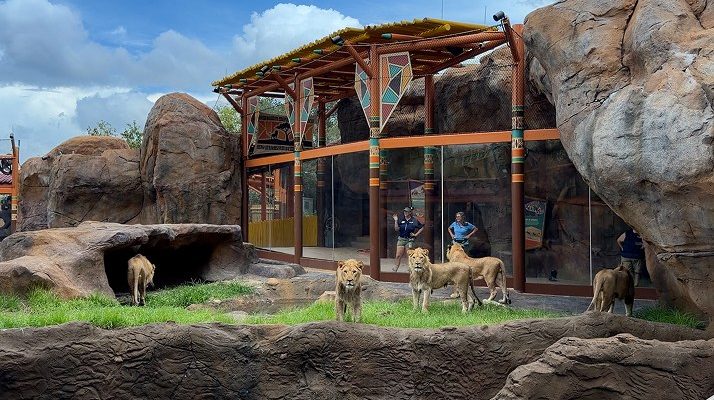
The terrain is built as rocky kopje formations, the granite outcrops that rise out of the East African savanna and that lions genuinely use, with cascading water elements, climbing structures, caves and overhead bridges.
Two details are worth pulling out. The rockwork includes surfaces that are specifically heated and cooled, which lets an animal in Florida choose its own thermal comfort rather than depending on shade and season. And guests view through 270 degrees of glass, so the sightlines wrap around the animals instead of facing them across a moat.
“Lion & Hyena Ridge was designed to create a very immersive and interactive experience for the animals,” said Andrew Schaffer, vice president of design and engineering.
The animals-first phrasing is not a slip. Choice, complexity and the ability to get away from the viewing glass are what the enrichment literature actually measures, and they are what a habitat like this is built around; the guest experience is a consequence of putting the animals somewhere they want to be.
The lions
The five are brothers, all born in 2024: Pascal, Lou, Henri, Hugo and Herman. Busch Gardens describes them as the largest lion coalition at any AZA-accredited facility in the country.
A coalition is a real social structure and not a marketing term. In the wild, male lions leave their natal pride as adolescents and band together, usually with brothers or cousins, and those groups take and hold territory. Larger coalitions hold better ground for longer. Keeping five related males together as they mature is a decision to let that structure develop rather than to break it up, and it is the reason the habitat needed the size it has.
The hyenas are Cazi and Dazi, a male and a female.
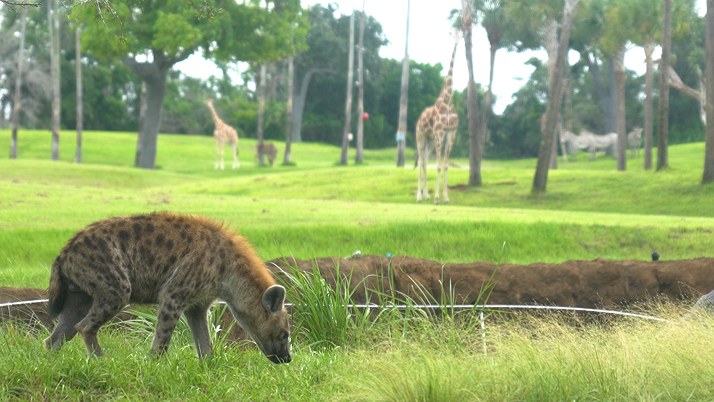
Hyenas deserve better press than they get
Spotted hyenas are the animal most consistently misrepresented in popular culture, and the exhibit leans into correcting it.
They are not scavengers living off lion leftovers; they hunt the majority of what they eat, and in much of Africa lions steal from hyenas at least as often as the reverse. Their clans are matriarchal, run by females who outrank every male, and they are held up by researchers as among the more socially sophisticated carnivores alive, with individual recognition and rank inheritance that invite comparison to primates.
Giving them the same two yards the lions use, at different hours, is a way of staging that rivalry honestly rather than casting one side as the villain. Busch Gardens frames it for visitors as a choice: Team Lion or Team Hyena.
Part of something larger
Lion & Hyena Ridge anchors a $200 million, five-year transformation of the park.
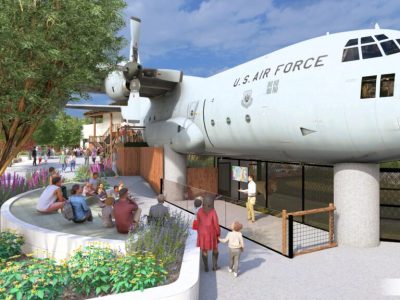
Big-cat habitats are having a year. The Abilene Zoo broke ground in March on a lion habitat built around a C-130 Hercules aircraft, and Brandywine Zoo opened its $2.5 million Hidden Falls habitat in July.
“This immersive experience brings guests face to face with these incredible animals while showcasing our continued commitment to exceptional animal care,” said Jon Vigue, park president.
The project grew between announcement and opening. When Busch Gardens unveiled it in November 2025, then under park president Brian Bacica, the habitat was described as nearly 35,000 square feet and slated for spring. It opened in July at 38,000.
The ridge sits alongside the park’s 65-acre Serengeti Plain, which is the other half of the argument for building it here: the hyenas now look out across giraffes and antelope on open ground, which is more or less the view they would have in Africa.
Go see it
What this adds up to for a visitor is one of the best big-cat viewing experiences in the country. You walk into the savanna rather than looking at it from across a moat. The glass wraps around you. Five lions are on the other side of it, and on a good morning they are up on the kopje in the sun, or down in the water, or coming over to see who you are.
Come back later and the same ground has changed hands. It is hyenas out there instead, doing something completely different with it, with the giraffes of the Serengeti Plain moving in the distance behind them.
It is a very good day out, and it is a better life for nine animals. Both of those things are the point.