
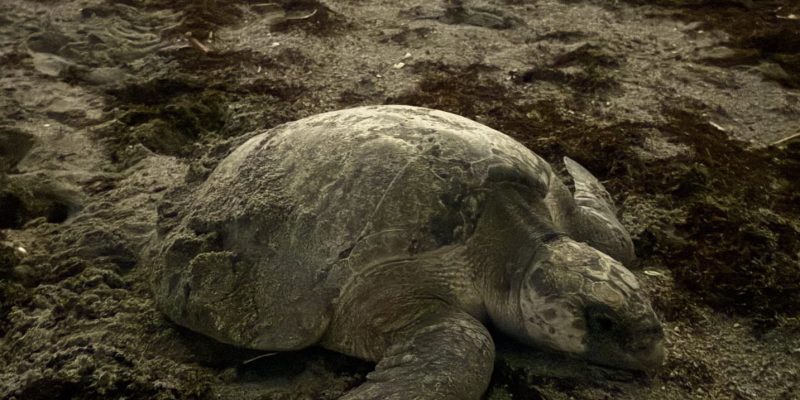
Researchers at Loggerhead Marinelife Center have documented an olive ridley sea turtle nesting in Florida, the first record of the species nesting anywhere in the state.
The turtle came ashore on Jupiter Beach on Monday, May 18, 2026. Staff named her Tini. Olive ridleys are normally seen nesting far to the south, on beaches in Brazil, Trinidad, Suriname and Gabon.
“Our team had been on the lookout for our usual third species of nesting turtles, green turtles, when this small and distinctive turtle came ashore to nest,” said Dr. Justin Perrault, vice president of research at the Juno Beach center.
What is an olive ridley sea turtle?
The olive ridley (Lepidochelys olivacea) is one of the smallest sea turtle species, named for the olive-green color of its heart-shaped shell. It is best known for a nesting behavior that has no real parallel among the other sea turtles.
“Olive ridley sea turtles are famous for their unique nesting strategies, which include solitary nesting and the ‘arribada,’ a mass-nesting event where thousands of females come ashore simultaneously,” Perrault said.
Florida’s beaches normally host three nesting species: loggerheads, greens and leatherbacks. Tini is a fourth.
Nesting counts are how the state tracks all of them. New England Aquarium researchers tagged a record 23 nesting leatherbacks in Puerto Rico this season, work that depends on the same kind of patrolling that turned up Tini.
Why would an olive ridley nest in Florida?
Researchers at the center offered several possible explanations rather than one. The species’ range may be shifting north as ocean temperatures rise. The population may be growing. And fishing pressure is a factor in a more roundabout way: turtles caught in gear can be carried passively into Florida waters after being injured and cut loose.
None of those has been established for Tini specifically. What the nest does is put a data point on the map where there was none.
What happens next
All records from the nesting event went to the Florida Fish and Wildlife Conservation Commission. After the nest hatches, the research team plans to collect genetic samples from it, which can indicate which population Tini belongs to.
They will also be watching the same stretch of coast to see whether she returns to nest again this season. Sea turtles typically lay several clutches in a nesting year, so a second Florida nest from the same animal is a real possibility.
Loggerhead Marinelife Center runs the sea turtle nesting survey for its stretch of Palm Beach County coastline, which is how a turtle that should not have been there was spotted at all.