
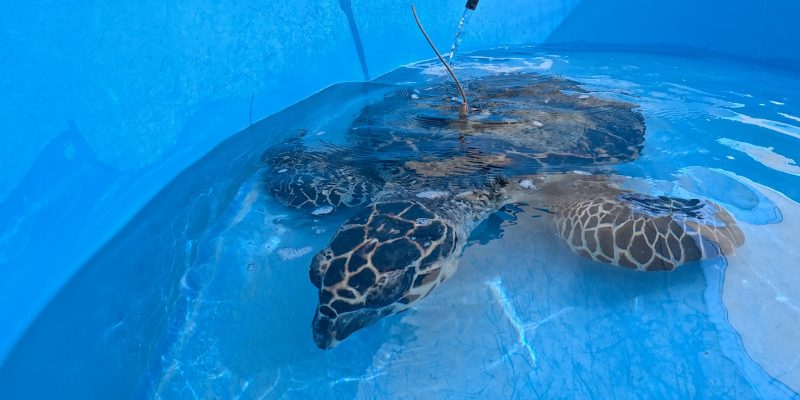
A hawksbill turtle called Amit went back into the Gulf of Eilat last Thursday, about a month after she was pulled out of a net strung in the water beside the Israeli navy base there. She is one of six hawksbills that hatched at the Underwater Observatory Park in Eilat roughly thirty years ago and were put into the gulf for the first time only last August.
The Israel Nature and Parks Authority published the account on November 23. Amit was treated at the authority’s National Sea Turtle Rescue Center, found fit for release, and taken back to the water she was found in, at the Coral Beach Nature Reserve. Shai Kabasa, an inspector with the authority’s marine unit, moved her from the center. Divers from the Underwater Observatory went in with her.
What else the net caught
The net was not fishing gear. The authority says the navy placed it to keep swimmers and divers out of the water around the base, which is a barrier doing exactly what a barrier is supposed to do, and that it then went on catching whatever swam into it.
By the authority’s account the same net killed a second hawksbill turtle and a blacktip shark, and caught a range of fish species, many of them protected. In a related incident a diving instructor freed another animal from it alive. That is the part of this story worth holding onto: Amit is the survivor of a larger toll, and a net does not know the difference between a diver and a Critically Endangered turtle.
Thirty years in a tank, then one summer of freedom
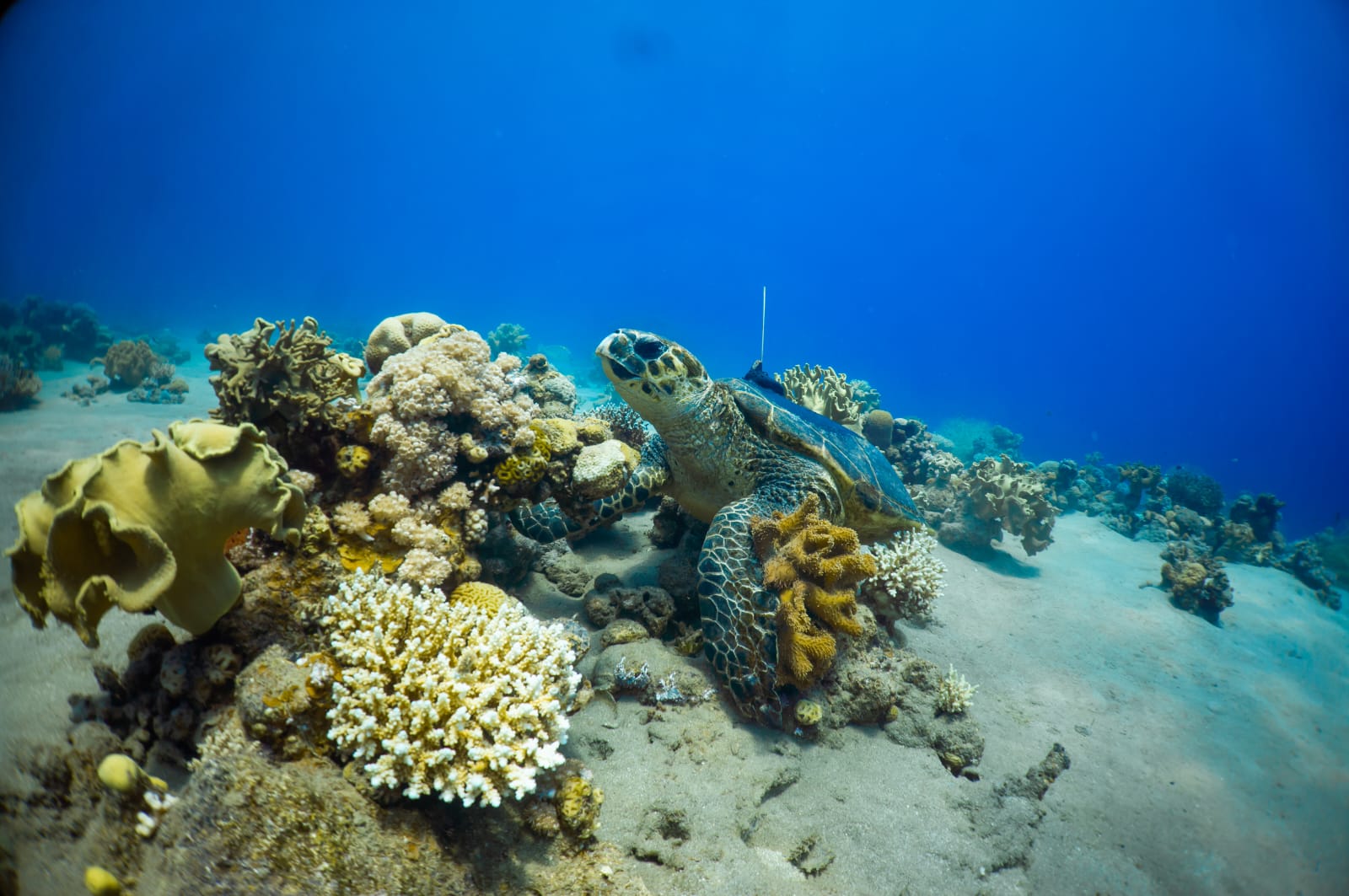
Amit’s biography is unusual enough to be worth stating plainly. She hatched at the Underwater Observatory Park in Eilat about three decades ago, and she and five other hawksbills stayed there. Last August all six were released into the Gulf of Eilat, a move the authority describes as strengthening a natural population it calls small and vulnerable, and in which every individual counts.
Aviv Levy, the Underwater Observatory’s scientific director, tracks the six animals in the wild. He said of Amit: “היא הספיקה לטייל לאורך כל מפרץ אילת לפני שנלכדה ברשת שהוצבה באזור בסיס חיל הים באילת.” In English: “She managed to travel the length of the whole Gulf of Eilat before she was caught in the net placed in the area of the naval base in Eilat.” Translation by ZooReviews.
So a turtle that had never navigated open water worked her way along the entire gulf in a matter of weeks. Then she met the one obstacle in it that was not there when she hatched.
The treatment, and the word to learn from it
Guy Ivgi, the lead caretaker at the authority’s sea turtle rescue center, described what was done: “חולצה בחיים והועברה לטיפול במרכז הארצי להצלת צבי ים, שם עברה טיפול מציל חיים שכלל הליך שטיפת ריאות.” In English: “She was rescued alive and taken for treatment at the National Sea Turtle Rescue Center, where she underwent life-saving treatment that included a lung lavage procedure.” Translation by ZooReviews.
Lung lavage is the term that does the work in that sentence. It means washing out the airways, and it is what a drowning animal needs rather than what an injured one needs. A sea turtle caught in a net cannot surface, and a reptile that breathes air and is held underwater takes seawater into its lungs. The procedure is the reason this was a month of rehabilitation and not a day of first aid, and it is why entanglement kills turtles that have no visible wound at all.
We have covered the same rescue center releasing loggerheads and green turtles that had swallowed plastic bags, and the authority working with the Underwater Observatory to free a wrasse with a fishing hook in its face at the same stretch of coast last week. The pattern in Eilat is consistent: the injuries arrive from gear in the water, and the same two organizations keep showing up to undo them.
Which zoos or aquariums fund this
On the money, the honest answer is the one we have reached twice before about this center. The National Sea Turtle Rescue Center is run by the Israel Nature and Parks Authority, a government body, and the charitable money behind it that we can name comes from the Israel Nature and Heritage Foundation, which is a foundation rather than a zoological institution. We looked again for an accredited zoo or aquarium funding this rescue and this release, and did not find one named.
The zoological facility in this story is not a distant donor. It is the Coral World Underwater Observatory Marine Park itself, which hatched these six turtles, held them for thirty years, put them into the gulf in August, monitors them through its scientific director, and sent its divers to the release. That is participation rather than philanthropy, and it is the reason this article carries the observatory and nothing else.
For scale on the wider question, the Association of Zoos and Aquariums reports that in 2025 its 235 accredited and certified facilities spent approximately $372.4 million on conservation across 139 countries. None of that figure can be traced to this particular turtle.
What the lists actually say
The authority describes the hawksbill as critically endangered globally, and that is almost certainly right, but it is worth naming which list is being quoted. NOAA Fisheries, which we were able to open, lists the hawksbill as Endangered under the United States Endangered Species Act and on Appendix I of CITES. Those are two separate instruments with separate vocabularies, and neither of them is the IUCN Red List.
The Red List page for the species returned a refusal to both of our machines this week, as it has for several weeks, so we are not printing a Red List category we could not open and read. The authority’s own wording stands as the authority’s, and the two listings we could verify are stated above as what they are.
One wrinkle in the dates
The release gives 17 September 2026 as the day Amit was caught in the net, and also describes about a month of rehabilitation before a release last Thursday, which would be 19 November. Those two do not quite meet in the middle. We are printing both as the authority gives them rather than choosing one, and the figure that matters either way is the same: she was in care long enough to need a lung wash, and long enough that getting her back was not a foregone conclusion.
What happens next is a tracking question
The observatory’s monitoring is the thing that makes this more than a good afternoon. Amit was followed through her first summer in the gulf closely enough that her movements are described in weeks, which means a second entanglement, or a long quiet stretch of normal behavior, will both be visible.
Six animals is not a population. It is an addition to one, and the gulf is small, busy and ringed with infrastructure. The useful measure of the August release will not be that all six went in, but how many are still swimming a year from now.
Quick answers
- What happened to the hawksbill turtle Amit?
She was caught in a net strung in the water beside the Israeli navy base at Eilat, rescued alive, and treated at the Israel Nature and Parks Authority’s National Sea Turtle Rescue Center, where the care included a lung lavage procedure. After about a month she was found fit for release and returned to the Gulf of Eilat at the Coral Beach Nature Reserve.
- Why is a turtle that hatched in captivity being released now?
Amit is one of six hawksbills that hatched at the Underwater Observatory Park in Eilat roughly thirty years ago. All six were released into the Gulf of Eilat for the first time last August, which the authority describes as strengthening a natural population it calls small and vulnerable. Amit had been free for a few weeks, and had travelled the length of the gulf, when she was netted.
- What else was caught in the same net?
The authority says the net, placed to keep swimmers and divers away from the base, also killed a second hawksbill turtle and a blacktip shark and caught a range of fish species, many of them protected. A diving instructor freed another animal from it alive in a related incident.
- Which zoos or aquariums funded this rescue?
None that we could verify. The rescue center is run by the Israel Nature and Parks Authority, a government body, and the charitable supporter we can name is the Israel Nature and Heritage Foundation rather than a zoological institution. The zoological facility in the story is the Underwater Observatory Park itself, which hatched the turtles, held them, released them in August, monitors them and sent divers to this release.