Before the bait went down on Alphonse Atoll, somebody had to move the tortoises. All 187 wild Aldabra giant tortoises on the island were gathered into a secure enclosure and kept there while the rats were removed, which is the sort of logistical detail that tends to get left out of the word “eradication.”
The Island Conservation Society set out the operation on October 19: a coordinated removal of rats, mice, feral cats and feral chickens from an atoll in the Seychelles outer islands, run with the Alphonse Foundation, the Islands Development Company, Blue Safari Seychelles and outside specialists. It is technically led by Island Biodiversity and Conservation, with Dr Gerard Rocamora directing the eradication work.
What is actually on the island, and why it matters
Alphonse has been worked by people for more than two centuries. From the 18th century it was a commercial coconut plantation, and the shipping that built the plantation brought rats, while the people brought cats for company and chickens for food. On a small isolated island, each of those is a different kind of problem.
Rats and cats eat seabirds, and both will climb a tree to take a fledgling off its perch. Chickens are the less obvious case: they are invasive here because they compete with small reptiles for food, occupy the same ground that ground-nesting species need, and turn over the leaf litter that invertebrates live in.
The Society has run a permanent conservation center on Alphonse since 2007, monitoring seabirds, sea turtles, marine ecosystems and native habitat, and that nineteen-year record is what made a credible eradication plan possible. In an account published in February 2025, its conservation officer Jack Coupland described the symptom the monitoring kept producing: “Whilst we get large numbers of roosting seabirds, our breeding populations have always been small with low success rate.” At that point the island was estimated to hold around 400 chickens and more than 30 cats, and a full-time staff member had already removed 21 cats and over 200 chickens across seven months.
The sequence, which is the whole trick
An eradication is not one operation but several, run in an order that does not allow the survivors of one to benefit from another.
Feasibility studies began in January 2026. An island-wide biodiversity assessment followed in March, establishing the baseline that any claim of recovery will later be measured against, which is a step that is easy to skip and impossible to reconstruct afterwards. The island was then physically prepared: vegetation trimmed, green-waste areas cleared so there was nowhere for rodents to shelter or feed, and staff trained. The tortoises went into their enclosure.
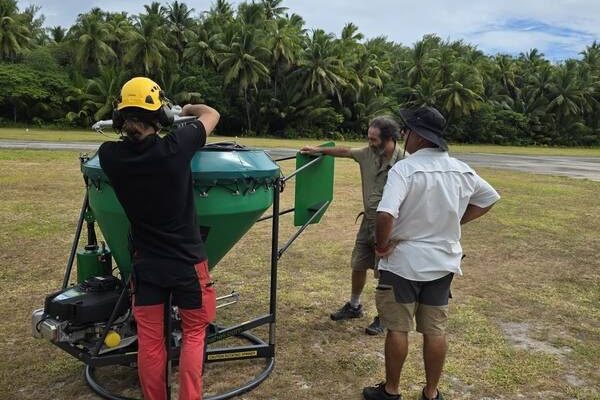
Rat eradication ran from June into July, with intensive trapping and monitoring continuing through October to confirm that none remain. Mice were targeted separately, concentrated around buildings and staff areas where they persist. Cats were worked between June 23 and September 2 using targeted baiting, camera traps and island-wide searches, and that phase has now shifted to surveillance to confirm the island stays cat-free. The feral chickens are last, with systematic searches still under way.
“Many seabirds, reptiles and invertebrates cannot live in the presence of introduced rats and cats,” Dr Rocamora said. “We need to restore these small islands to create sanctuaries where ecological conditions are as close as possible to those that prevailed before humans arrived. Alphonse is now being given that opportunity.”
What recovery would look like
The species the Society expects to respond first are the wedge-tailed shearwater and the white-tailed tropicbird, both of which nest where a rat can reach them. Native vegetation and ground-dwelling invertebrates should follow as the pressure from rodents and chickens comes off.
The part worth understanding is what happens after that, because it is the reason island eradications pay for themselves. Seabirds feed at sea and defecate on land. A recovered colony is a nutrient pump running from the ocean into the soil, and the guano it delivers enriches the ground, drives plant growth and feeds an invertebrate community that in turn supports everything else. The same nutrients wash back out onto the reef. Removing a rat from a small island is, in the end, a way of fertilizing it.
The land is only half of what the Society watches on this atoll. It also runs a satellite tagging program on the sharks of the surrounding marine protected area, which we covered on November 6. The same organization is counting what lives on the island and what swims around it, and the guano argument is the sentence that joins the two.
Which zoos or aquariums are funding this
None that we could verify. The partners the Society names for this operation are the Alphonse Foundation, the Islands Development Company, Blue Safari Seychelles and Island Biodiversity and Conservation: a private island foundation, a Seychelles state company, a tourism operator and a technical consultancy. Its own about page describes partners as “national and world leaders in conservation” without listing them, and its partners page returns a 404. We searched the zoos’ side as well and found no accredited institution named in connection with Alphonse.
Island eradications of this kind are frequently zoo-funded elsewhere, and the American Zoo and Aquarium Association reports its 235 accredited and certified facilities spent roughly $372.4 million on conservation across 139 countries in 2025. We could not connect any of it to this island, and would rather say so than invent a link.
Quick answers
- What is being removed from Alphonse Atoll?
Rats, mice, feral cats and feral chickens. The Island Conservation Society is running the operation with the Alphonse Foundation, the Islands Development Company, Blue Safari Seychelles and outside specialists, and it is technically led by Island Biodiversity and Conservation under Dr Gerard Rocamora.
- Why were the giant tortoises moved?
To keep them out of the way of the eradication work. All 187 wild Aldabra giant tortoises on the island were gathered into a secure enclosure for the duration.
- What is the timeline?
Feasibility studies began in January 2026 and an island-wide biodiversity assessment followed in March to establish a baseline. Rat eradication ran from June into July, with trapping and monitoring continuing through October. Cats were worked between 23 June and 2 September and that phase is now in surveillance. Feral chickens are the last target.
- Which zoos or aquariums fund this work?
None that we could verify. The named partners are a private island foundation, a Seychelles state company, a tourism operator and a technical consultancy. The Society's about page does not list its partners and its partners page returns a 404, and we found no accredited institution named in connection with Alphonse.