Ol Pejeta Conservancy has put 745 improved clay cookstoves into 22 communities living within five kilometers of its fence line, and the reason a wildlife conservancy is in the stove business is arithmetic: the stoves cut household fuel use by half, and the fuel in question is wood cut from the same landscape the conservancy is trying to keep intact.
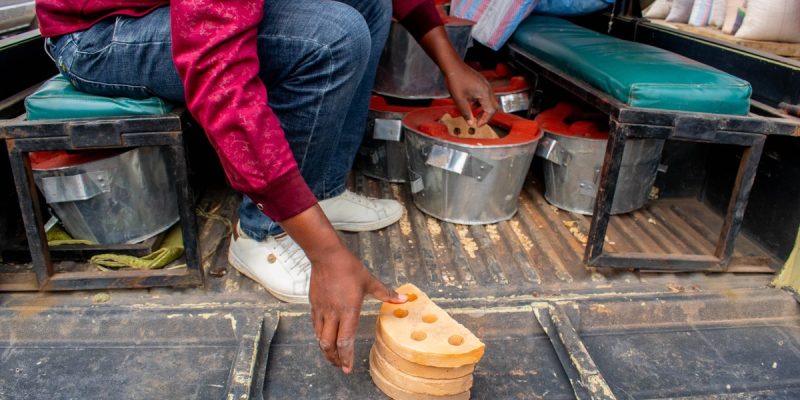
The project began in March 2025 with support from the Darwin Initiative, the British government’s biodiversity fund, and is now carried forward by Die Ofenmacher, a German association whose entire purpose is replacing open cooking fires with enclosed stoves. It works in Nepal, Ethiopia, Tanzania and Kenya. The stove itself is a jiko, the Kiswahili word for a cookstove, and the improved version is a liner of fired clay brick seated inside a metal jacket, which traps heat that an open three-stone fire sends straight into the room.
What does an improved stove actually change?
Two numbers, both from the conservancy: cooking time falls by 55 percent and fuel consumption by 50 percent. Those are the figures, and the women using the stoves describe what they mean in practice.
“Before we got this jiko, we used to spend a lot of money buying firewood for cooking,” Faith Kibenei, who lives in the Sweetwaters community, told the conservancy. “Now we buy much less because the stove uses very little fuel. The money we save can go towards other important household needs, such as farming activities and supporting our families.”
Ann Wairimu, also in Sweetwaters, framed it as a scarcity problem rather than a budget one. “These days, finding firewood and charcoal is not easy,” she said. “There are fewer trees around, and sometimes you must walk quite far to find something to cook with. This jiko has really helped us because even the little firewood we manage to get is enough to prepare our meals.” In Chuma, Lydiah Wangui said the stove had taken the labor out of the task: “I don’t have to keep adding wood to the fire every now and then. It saves fuel and makes cooking less tiring.”
There is a health half to this as well. Reginah Muthoni, in neighboring Mirera, had been coming home to a kitchen full of smoke that aggravated her failing eyesight. The enclosed firebox is what fixes that, and it is the reason stove programs are usually counted as public health work before anyone counts the trees.
Why the conservancy builds them instead of buying them
Ol Pejeta did not import finished stoves. It trained local makers to build, repair and maintain them, which means a cracked liner is a job for a neighbor rather than a reason to go back to the open fire once the project phase ends. It also means the skill stays in the community as a livelihood.
The demand signal is coming from the fences. In Chuma, women from nearby households have been looking over to see the stoves for themselves and asking to have one built. “One of the most encouraging signs of the project’s impact is the growing demand from households,” said project lead Joseph Ikaria. “I receive calls from people across almost all the communities we work with, requesting more stoves and asking when we can extend the program to their households.”
Which zoos are behind this? None that we could find
ZooReviews traces the funding behind African conservation work to the accredited zoos and aquariums that pay for it, because that chain is real more often than people expect. On this project it is not. The two funders the conservancy names are the Darwin Initiative and Die Ofenmacher, a government biodiversity fund and a cookstove charity. Ol Pejeta’s own partners page renders its partner list in JavaScript and lists nobody in the page source, so there is no second list to check against. We looked for a zoological institution behind these 745 stoves and did not find one.
That is worth saying precisely, because a zoo is at work at Ol Pejeta, on something else entirely. Safari Park Dvůr Králové in the Czech Republic is one of the three organizations the BioRescue consortium names as supporting its mission to save the northern white rhino, alongside the Rewind Rhino Foundation and Ol Pejeta itself, and Dvůr Králové scientists have worked on the oocyte collections carried out on the conservancy. That is a genuine zoo presence on this property. It has nothing to do with the cookstoves, so it earns no place in this story beyond this paragraph.
The quiet case for counting stoves as conservation
“At Ol Pejeta, community livelihoods and wildlife conservation are deeply intertwined,” the conservancy’s account argues, and the mechanism it claims is modest and checkable: less firewood and charcoal burned means less pressure on the surrounding ecosystems. The conservancy does not put a number on trees saved, and neither will we. What it does put a number on is 745 stoves, 22 communities and a five kilometer radius, with the demand curve still pointing up.
Source: Ol Pejeta Conservancy, published 16 November 2026, written by Sam Miller. Ol Pejeta’s water master plan is the same argument applied to boreholes.
Quick answers
- How many cookstoves has Ol Pejeta installed?
745, in both portable and permanent models, across 22 communities living within a five kilometer radius of the conservancy. The project began in March 2025.
- How much fuel does an improved jiko save?
Ol Pejeta reports that the improved clay-brick stoves cut cooking time by 55 percent and fuel consumption by 50 percent compared with an open fire. A jiko is the Kiswahili word for a cookstove.
- Which zoos fund this project?
None that could be verified. The two funders Ol Pejeta names are the Darwin Initiative, a British government biodiversity fund, and Die Ofenmacher, a German cookstove association. Safari Park Dvur Kralove does work at Ol Pejeta through the BioRescue northern white rhino program, but that is a separate project and is not behind the stoves.
- What does a cookstove have to do with wildlife?
Fuel. The wood and charcoal burned in open fires is cut from the landscape around the conservancy, and residents say trees have grown scarce enough that they must walk long distances to find firewood. Halving the fuel each household burns reduces that pressure.