Jackals use the culverts under Israel’s Highway 6. So do foxes, badgers and porcupines. Gazelles will not go through a tunnel, and that single behavioral fact is why Israel has just approved building them a bridge instead.
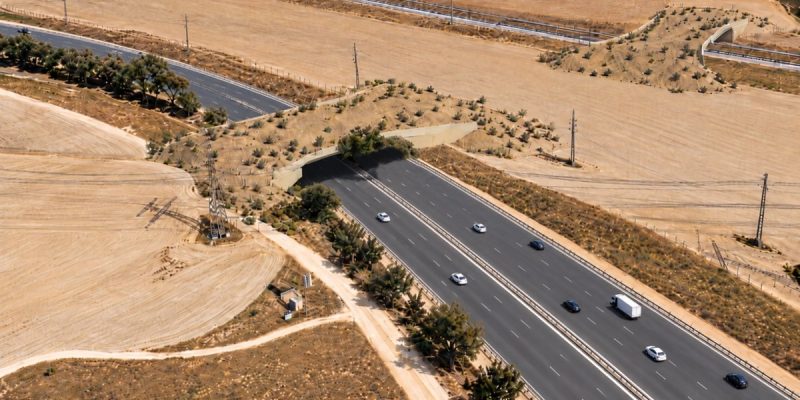
The National Council for Planning and Building cleared the continued advancement of a plan, initiated by the Israel Nature and Parks Authority, for an overhead ecological crossing over Highway 6 near the Ma’ahaz Interchange and the Pura Nature Reserve in the northern Negev. The authority announced the decision on November 9. The structure as planned is about 50 meters wide and about 80 meters long, planted and carried over the top of the traffic.
The mechanism, not the metaphor
It would be easy to file this as a feel-good green bridge story. The actual engineering problem is narrower and more interesting: the existing underpasses in the area work, but they work for the wrong animals.
Dr. Yariv Malihi, the authority’s Central District ecologist, set out the asymmetry. Jackals, foxes, badgers and porcupines are able to use the underpasses that already exist, including those on the Pura, Shikma and Adorayim streams. Gazelles hardly use them at all. An open-country animal that relies on sight lines and on the ability to run does not willingly walk into a concrete box, and no amount of additional underpass capacity changes that.
So the barrier stands. The authority’s assessment is that the transport infrastructure in this corridor, Highway 40, Highway 6 and the railway together, now isolates the gazelle population in eastern Lachish from the gazelle population in the Shikma area. Those are two halves of what used to be one population, and the fix is not a fence gap or a warning sign. It is a surface the animals will voluntarily walk across.
What it connects
The crossing sits on a national ecological corridor: a chain of protected natural areas running from the southern Judean hills, through the Lachish region and the hills of the Shephelah, out to the Nahal Shikma expanses and the Ruhama badlands. Highway 6 cuts it.
The plan’s second half is the part that makes it work. The approved crossing over the highway will link up with a separate ecological crossing, already approved, over a railway line planned for the same area. Two structures, one continuous route, so an animal moving between the two halves of the corridor clears both pieces of infrastructure without ever touching ground traffic. The overhead crossing was designed with the help of the landscape architect Shai Harnoy.
The siting was not a matter of picking a convenient gap in the traffic. The authority says the planning work included a full ecological analysis using models that predict where gazelles live and which movement routes they prefer, and that three alternative locations were weighed against each other on ecological, planning, engineering and economic grounds before this one was chosen.
What the planner said
Mira Avneri, the authority’s Central District planner, made the case in terms of what a highway does to an animal population rather than to an individual animal.
“עבור הצבאים, כביש מהיר הוא לא רק סכנת דריסה, אלא גם מחסום שמפריד בין אוכלוסיות ומגביל את יכולתן לנוע ולהתרבות. המעבר האקולוגי המתוכנן יאפשר לחבר מחדש בין אזורי מחיה חשובים ולשפר את סיכוייהן של אוכלוסיות חיות הבר להתקיים לאורך זמן.”
“For the gazelles, a highway is not only a danger of being run over, but also a barrier that separates populations and limits their ability to move and to reproduce. The planned ecological crossing will make it possible to reconnect important living areas and to improve the chances of wildlife populations persisting over time.”
The Hebrew is the authority’s and the English translation is ours. Avneri added that overhead ecological crossings are already operating elsewhere in Israel and that the authority monitors them, and framed the approval as evidence that national infrastructure can be planned around the animals living beside it.
The species, and the two population figures
The animal at the center of this is the mountain gazelle, Gazella gazella, often called the Israeli gazelle. The authority describes it as a species in danger of extinction, and on this the assessment agrees with the agency: the IUCN Red List lists Gazella gazella as Endangered under criterion A2acd, assessed by the IUCN SSC Antelope Specialist Group, with a decreasing population trend.
Where it gets worth reading carefully is the count. The Red List entry gives 2,500 mature individuals, and that assessment was published in 2017 from work dated 2016. A 2021 paper in the journal Oryx describes Israel as the species’ last remaining stronghold with about 5,000 individuals. The two numbers are not in conflict so much as they are different quantities: mature individuals is a smaller category than all individuals, and the paper is five years the newer document. We give the Red List category because it is the one anybody can go and check, and we give both counts with their sources attached rather than picking the flattering one.
Either way, the number is small enough that genetics is the point. Connectivity between the Lachish and Shikma groups raises genetic diversity, and genetic diversity is what carries a population of this size through a bad decade.
Who funds this
We trace the accredited zoos and aquariums behind conservation work wherever we cover it. There are none behind this one. The initiative is the parks authority’s, the approval came from a national planning body, and the named outside contributor is a landscape architect. No zoological institution appears in the authority’s account, and inventing a connection to fill the line would be worse than leaving it empty.
It is, though, the same agency whose gazelle work we have covered before, when it published its annual count of dorcas gazelles in the Negev. Counting the animals and then building a 50 meter bridge so two groups of them can meet are the same program at two different stages, and the second one only makes sense if somebody has been doing the first.
Quick answers
- Why build a bridge when underpasses already exist?
Because gazelles will not use them. The Israel Nature and Parks Authority says jackals, foxes, badgers and porcupines pass through the existing underpasses on the Pura, Shikma and Adorayim streams, but gazelles hardly use them at all. An open-country animal that relies on sight lines does not walk into a concrete box.
- How big is the planned crossing?
About 50 meters wide and about 80 meters long, planted and carried over the top of Highway 6 near the Ma’ahaz Interchange and the Pura Nature Reserve in the northern Negev. It was designed with the help of the landscape architect Shai Harnoy.
- What does it connect?
A national ecological corridor running from the southern Judean hills through the Lachish region and the hills of the Shephelah to the Nahal Shikma expanses and the Ruhama badlands. It will link up with a separate crossing, already approved, over a railway line planned for the same area.
- How many mountain gazelles are left?
The IUCN Red List lists Gazella gazella as Endangered under criterion A2acd and gives 2,500 mature individuals, in an assessment published in 2017 from 2016 work. A 2021 paper in Oryx describes Israel as the species’ last remaining stronghold with about 5,000 individuals. Mature individuals and all individuals are different quantities.