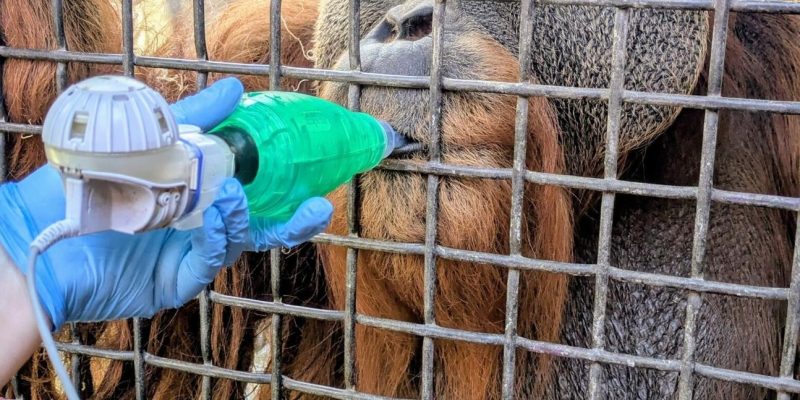
Twice a day, every day, a 42-year-old male orangutan named Busar sits down face to face with a keeper at Fresno Chaffee Zoo and breathes in and out through a flutter valve for the better part of an hour. He is not restrained and he is not sedated. He can leave whenever he likes. He almost never does.
That is roughly two hours of voluntary medical treatment a day, and it is the most demanding thing any animal at the zoo is asked to do.
What is ORDS?
Orangutan respiratory disease syndrome, or ORDS, is a chronic bacterial infection and inflammation of the respiratory tract that is essentially unique to orangutans. It can settle in the sinuses, the airways, the lungs, the bones of the skull, or the air sacs, which are the inflatable throat structures a male orangutan uses to make his long call carry. Fresno Chaffee Zoo puts the share of orangutans in human care who develop it at about 20 percent.
The zoo describes the condition as believed to resemble cystic fibrosis in humans. The published work has gone a step further than that hedge. A 2021 study in the American Journal of Primatology identified a nonsense variant in the orangutan version of the CFTR gene, the same gene responsible for cystic fibrosis in people, and showed it produced no full-length protein. The authors traced the allele through a pedigree and proposed screening the managed population for it.
So the resemblance is not only a resemblance, at least for some animals. It is the same gene.
The diagnosis they could not get
Busar was born in 1984 at the Yerkes National Primate Research Center in Atlanta and came to Fresno in 1997, at 13. He has fathered four offspring here: Labu and N’dari in 2010, Hantu in 2018, and Marigold this year. He lives in the zoo’s Kingdoms of Asia.
His symptoms began as allergy-like flare-ups and worsened with age. Confirming ORDS properly means imaging, and that is where the story stalls. The zoo needed an MRI machine large enough for an adult male orangutan, at a facility willing to admit a non-human primate, close enough that Busar could be driven there and back safely in one go. No machine met all three conditions. The zoo looked and did not find one.
Without imaging there is no confirmed diagnosis, and without a diagnosis the team treats what it can see. That is an honest limit, and it is worth sitting with: a large accredited zoo with a full veterinary department could not get a scan on a patient because the patient weighs what he weighs and is the species he is.
An hour at a time, with audiobooks
Busar’s treatment has changed as the field has. He spent years on oral and nasal spray medications. In early 2023 he started inhaling a regimen through a nebulizer, which meant training him to breathe deliberately through a valve and then to keep doing it, in one position, for close to an hour.
That approach is where the research has landed too. A 2024 paper in the Journal of Zoo and Wildlife Medicine describes long-term management of chronic ORDS in three adult male Bornean orangutans at a rehabilitation center in Indonesia, using nebulized drugs in combination regimens adapted from how human bronchiectasis is treated. The paper is blunt that ORDS causes progressive structural damage and that the goal of chronic treatment is to stabilize respiratory function, reduce flare-ups and keep the animal well, rather than to cure anything.
Which is why the hour matters. Keepers break the sessions up with other trained behaviors, exercises, games and food rewards, and they have played him a fair quantity of audiobooks and podcasts over the years, on the reasoning that a human sitting still for an hour twice a day needs enrichment too.
The rest of Busar’s medical training is the ordinary extraordinary stuff of a modern ape department. He presents an arm for a blood draw, opens his mouth to have his teeth brushed, offers his stomach for an ultrasound, gives urine samples, and stands on a scale that doubles as an X-ray station. He takes practice injections so a real one is uneventful.
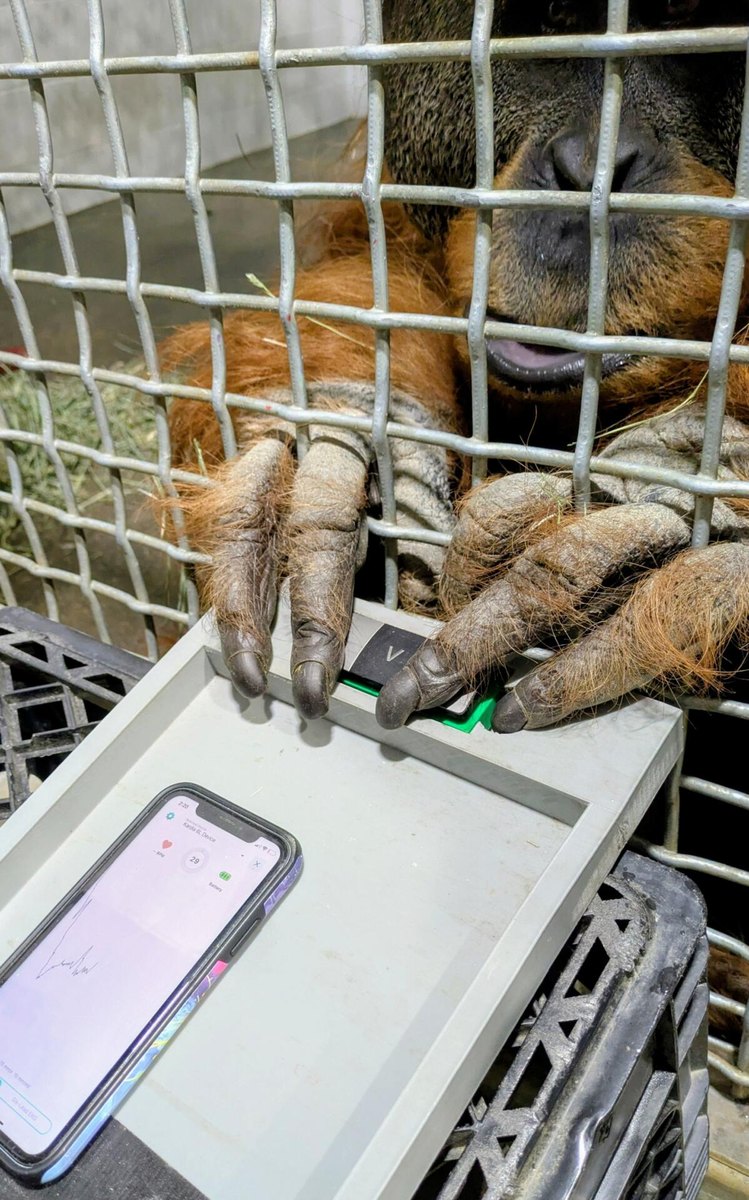
Recently the veterinary team added his heart. Cardiovascular disease accounts for about a fifth of deaths among orangutans in human care, by the zoo’s figure, so Busar has learned to press his fingers onto the sensors of a handheld EKG device and hold them there while a reading is taken. The practical obstacle, which is the kind of detail that only turns up in doing it, is that orangutans tend to press things with their fingernails rather than the pads of their fingers, and a fingernail does not complete the circuit.
Why voluntary is the whole point
None of this is cooperation for its own sake. Every behavior on that list is a procedure that would otherwise require anesthesia, and anesthesia on a geriatric ape with compromised lungs is exactly the thing you do not want to do twice a year. Training is what converts a medical emergency into a Tuesday.
Fresno Chaffee Zoo cares for five orangutans, and the group has a collective noun the keepers like: a buffoonery. The same team recently managed the Species Survival Plan transfer of its lions Asali and Taraj, which is the other half of this job, the part that moves animals between institutions.
Busar is not going anywhere. He makes thick nests on the ground every night and tends to stay in bed until somebody brings him a treat, which at 42 seems fair. Then he gets up, takes his vitamins in a spoonful of yogurt, and goes to work on his breathing.
Quick answers
- Who is Busar?
A 42-year-old male orangutan at Fresno Chaffee Zoo. He was born in 1984 at the Yerkes National Primate Research Center in Atlanta and came to Fresno in 1997.
- What is ORDS?
Orangutan respiratory disease syndrome, a chronic bacterial infection and inflammation of the respiratory tract that is essentially unique to orangutans. It can affect the sinuses, airways, lungs, skull bones and air sacs.
- How common is ORDS?
Fresno Chaffee Zoo puts the share of orangutans in human care who develop it at about 20 percent.
- Is ORDS really like cystic fibrosis?
A 2021 study in the American Journal of Primatology identified a nonsense variant in the orangutan CFTR gene, the same gene responsible for cystic fibrosis in humans, and showed it produced no full-length protein.
- How is Busar treated?
He inhales a regimen of medications through a nebulizer, breathing through a flutter valve for close to an hour, twice a day. He participates voluntarily and is neither restrained nor sedated.
- Why has Busar never been formally diagnosed?
Confirming ORDS needs imaging. The zoo could not find an MRI machine that was large enough for an adult male orangutan, would admit a non-human primate, and was close enough for a safe round trip.
- What other medical behaviors do the orangutans know?
Presenting an arm for a blood draw, opening the mouth for tooth brushing, presenting the stomach for an ultrasound, giving urine samples, standing on a scale that doubles as an X-ray station, and taking practice injections.
- Why does the zoo check his heart?
Cardiovascular disease accounts for about a fifth of deaths among orangutans in human care, by the zoo's figure. Busar presses his fingers onto the sensors of a handheld EKG device so a reading can be taken.