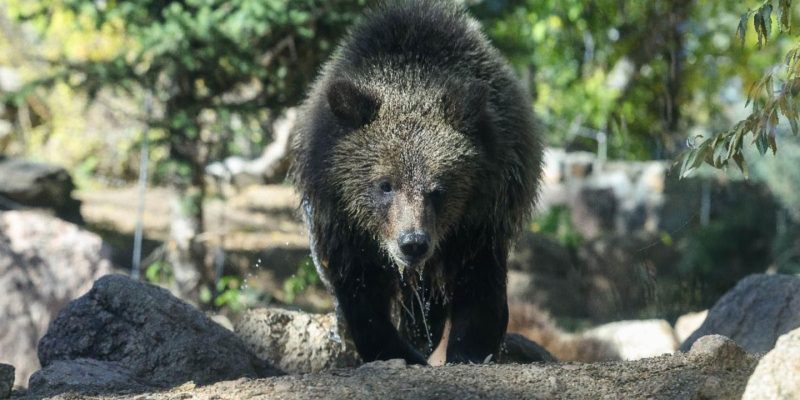
Two orphaned grizzly bear cubs went on public view at Cheyenne Mountain Zoo on Tuesday, November 10, in a renovated yard in Rocky Mountain Wild. Scout and Ranger have two adult grizzlies as neighbors and will not share space with them. The barrier between the two groups is permanent, and it is the thing that makes the arrangement work.
The cubs had the renovated yard to themselves the day before, Monday, November 9, which was the first time they had been in it. The zoo’s account of that first afternoon is mostly noses: the two of them working their way around the space, sampling snacks, and then, having established that nothing in it was dangerous, descending into zoomies and wrestling matches.
What is a howdy?
It is the industry’s word for a controlled introduction in which two animals can see, hear and smell each other through a barrier without ever being able to reach each other. Nothing is risked and both parties get used to the idea.
Scout and Ranger have been doing howdies with Emmett and Digger, the zoo’s two 21-year-old grizzlies, through protective barriers. The care team is working with all four so that each pair knows the other exists. What it is not building toward is a merger. The cubs and the adults are neighbors by design, and the zoo has said plainly that they will not share space.
That distinction matters more than it sounds. A visitor who reads “the cubs joined the grizzly habitat” pictures four bears in one yard, and that picture is wrong. What has actually been built is adjacency: separate space, shared fence line, supervised familiarity.
How they got here
Scout and Ranger arrived at Cheyenne Mountain Zoo in June 2026, at six months old, after a ten-hour drive from Montana. They came because their mother, an adult female grizzly with a long history of conflicts with people and with human food sources, was euthanized, and two six-month-old cubs cannot feed themselves.
That is the whole of the loss, and the rest of this is what came after it. Two cubs that had no prospects in Montana got a ten-hour drive, a care team and a yard. The zoo says they are grandcubs of 399, a well-known wild grizzly, which gives the story a lineage most orphan cases do not have.
Cheyenne Mountain Zoo used the naming to raise money. The public voted on pairs of names at a five dollar minimum donation, and the winning pair, Scout and Ranger, was chosen to stand for the people and organizations who work on grizzly habitat. With the zoo’s own conservation funds added, a total of $18,000 went to the Vital Ground Foundation’s work protecting and restoring grizzly habitat in Montana, which is where the cubs came from. We covered the naming vote and the cubs’ arrival when it ran.
The quiet zone, and why it is not a gimmick
The viewing area sits in a designated quiet zone. The zoo’s request is straightforward: guests who keep their voices down are more likely to see the cubs out and active, and guests who do not are more likely to see an empty yard, because Scout and Ranger have access to behind-the-scenes dens whenever they want them.
That is not a rule invented to manage crowds. It is a description of how a young bear decides whether to be visible. Giving an animal somewhere to go is the design choice, and the quiet is what makes the animal less likely to use it.
What grizzlies are, officially
The grizzly bear, Ursus arctos horribilis, is a brown bear, and the brown bear as a species is not globally at risk. The population in the lower 48 states is a different matter: the U.S. Fish and Wildlife Service has listed it as Threatened under the Endangered Species Act since July 28, 1975, with a separate experimental population designation added in 2000.
Which is the context for the sentence the zoo chose to build its announcement around, and it is not a cheerful one: the cubs are here because of human food, human garbage and human proximity. The zoo’s own framing is that if wildlife can sense you, you are too close.
There is more coming to that corner of the zoo. Cheyenne Mountain is preparing for the arrival of two rescued moose calves, on a seventeen-hour journey from Alaska.
Quick answers
- When did Scout and Ranger go on public view?
Tuesday, November 10, 2026. They explored the renovated yard for the first time the day before, on Monday, November 9.
- Will the cubs live with the adult grizzly bears?
No. Scout and Ranger will not share space with Emmett and Digger, the two 21-year-old grizzlies at Cheyenne Mountain Zoo. They are neighbors, with a permanent barrier between them.
- What is a howdy?
A controlled introduction in which two animals can see, hear and smell each other through a barrier without being able to reach each other. The cubs have been doing howdies with the adult grizzlies.
- Why are Scout and Ranger at a zoo?
They were orphaned in Montana. Their mother, an adult female grizzly with a long history of conflicts with people and with human food sources, was euthanized, and the cubs were six months old. They arrived at Cheyenne Mountain Zoo in June 2026 after a ten-hour drive.
- Why is the viewing area a quiet zone?
The cubs have access to behind-the-scenes dens whenever they want them. Guests who keep their voices down are more likely to see them out and active.
- How much did the naming vote raise?
With conservation funds from the zoo added, a total of $18,000 went to work by the Vital Ground Foundation to protect and restore grizzly habitat in Montana, where the cubs came from.
- Are grizzly bears endangered?
The U.S. Fish and Wildlife Service has listed the grizzly bear in the lower 48 states as Threatened under the Endangered Species Act since July 28, 1975, with a separate experimental population designation added in 2000. The brown bear as a species is not globally at risk.