
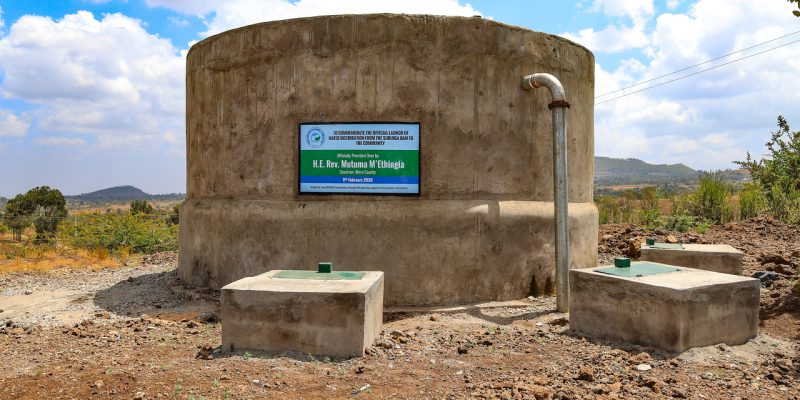
The plaque bolted to the side of the new concrete water tank at Subuiga, in Kenya’s Meru County, records the date as February 11, 2026, names the Meru County governor who presided, and ends with a line that explains why a zoo news site is writing about a dam: funded by the Lewa Wildlife Conservancy through the support of its partners and donors.
One of those partners is Zoo Zurich.
The Subuiga Dam and its community distribution tank were launched that week after three years of construction, and when fully operational the reservoir is expected to serve more than 10,000 residents of Matunda, Ntumburi and Subuiga: drinking water, cooking and washing water, and water for the smallholder farms that most of the local economy rests on.
What the money actually bought
Built between 2023 and 2025, the project was led by the Lewa Wildlife Conservancy through its community development program, and the list of parties needed to finish it is long enough to be the story in itself. Lewa worked with Kenya’s Ministry of Water and Irrigation, the Water Resource Authority, the Meru County Government, the local Water Resources Users’ Association and Kisima Farm, which donated the land the dam now sits on, turning private ground into a shared public resource.
The funding came from Zoo Zurich alongside Al Pace and the Rees Jones, Donner Canadian and Clean Water foundations.
The water users’ association did the work that infrastructure projects usually discover they needed afterwards: mobilizing residents and setting the terms for responsible use. A dam is only as good as the agreement about who draws from it, and Lewa is open that the reservoir’s long-term value depends on how carefully it is managed rather than on the concrete.
Why a Swiss zoo is paying for Kenyan water
This is the part that tends to surprise readers, and it is the most ordinary thing in the story to anyone who works in field conservation.
Zoo Zurich has supported Lewa since 1998, formalized as a partnership in 2019, and its support has never been confined to wildlife. The zoo’s own account of the project describes funding classrooms, local healthcare and sustainable agriculture in the communities around the conservancy, alongside equipping the rangers and patrols that protect its wildlife. We reported on that ranger work in September, when 24 black and white rhinos were notched across the Lewa-Borana Landscape. The dam and the notching operation come out of the same relationship.
The logic is not charity attached to a conservation program. It is the conservation program. Lewa sits inside a landscape where people and wildlife use the same water, and where a failed harvest or a dry well pushes households toward the choices that conservancies spend their budgets trying to prevent. John Kinoti, head of programs and partnerships at Lewa, stated the connection directly: “Conserving wildlife goes hand in hand with improving livelihoods. This project shows how water security and sustainable development support conservation.”
Lawrence Mutuma, who heads community development at the conservancy, put the problem in terms of the rain rather than the budget. “Our surface and groundwater are under growing pressure, and so is the way people make a living,” he said. “When wells run dry, crops fail and livestock suffer. The path forward is clear. We must turn the rainy season from a fleeting moment into a year-round lifeline. By harvesting rain and managing it responsibly, we secure our food, our incomes and the future of our community.”
The figure to watch
The 10,000 residents is a projection, not a count. It is what the reservoir is expected to serve when fully operational, and a water project’s real test arrives in its second and third dry season rather than at the ceremony. Lewa has published nothing further about Subuiga since the launch, so for now the number stands as an expectation on a plaque.
What is already true is the shape of it. An accredited European zoo, a Kenyan conservancy, a county government, a national ministry, a commercial farm and a residents’ association built a reservoir together, and the zoo’s share of it is a line item that will never appear in an exhibit. Readers who want to see how the same thinking plays out on a larger scale can read our report on Ol Pejeta’s water master plan, a few hours’ drive west in Laikipia.
Zoo Zurich publishes its own account of the Lewa partnership on its conservation pages.
Quick answers
- What is the Subuiga Dam?
A reservoir and community water distribution tank in Meru County, Kenya, built between 2023 and 2025 and launched on February 11, 2026.
- Who will it serve?
When fully operational it is expected to serve more than 10,000 residents of Matunda, Ntumburi and Subuiga, supplying water for drinking, cooking and cleaning as well as for smallholder farms.
- Which zoo funded it?
Zoo Zurich, alongside Al Pace and the Rees Jones, Donner Canadian and Clean Water foundations, with the project led by the Lewa Wildlife Conservancy.
- Why would a zoo fund a water project?
Zoo Zurich has supported Lewa since 1998, formalized as a partnership in 2019, and its support covers classrooms, local healthcare and sustainable agriculture in the communities around the conservancy as well as the rangers who protect its wildlife.
- Who else was involved?
Kenya's Ministry of Water and Irrigation, the Water Resource Authority, the Meru County Government, the local Water Resources Users Association, and Kisima Farm, which donated the land.
- Is the 10,000 figure confirmed?
No. It is a projection for when the reservoir is fully operational, not a count of people currently served.