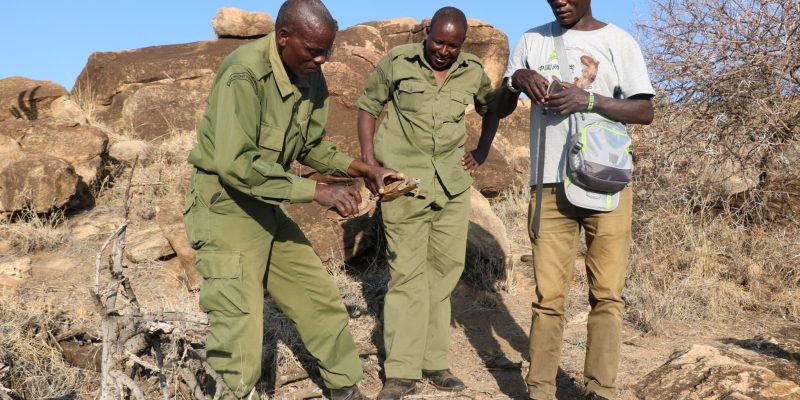
In November 2019, a survey team working the rocky outcrops of the Lewa Wildlife Conservancy in northern Kenya was ready to go home empty-handed. They were looking for a tortoise with a flat, flexible shell that does not withdraw into itself when threatened but squeezes sideways into a crack in the rock, which is an excellent way to survive a predator and a very good way to be overlooked by scientists. They had found nothing.
Then a Lewa staff member named Sumpere Ole Toki asked them to describe exactly what they were looking for, thought about where he had seen something like it before, and walked them to a crevice holding two pancake tortoises. The team found five more the same day.
Those seven animals were the first pancake tortoises formally recorded at Lewa, and at 1,647 meters they were the highest the species had been recorded anywhere in Kenya. Six years later, that afternoon has become a national program.
What a pancake tortoise is, and why the shell matters
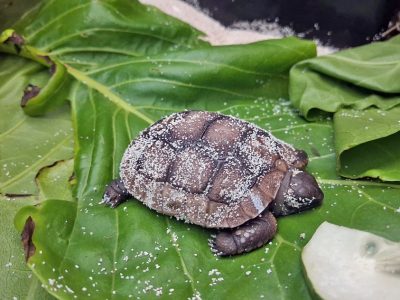
The pancake tortoise, Malacochersus tornieri, is a small reptile endemic to the arid and semi-arid rangelands of Kenya and Tanzania. Kenyans call it kobe kama chapati, the tortoise like a flatbread. Its shell is the whole story: thin, flattened and flexible rather than domed and rigid, which is a reversal of the usual tortoise bargain. A domed tortoise survives by being a sealed box. A pancake tortoise survives by being thin enough to disappear into a gap in a rock pile and wedge itself there.
That design makes the animal quick and agile by tortoise standards, and it ties it absolutely to one kind of place. No rocky outcrop, no pancake tortoise. In Kenya, John Wambua, the Kenya Wildlife Service assistant director for the eastern conservation area, lists its habitat across Tharaka-Nithi, Meru, Embu, Samburu, Laikipia, Isiolo, Kitui, Mwingi, Tana River and Marsabit counties.
It also breeds about as slowly as a reptile can. Females lay a single egg per clutch per season, and juvenile survival in the wild is low, with plenty of predators for an egg or a hatchling. A population that loses adults to collectors does not replace them quickly, and that arithmetic is why the species is in the trouble it is in.
Critically Endangered, and still traded
The National Recovery and Conservation Action Plan published by the Kenya Wildlife Service records the formal position. The pancake tortoise is listed as Critically Endangered on the IUCN Red List, the highest threat category, having been revised upward from Endangered in 2019 following a 2018 reassessment. In the same year it moved from Appendix II to Appendix I of CITES, which bars commercial international trade in wild specimens. The plan was reviewed by the IUCN SSC Tortoise and Freshwater Turtle Specialist Group.
The drivers are habitat loss, land clearance for agriculture, and collection for the exotic pet trade, which has a particular appetite for a tortoise that is small, strange-looking and easy to carry.
One figure in the plan reframes everything else in it: more than 95 percent of the pancake tortoise’s habitat and population in Kenya sits on community and private land, outside any formal wildlife protected area. A recovery plan for this species cannot be run from inside park boundaries, because the species is not inside them.
A ten-year plan, and who paid for it
On May 16, 2025, Kenya unveiled the National Recovery and Conservation Action Plan for the Pancake Tortoise in Kenya, 2025 to 2035, at Chiakariga in Tharaka-Nithi County, one of the species’ last strongholds. It was developed under the leadership of the Kenya Wildlife Service with the National Museums of Kenya and the Lewa Wildlife Conservancy, and species experts from the National Museums shaped the science in it.
Lewa is a Kenyan conservancy rather than a zoological institution, so the question this newsroom asks of every conservation story is where the money came from. Here it is answered in the plan’s own acknowledgments: financial support came from the Turtle Survival Alliance, the US Fish and Wildlife Service, the Turtle Conservation Fund, re:wild and Cheyenne Mountain Zoo of Colorado Springs, channeled through the Lewa Wildlife Conservancy. An accredited American zoo helped pay for a sovereign national species plan in Kenya, and the plan says so in a document anyone can download.
Worth noting, because we read both lists: Lewa’s own account of the launch names the Mohamed bin Zayed Species Conservation Fund among the supporters and does not mention the US Fish and Wildlife Service, while the plan’s acknowledgments name the federal agency and not the fund. The two were written for different purposes and neither contradicts the other, but we have used the plan’s wording for the plan’s funders.
“The Turtle Survival Alliance is honored to stand alongside the Lewa Wildlife Conservancy, the National Museums of Kenya and the Kenya Wildlife Service in the development and implementation of the National Pancake Tortoise Recovery Plan,” said Marc Dupuis-Desormeaux, the alliance’s president and chief executive.
Dr. Erastus Kanga, director general of the Kenya Wildlife Service, framed it as a national obligation, saying that “it’s up to all of us, as Kenyans, to secure its future.”
Seven tortoises, then 118, then 387
Behind the plan sits the survey work that made the species visible in the first place. After the 2019 discovery at Lewa, researchers widened the search. By March 2022, expanded surveys across Lewa and neighboring conservancies had recorded 118 animals. By the middle of 2025, the figure across the Lewa landscape and the surrounding community conservancies stood at an estimated 387.
It is tempting to read that as a population tripling, and the researcher who ran the work will not let you. “We are still in the process of documenting the population,” said Mercy Kinya, a herpetofauna and hydrology researcher at Lewa. “While it is encouraging to see such numbers, we have not yet determined whether the population is increasing.”
What the numbers measure, stated honestly, is how much looking has been done. The animals are monitored with PIT tags, GPS mapping and genetic sampling, so the individuals counted in 2022 and 2025 are known individuals rather than repeated sightings. But a rising count across an expanding search area is a map of effort before it is a map of recovery. What Kinya will say is that several measures have reduced the pressure: community education and active monitoring that have lowered collection, and legal protection and enforcement that have made the trade harder.
Kinya is also clear about where the 2019 breakthrough came from. “Sumpere’s insight changed everything,” she said. “That moment not only confirmed the species’ presence on Lewa but also demonstrated the immense value of indigenous knowledge in conservation work.”
Is the trade actually stopping?
Not yet, and the honest version of this story has to say so. On August 10, 2025, less than three weeks after Lewa published its account of the recovery work, Kenya Wildlife Service rangers and police arrested three suspects in a sting operation at the Marimanti trading center in Tharaka-Nithi County. They were moving four pancake tortoises to a buyer, in the same county where the recovery plan had been launched three months earlier.
That is what a ten-year plan is for. The 2025 to 2035 window exists because the threat did not end at the launch ceremony, and because more than 95 percent of the work has to happen on land that belongs to farmers and families rather than to the state. John Kinoti, Lewa’s chief of programs and partnerships, put the conservancy’s role this way: “We’re not just conserving wildlife; we’re investing in people and landscapes. This plan is a model for how recovery is done, with science, with community, and with heart.”
Lewa says it will keep working on implementation, mobilizing resources and monitoring progress alongside county governments and local landowners. For a species that nobody at Lewa could reliably find six years ago, being counted at all is where the argument starts.
Our earlier report on rhino notching across the Lewa-Borana Landscape covers the monitoring machinery this survey work runs alongside, and we have separately traced Cheyenne Mountain Zoo’s field funding in Kenya on another program. The recovery plan itself is published as a downloadable document.
Quick answers
- What is a pancake tortoise?
A small tortoise endemic to the arid rangelands of Kenya and Tanzania whose shell is thin, flat and flexible, so it escapes predators by wedging into rock crevices rather than withdrawing into its shell.
- How is the pancake tortoise listed?
Critically Endangered. Kenya's national recovery plan records that the IUCN Red List category was revised upward from Endangered in 2019 after a 2018 reassessment, and that the species moved from CITES Appendix II to Appendix I in the same year.
- What is the National Recovery and Conservation Action Plan?
A ten-year plan for the species covering 2025 to 2035, unveiled on May 16, 2025 at Chiakariga in Tharaka-Nithi County and developed by the Kenya Wildlife Service with the National Museums of Kenya and the Lewa Wildlife Conservancy.
- Which zoo helped pay for it?
Cheyenne Mountain Zoo in Colorado Springs. The plan's acknowledgments name the zoo alongside the Turtle Survival Alliance, the US Fish and Wildlife Service, the Turtle Conservation Fund and re:wild, with the funding channeled through the Lewa Wildlife Conservancy.
- How many pancake tortoises are there at Lewa?
An estimated 387 across the Lewa landscape and surrounding community conservancies as of mid-2025, up from seven first recorded in 2019 and 118 by March 2022. Lewa researchers caution that this reflects expanded survey effort and does not yet establish that the population is growing.
- Where does the species actually live?
More than 95 percent of its habitat and population in Kenya sits on community and private land outside formal protected areas, which is why the recovery plan is built around landowners rather than park boundaries.
- Is the illegal trade still going on?
Yes. On August 10, 2025, Kenya Wildlife Service rangers and police arrested three suspects moving four pancake tortoises to a buyer at the Marimanti trading center in Tharaka-Nithi County.