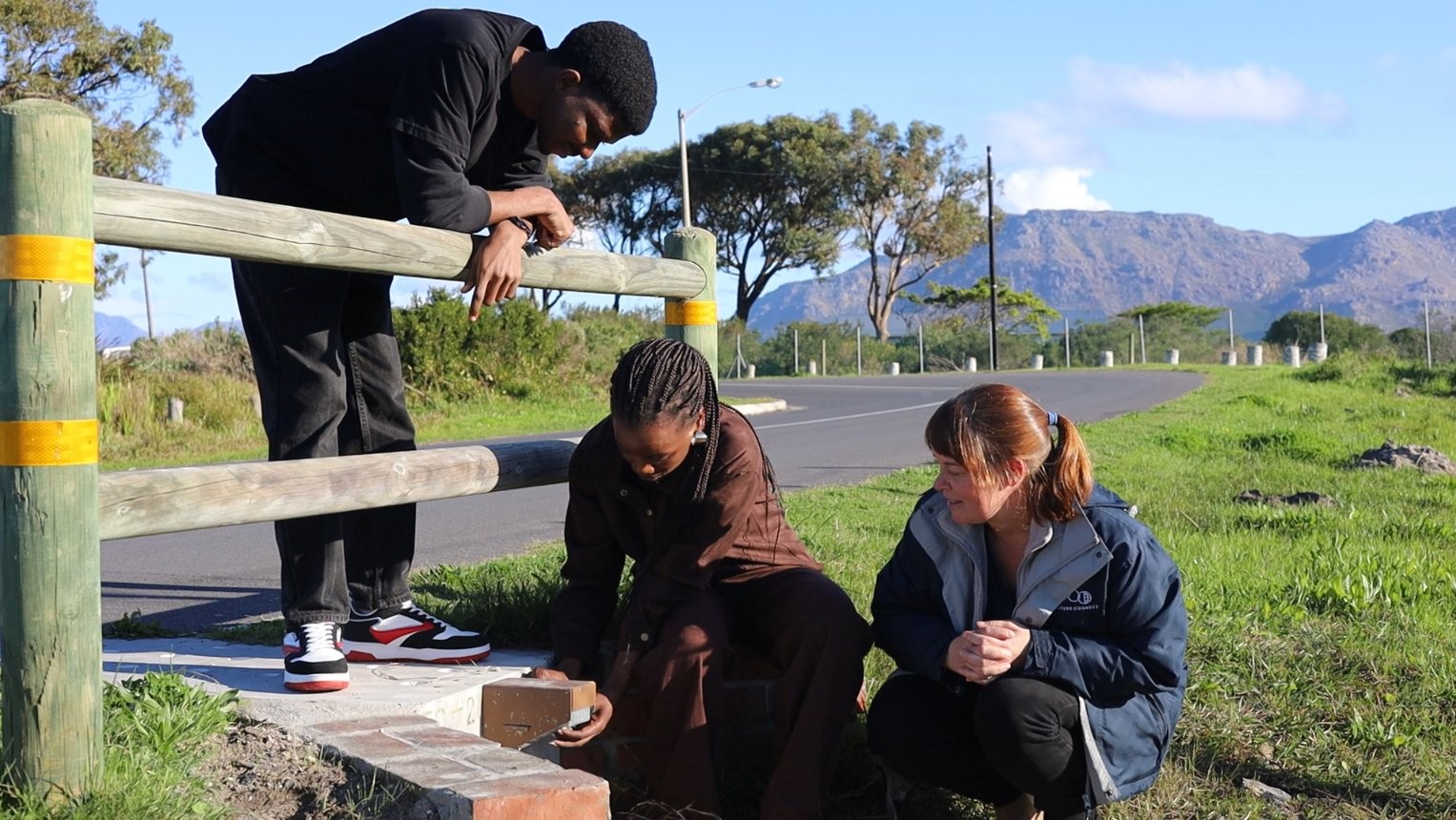
Six concrete tunnels run under Peninsula Road where it cuts through the False Bay Nature Reserve in Cape Town. They were built for an animal that weighs about as much as a tennis ball, and for four winters nobody could say with any confidence how many of them were using the tunnels.
This season, a computer read every photograph the tunnel cameras took and answered the question.
Nature Connect, the Cape Town organization that runs the Western Leopard Toad Underpass Project, reported on October 26 that its system has now checked 2,160,620 camera-trap photographs from the 2023 to 2026 breeding seasons. The 2026 season alone produced 1,176,380 of them. Fewer than one photograph in a thousand contains a toad: 384 images, which resolve to 130 toad sightings once repeat shots of the same animal minutes apart are counted once.
The busiest night was August 17, when sixteen toad visits were recorded at the tunnels.
The student, the model and the spot patterns
The detector is the work of Joshua Salako, a master’s student from Nigeria studying at the African Institute for Mathematical Sciences (AIMS) South Africa. His study, Annotation-Efficient Object Detection of Endangered Western Leopard Toads in Camera Trap Imagery for Assessing Wildlife Tunnel Use, was written with Lorène Jeantet of AIMS and Kim Gordon of Nature Connect.
The method is built to need as little hand-labeling as possible. It starts from twenty labeled photographs, lifts the contrast on dark night frames, compares four detection models, and then lets the computer choose which photographs are most worth labeling in the next round of training. Applied to the first million-odd images from 2023 to 2025, it found 730 sightings across 387 separate events and mapped fifteen re-encounters, meaning toads photographed again on the far side of a tunnel.
In October, Salako released the application openly as AmphiLens: the code, the trained models and an installation guide, so that any camera-trap project can use it.
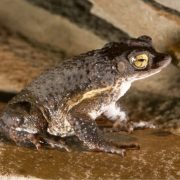
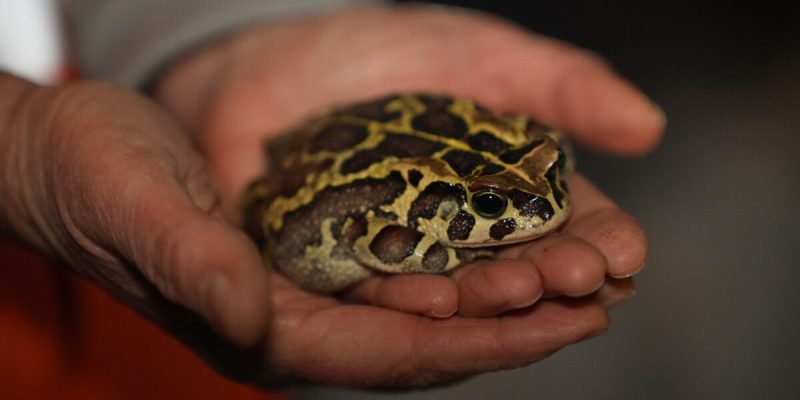
Individual toads can be told apart because each one carries its own arrangement of dark patches edged in yellow and keeps that pattern for life. Nature Connect’s portal now proposes matches and a person confirms every one. The organization gives a worked example: a toad logged as T2026-7 was photographed at the Rondevlei end of tunnel 4 at 00:38 on August 21 and at the Zeekoevlei end eight minutes later. Of thirty-six points the software matched on its back, thirty-five land on each other when the two photographs are laid together.
Nature Connect says it is still confirming the season’s matches and will publish the number of individual toads and confirmed crossings when that review is finished. The caution is the point: a likely match is not a crossing until a person has checked it.
Why the cameras fire every fifteen seconds
Camera traps normally trigger on body heat, which does not work on an animal that does not generate its own. The tunnel cameras are therefore set to take a photograph every fifteen seconds regardless, and one sequence from August 17 shows what that costs. At 21:14:53 the camera at the Rondevlei end of tunnel 3 photographed an empty floor. At 21:15:09 a toad was in mid-crawl. At 21:15:25 the floor was empty again. The animal had crossed the camera’s entire field of view in less time than the camera waits between frames, which means the real number of crossings is likely higher than the count.
Another frame, from the Rondevlei end of tunnel 6 at 20:30 on August 18, caught two toads in amplexus, the mating position in which the male clasps the female from behind while she lays her eggs.
What the aquarium has to do with it
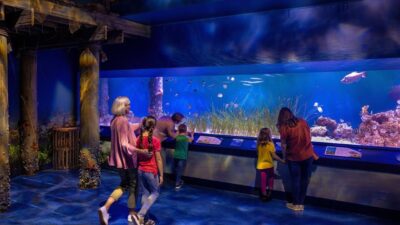
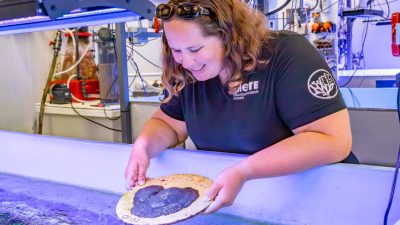
The Two Oceans Aquarium published its own account of the toad migration in August, and the connection is not a sponsorship line. Helen Lockhart, the aquarium’s Conservation and Sustainability Manager, is a volunteer toad coordinator for the Zeekoevlei, Rondevlei and Grassy Park areas, which is to say for the stretch of road the tunnels were built under. She patrols the hotspot roads herself.
“Some Western leopard toads will travel up to 5km to get to their breeding grounds, but many lose their lives on the roads,” Lockhart said. “In an interaction between a toad and a car, the toad always comes off second best.”
The tunnels came out of a 2013 national Biodiversity Management Plan for the species, which flagged road deaths at breeding sites as the single greatest threat the toad faces. “Moving toads across roads by hand, while an effective method of preventing casualties, also has limits,” Gordon has said of the volunteer patrols, noting that migrations depend on the weather and no group of volunteers can cover every route every night.
Gordon also puts the broader case plainly: “The toads’ plight draws public attention to the broader health of Cape Town’s wetlands, which benefits far more than just this one toad.”
Who paid for the tunnels
We looked for accredited zoo and aquarium money behind this work, and the honest answer is that the construction was not funded by any.
Nature Connect installed the first two tunnels in 2021 with the contractor William Dau Civils, funded by Fondation Ensemble and the Leisure Charitable Trust. Four more followed in 2023, funded by the Mohamed bin Zayed Species Conservation Fund and the Forvia Foundation. The camera traps that made the whole count possible have been sponsored by Hensoldt since 2023. None of those is a zoological institution.
What the Two Oceans Aquarium supplies is staff and expertise rather than capital, through Lockhart’s coordinator role and through the aquarium’s own conservation and education work on the species. The aquarium is a member of the World Association of Zoos and Aquariums, which it joined in 2019, and of the African Association for Wildlife in Human Care. Its listed corporate partners are fishing, retail, media and dive-equipment companies and the Save Our Seas Foundation, with no other zoo or aquarium among them.
For scale, the Association of Zoos and Aquariums reports that in 2025 its 235 accredited and certified members spent approximately $372.4 million on conservation across 139 countries. No published breakdown isolates an African share of that figure, so we are not going to estimate one.
A note on the listing
Both Nature Connect and the Two Oceans Aquarium describe the Western leopard toad (Sclerophrys pantherina) as endangered, and Nature Connect states that more than half of its subpopulations are considered non-viable without direct intervention. We could not reach the IUCN Red List entry to confirm the category independently during this report, so the description here is attributed to those two organizations rather than presented as a verified assessment. The species is endemic to a small part of the Western Cape and lives nowhere else on Earth.
If you are driving in Cape Town after dark
Lockhart’s advice is specific. “The toads tend to move at night from around 18h30, mostly after heavy rains and when temperatures reach about 15°C. They often look like small white stones in the headlights of cars.” That last detail matches the four-season pattern in the camera data, where most movement fell between 12 and 17°C and the single busiest temperature was 15°C.
Migration hotspots include Kirstenhof, Lakeside, Muizenberg, Norfolk Park, Orchard Village, Tokai, Constantia, Zeekoevlei, Rondevlei, Grassy Park and Noordhoek, generally on roads flanking marshy ground.
“If you spot a toad on the road, pull over safely, gently pick up the toad, and move it to the other side of the road in the direction it was facing,” Lockhart said. “The toads know exactly where they are going, so you don’t have to figure it out for them.”
Volunteers remain the constraint. “Keeping volunteers for night patrols consistently is one of our biggest ongoing challenges,” Gordon said. “Many cancel at short notice, which sometimes leaves a single supervisor covering a patrol alone. Every extra pair of hands genuinely makes a huge difference.”
Sightings can be logged on the Western Leopard Toad Monitoring Project on iNaturalist, photographed from directly above so the spot pattern is usable.
The Two Oceans Aquarium’s conservation reporting this season has also covered the National Sea Turtle Workshop and its nine priorities and the IZE 2026 conference it hosted in Cape Town.
Quick answers
- How many Western leopard toads used the tunnels in 2026?
Nature Connect counted 130 toad sightings from 384 photographs, out of 1,176,380 camera-trap images taken during the 2026 breeding season. Repeat photographs of the same animal minutes apart are counted once. The organization is still confirming which of those sightings represent individual toads completing a crossing.
- What is AmphiLens?
An application built by Joshua Salako, a master's student at the African Institute for Mathematical Sciences South Africa, that automatically detects Western leopard toads in camera-trap images. He released the code, the trained models and an installation guide openly in October 2026 so other camera-trap projects can use it.
- How can individual toads be told apart?
Every Western leopard toad has its own arrangement of dark patches edged in yellow, and it keeps that pattern for life. Software proposes matches between photographs and a person confirms each one before it counts as a crossing.
- Why do the tunnel cameras photograph every fifteen seconds?
Camera traps usually trigger on body heat, which does not work on a cold-blooded animal, so the cameras fire on a fixed interval instead. One sequence from August 17 shows an empty tunnel floor, a toad mid-crawl sixteen seconds later and an empty floor again sixteen seconds after that, so some crossings are certainly missed.
- Which zoo or aquarium funded the toad tunnels?
None did. The first two tunnels were funded by Fondation Ensemble and the Leisure Charitable Trust in 2021 and four more by the Mohamed bin Zayed Species Conservation Fund and the Forvia Foundation in 2023, with cameras sponsored by Hensoldt. The Two Oceans Aquarium contributes staff and expertise rather than money, through its Conservation and Sustainability Manager's role as a volunteer toad coordinator.
- What should a driver do about toads on Cape Town roads?
Slow down on roads near wetlands after heavy winter rain, particularly from about 18h30 when temperatures are around 15 degrees Celsius. If you find a toad on the road, pull over safely, pick it up gently and put it down on the side it was already heading for.