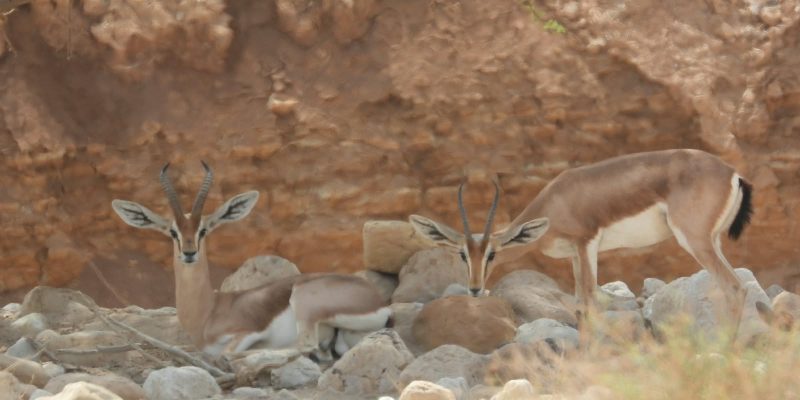
Over four days this autumn, dozens of Israel Nature and Parks Authority staff and volunteers walked and watched five nature reserves in the Negev and the Arava and counted 1,387 dorcas gazelles. The authority published the result on October 22, 2026, and attached an unusual instruction: do not compare it with last year.
The numbers, and the caveat that comes with them
The count is a sample-based survey repeated annually in the same reserves. The 2026 figures, with 2025 in brackets, were: Nahalim Gdolim, the Great Streams reserve, 829 (865); the Makhteshim reserves at Ein Yahav and Nahal Shizaf, 169 (149); Yotvata, 23 (21); Ashosh, 230 (282); and Har HaNegev, 136 (125). Evrona, normally part of the survey, was left out this year because of restoration work in the reserve.
The authority states plainly that the annual count is not designed to compare one year against the next. It is designed to detect long-term trends, and the window it uses is roughly three gazelle generations, about fifteen years. Over that period the trend in the Great Streams reserve is upward, and the other areas are relatively stable.
That is a more useful thing to publish than a headline number, and a less flattering one, because it rules out the two easiest stories: a single year’s dip is not a decline and a single year’s rise is not a recovery.
Dr Sefi Horesh, the authority’s Southern District ecologist, put the operational side of it this way:
“מדובר במבצע ניטור שנתי מורכב, המתבצע באמצעות צוותים בתנאי שטח מאתגרים, ומאפשר מעקב ארוך טווח אחר מצב אוכלוסיית צבי הנגב בישראל.”
“This is a complex annual monitoring operation, carried out by teams working in challenging field conditions, and it makes long-term tracking of the state of the Negev gazelle population in Israel possible.” Translated from the Hebrew release by ZooReviews.
The animal
The dorcas gazelle, Gazella dorcas, is a small desert antelope, and the authority treats it as an indicator species for the condition of desert ecosystems: a population that holds up suggests the system around it is working.
The authority describes it as Vulnerable on the IUCN Red List, and that matches the listing. The Convention on Migratory Species, which has carried the species on its Appendix I since 1979, also records the global category as Vulnerable. We were unable to open the Red List assessment page itself to confirm the assessment year, so we are citing the category and not a date.
Corridors, not just reserves
The more consequential half of the announcement is about land outside the reserves.
The authority’s position is that gazelle populations depend on wide, continuous tracts of open habitat that let animals move and keep separate populations connected to each other. Fragmentation from development and changing land use does not only shrink habitat; it isolates groups, and isolated groups have worse long-term odds. Protecting gazelles therefore means protecting the ecological corridors between reserves, not only the reserves themselves.
Israel’s National Planning and Building Council has now approved an ecological corridors plan for the Southern District, as Amendment 26 to the national outline plan, led by the Planning Administration. Horesh called it the part that matters:
“אנחנו מברכים על ההחלטה האמיצה לקדם שמירה על מסדרונות אקולוגים, תכנית שלבטח תמשיך לשפר את חייהם של המינים הייחודיים שחיים בטבע הישראלי גם עוד שנים רבות קדימה.”
“We welcome the brave decision to advance the protection of ecological corridors, a plan that will certainly go on improving the lives of the unique species that live in Israel’s natural areas for many years to come.” Translated from the Hebrew release by ZooReviews.
A planning amendment is not the kind of thing that photographs well, but for an animal whose problem is fragmentation it is worth more than a fence.
Which zoos fund this
None that we can find. The Negev gazelle count is run by a government authority using its own rangers, ecologists and volunteers, and neither the announcement nor the authority’s monitoring pages name a zoological institution as a partner or funder.
That is the standing answer for this source rather than a new one. We have reported the same negative on the authority’s sea turtle releases and on its marbled electric ray survey, and it is worth repeating rather than quietly dropping: a great deal of conservation in this region is paid for by states, and a story is not improved by implying a zoo behind it.
Where Israeli zoos do enter this beat is at the other end, when an individual animal needs treatment. A pregnant mountain gazelle confiscated near Idhna last month went to the Israeli Wildlife Hospital at the Ramat Gan Safari, which is a different species and a different kind of story from counting wild animals in a wadi.
What the authority asks of visitors
The same release closes with the request that always accompanies these announcements and is always worth printing: keep your distance from wild animals, do not touch or feed them, not even for a photograph, and let them move on. An injured or distressed animal should be reported to the authority’s hotline.
The count announcement is on the Israel Nature and Parks Authority site, in Hebrew.
Quick answers
- How many dorcas gazelles are there in the Negev?
The Israel Nature and Parks Authority counted 1,387 in its 2026 annual survey of five Negev and Arava nature reserves. The count is sample-based and covers those reserves, not the whole country.
- What were the results by reserve?
Nahalim Gdolim 829, the Makhteshim reserves at Ein Yahav and Nahal Shizaf 169, Yotvata 23, Ashosh 230 and Har HaNegev 136. The 2025 figures for the same reserves were 865, 149, 21, 282 and 125. Evrona was not counted in 2026 because of restoration work there.
- Why does the authority say not to compare years?
Because the survey is designed to detect long-term trends rather than year-to-year change. It reads the data over about three gazelle generations, roughly 15 years, which is long enough to separate a real shift from sampling noise.
- What is the long-term trend?
Over the last 15 years the number of gazelles observed in the Nahalim Gdolim reserve has trended upward, while the populations in the other count areas have been relatively stable.
- What conservation status does the dorcas gazelle have?
It is listed as Vulnerable on the IUCN Red List, and the Convention on Migratory Species, which has carried the species on Appendix I since 1979, records the same global category. We could not open the Red List assessment page itself, so we cite the category and not an assessment year.
- What are ecological corridors and why do they matter here?
Continuous strips of open habitat connecting protected areas, which let animals move between them and keep separate populations in contact. Israel’s National Planning and Building Council has approved an ecological corridors plan for the Southern District as Amendment 26 to the national outline plan.
- Which zoos fund the Negev gazelle count?
None that we could find. The survey is run by a government authority using its own rangers, ecologists and volunteers, and neither the announcement nor the authority’s monitoring pages names a zoological institution as a partner or funder.