The satellite tag on Nori, a green turtle rehabilitated and released by the Two Oceans Aquarium Foundation’s Turtle Conservation Centre in Cape Town, has stopped transmitting. She had been tracked for 309 days and 12,540 kilometers. The aquarium’s position is that the silence is almost certainly the tag and not the turtle.
Two Oceans published the final update on October 20, 2026. We wrote about Nori and her tracking partner Kai in September, when both tags were still live and the pair had covered a little over 19,000 kilometers between them. This is the end of one of those two datasets.
What Nori did with her 309 days
Nori was found at Witsand in 2023 with neurological problems and damaged eyesight. Her rehabilitation ran for two years and included an enrichment program built to push her back toward natural behavior and rebuild the skills she would need in the wild. She was released into the De Hoop Marine Protected Area on November 26, 2025.
Over the 309 days that followed she covered 12,540 kilometers, an average of 40.5 kilometers a day, every day, for more than ten months.
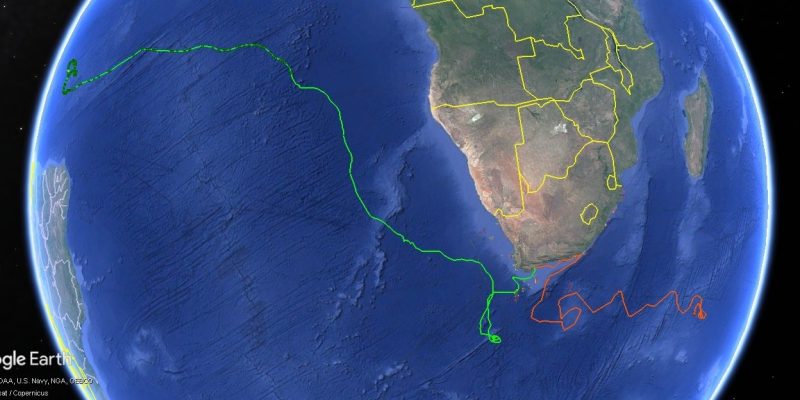
Her route is the part the aquarium finds hardest to explain. She went south first, making wide loops through the eddies thrown off by the Agulhas Current. Then she turned and started north, and kept going: up past Namibia and Angola, across the Walvis Ridge, a chain of ancient volcanic seamounts running out from the African coast, and on into the tropical Atlantic. She passed through waters associated with important green turtle feeding and nesting areas without settling in any of them.
In her last weeks of transmission she changed again, turning away from that northward line and beginning to follow the surface currents that run between South America and Africa, looping out across the open North Atlantic. Her final signal came from water between 28 and 29 degrees Celsius.
Why a tag goes quiet
A satellite tag can last up to three years, so the aquarium’s first explanation is the simplest one: the battery ran out.
There are others, and they are specific to the animal. Green turtles have smoother, rounder, oilier shells than some other sea turtle species, which makes a tag harder to keep attached. A growing shell loosens the mounting over time, and a turtle in good conditions grows faster. Barnacles and algae accumulate on the tag, a process called biofouling, and a fouled antenna transmits poorly or not at all. And turtles scratch, rubbing their shells against rocks and reefs, which can take off a tag that was attached perfectly well.
The aquarium is direct about what the loss of signal does and does not tell anyone. In its words, it “does not necessarily indicate that anything negative has happened to Nori.” It is the end of the data, not the end of the animal.
Kai is still transmitting, and went the other way
The contrast between the two turtles is the reason the aquarium tracks more than one.
Kai, a juvenile loggerhead sea turtle, spent nearly six years in rehabilitation before being released into the same marine protected area on May 14, 2026, weighing 100 kilograms. In the 157 days since he has covered 7,830 kilometers at an average of 49.9 kilometers a day.
He did it by riding. After a coastal stretch along the Garden Route and into the Eastern Cape he moved offshore and joined the Agulhas Current at the end of June. The Agulhas runs south along Africa’s east coast carrying warm tropical water toward the tip of the continent, where much of it turns back on itself and flows east into the Indian Ocean, a reversal called retroflection. Kai has followed that pathway almost exactly, crossing the Southwest Indian Ridge on the way.
Nori did close to the opposite. For much of her journey she swam independently of the prevailing surface currents, holding a direction of her own. How much of that was her choice and how much was water the aquarium cannot say, and says so.
Who paid for the tags
The two satellite tags were sponsored by the Morukuru Goodwill Foundation, which adopted both turtles. Rinse Wassenaar of Morukuru Family was part of the team that fitted Nori’s tag before her release.
We looked for an accredited zoo or aquarium outside South Africa funding this tracking work and did not find one named. That is a real answer rather than a gap. The Turtle Conservation Centre is run by the Two Oceans Aquarium Foundation, the aquarium’s own non-profit, which means this is an accredited aquarium paying for its own field program and a private foundation paying for the hardware that makes it legible.
It is worth being clear about what the hardware buys. Without a tag, a released turtle is a good news story that ends at the water’s edge. With one, a rehabilitation center finds out whether the animals it spent years on can actually do the thing it released them to do. Nori spent two years in a tank and then swam 12,540 kilometers.
What happens now
Nothing further has been published about Nori since the October 20 update, and that is the expected outcome rather than a worrying one: there is no longer any way to know. Kai’s tag is still reporting, and the aquarium’s open question about him is whether he keeps riding the current or breaks away and starts swimming with a destination in mind.
The full update, including the tracking maps for both animals, is on the Two Oceans Aquarium site.
Quick answers
- What happened to Nori the green turtle?
Her satellite tag stopped transmitting after 309 days and 12,540 kilometers. The Two Oceans Aquarium says the loss of signal does not necessarily indicate that anything negative has happened to her, and that the most likely explanation is that the tag battery ran out.
- How far did Nori travel?
12,540 kilometers over 309 days, an average of 40.5 kilometers a day. She was released into the De Hoop Marine Protected Area on November 26, 2025 after two years of rehabilitation.
- Why do satellite tags stop working on sea turtles?
Batteries last up to three years. Beyond that, green turtles have smoother, rounder, oilier shells that hold a tag less well, shell growth loosens the mounting, barnacles and algae accumulating on the tag interfere with transmission, and turtles rubbing against rocks and reefs can dislodge one.
- What is biofouling?
The accumulation of organisms such as barnacles and algae on a surface in the water. On a satellite tag it builds up over the antenna and degrades or blocks the signal.
- Where did Nori go?
South first, looping through eddies off the Agulhas Current, then north past Namibia and Angola, across the Walvis Ridge and into the tropical Atlantic. In her last weeks she turned and followed the surface currents running between South America and Africa. Her final signal came from water between 28 and 29 degrees Celsius.
- Is Kai still being tracked?
Yes. Kai, a juvenile loggerhead released on May 14, 2026 after nearly six years of rehabilitation, has covered 7,830 kilometers in 157 days at an average of 49.9 kilometers a day, largely by riding the Agulhas Current.
- Who paid for the satellite tags?
The Morukuru Goodwill Foundation, which adopted both turtles. We looked for an accredited zoo or aquarium outside South Africa funding this tracking work and did not find one named. The Turtle Conservation Centre is run by the Two Oceans Aquarium Foundation, the aquarium’s own non-profit.