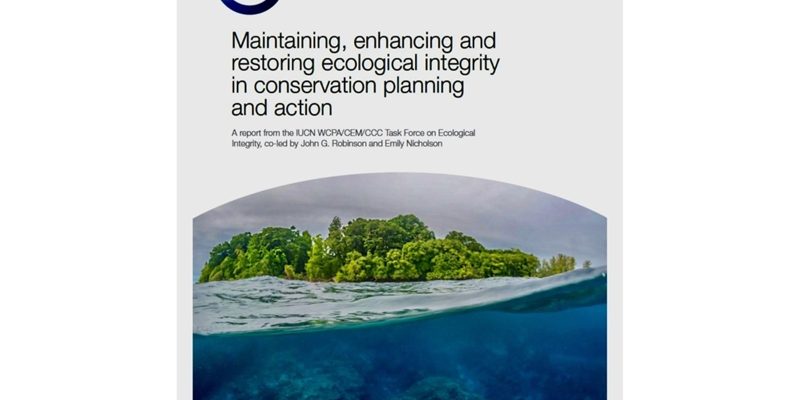
The International Union for Conservation of Nature published a technical report on October 19, 2026 that asks governments to stop grading conservation by how much land and sea sits inside a boundary, and start grading it by whether the ecosystems inside those boundaries still work. The report landed at the opening of the United Nations biodiversity conference in Yerevan, Armenia, and the Wildlife Conservation Society, whose scientist co-led the task force that wrote it, welcomed it the same day.
The document is Maintaining, enhancing and restoring ecological integrity in conservation planning and action, number 13 in the technical report series of the IUCN World Commission on Protected Areas. It runs 39 pages, carries sixteen named authors, and was co-led by John G. Robinson of WCS and Emily Nicholson.
What ecological integrity means
Ecological integrity is the degree to which an ecosystem still has its own composition, structure and function: the species that belong there, the physical arrangement of the place, and the processes that keep it running, from flooding to fire to predation. The report uses the operational definition written into the Global Biodiversity Framework glossary in 2022, which describes it as the degree to which those three things “resemble those characteristic of its natural range of variation.”
The phrase doing the work there is natural range of variation. A healthy ecosystem is not one fixed picture. A forest after a fire, a floodplain in a dry year and a grassland between grazing rotations are all different states of the same functioning system, so integrity is measured as a distance from a reference state rather than as a pass or a fail. That is also why the report insists integrity is a continuum, running from high to low, rather than a yes-or-no label.
Why a count of protected areas is not an answer
“The world has made ambitious commitments to halt and reverse biodiversity loss, but success cannot be measured by simply counting the number of conservation areas established, the species protected, or the amount of land and water conserved,” John G. Robinson said. “The real test is whether natural ecosystems, forests, grasslands, freshwater systems, and oceans, are maintaining or recovering the ecological integrity needed to sustain life.”
Joe Walston, executive vice president of global conservation at WCS, put the same point more bluntly: “A protected area on a map means little if its wildlife is gone, its rivers are cut off, or its forests no longer function.”
Madhu Rao, who chairs the IUCN World Commission on Protected Areas and directs protected and conserved areas at WCS, tied it to the target everyone is counting toward. “Ecological integrity can tell us whether protected and conserved areas are actually working, for nature and for the people who depend on them,” she said. “It should be a crucial measure of success for 30×30.” That is the shorthand for the Global Biodiversity Framework’s area-based goal, thirty percent of the planet conserved by 2030, and it is the number most national reporting is built around.
The gap the report is trying to close
The honest finding in the executive summary is not that governments ignore ecological integrity. It is that they reference it constantly and then do not use it. The concept appears in the Convention on Biological Diversity, the climate convention, the desertification convention and throughout the Kunming-Montreal Global Biodiversity Framework’s goals and targets. It is written into the IUCN Red List of Ecosystems Standard, the Key Biodiversity Area Standard, and the standards for nature-based solutions and ecosystem restoration. What has not happened, the report says, is systematic incorporation into national commitments, target setting or planning, because there has been no settled agreement on how to define and measure it.
So the report sets out six principles for anyone building a metric. Define the reference state and document how you chose it. Treat ecosystems as dynamic rather than fixed. Match the metric to the particular ecosystem rather than applying one global yardstick. Measure at a scale appropriate to the question. Account for human influence in both directions, including the long-standing Indigenous management that maintains integrity in many systems rather than degrading it. And use units that can actually be observed and checked on the ground.
That last one is the quiet barb. The report notes that as pressure grows on companies to show they have avoided, mitigated or compensated for their biodiversity and climate impacts, loose metrics are how greenwashing happens, and clearly defined, verifiable units are the defense against it.
What does this have to do with zoos and aquariums?
Accredited zoos and aquariums are among the steadiest funders of field conservation, and the programs they pay for tend to report back in exactly the currency this report is arguing against: hectares brought under protection, animals collared, patrols run. None of those are bad numbers. They are measures of activity rather than of outcome, which is the distinction the task force is pressing on, and a funder who starts asking the second kind of question changes what gets measured in the field.
It is also the second time in ten days that WCS has made this argument in Yerevan. On October 12 the organization named three tests it wants governments judged by at CoP17, the first of which was outcomes rather than activity. The difference now is that the argument comes with a document attached, and the document says how.
Who paid for it
The report was produced by the IUCN World Commission on Protected Areas, with support from WCS and the Gordon and Betty Moore Foundation. WCS is a zoological organization as well as a field one, running the Bronx Zoo, the Central Park, Queens and Prospect Park zoos and the New York Aquarium, though none of those facilities appears in this work and none is claimed for it here.
CoP17 runs in Yerevan through October 30, and it is the first global stocktake of progress toward the 2030 framework. Delegates arrived with four years left on the clock and a report telling them what to put on the scoreboard.
Quick answers
- What is ecological integrity?
It is the degree to which an ecosystem still has its own composition, structure and function: the species that belong there, the physical arrangement of the place, and the processes that keep it running. The Global Biodiversity Framework glossary defines it as the degree to which those three things resemble those characteristic of the ecosystem’s natural range of variation.
- What did the IUCN report actually say?
That ecological integrity is referenced throughout international environmental agreements but is rarely built into national commitments, target setting or planning, because there has been no settled agreement on how to define and measure it. The report sets out six principles for building a usable metric.
- Who wrote it?
The IUCN WCPA/CEM/CCC Task Force on Ecological Integrity, co-led by John G. Robinson of the Wildlife Conservation Society and Emily Nicholson. The report carries sixteen named authors and was produced by the IUCN World Commission on Protected Areas with support from WCS and the Gordon and Betty Moore Foundation.
- Why does it matter that a protected area is counted rather than measured?
Because area is a measure of activity rather than outcome. A protected area can be formally designated and still have lost its wildlife, had its rivers cut off or had its forests stop functioning, which is the point Joe Walston of WCS made on the day of release.
- What is 30x30?
It is the shorthand for the Global Biodiversity Framework’s area-based goal of conserving thirty percent of the planet by 2030. Madhu Rao, who chairs the IUCN World Commission on Protected Areas, argues ecological integrity should be a crucial measure of whether it is working.
- Where is CoP17 and when does it end?
Yerevan, Armenia. It runs through October 30, 2026, and it is the first global stocktake of progress toward the Kunming-Montreal Global Biodiversity Framework and its 2030 goals.